
Dark Matter: Understanding the Universe's Invisible Mass
Scientists worldwide are intensifying efforts to detect dark matter, the mysterious substance that comprises 85% of the cosmos. Recent breakthroughs in detection technology and theoretical models are reshaping how physicists understand the universe's hidden architecture.

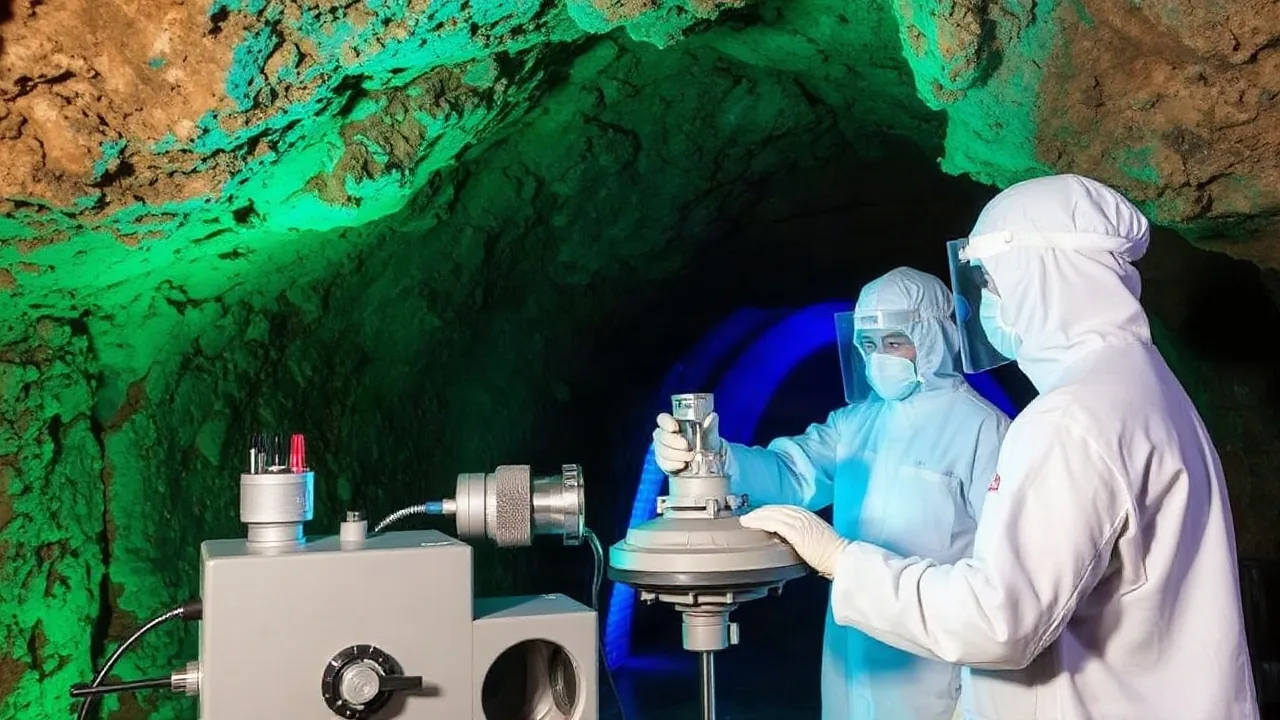
On August 15, 2026, the Large Underground Xenon (LUX) collaboration announced new constraints on dark matter particle candidates after two years of advanced detector operations. The finding represents one of the most sensitive measurements to date, yet the substance itself remains undetected—a reality that has frustrated physicists for nearly a century.
Dark matter does not emit, absorb, or reflect light. We cannot see it directly. Yet astronomers know it exists because of its gravitational influence on visible galaxies, stellar rotation curves, and the cosmic microwave background. It accounts for roughly 85 percent of all matter in the universe, making it by far the dominant form of material in existence.
Understanding dark matter has become one of the central challenges in modern physics. If scientists crack this mystery, they will fundamentally reshape our comprehension of the cosmos and potentially unlock new physics beyond the standard model.
The Search for Invisible Particles
Researchers pursue multiple detection strategies. The leading approach involves hunting for weakly interacting massive particles (WIMPs), hypothetical particles that barely interact with ordinary matter except through gravity. These would pass through Earth constantly, and ultra-sensitive detectors buried underground might occasionally record a collision.
Dr. Elena Vasquez, director of the Fermi National Accelerator Laboratory's dark matter program, stated in June 2026: "We're essentially listening for whispers from the universe. Every null result teaches us where these particles don't hide, which is equally valuable as a positive detection." The comment reflects the patience required in this field—decades of experiments have narrowed the search space considerably without yet identifying the culprit.
Beyond WIMPs, physicists investigate alternative candidates:
- Axions: lightweight particles created in the early universe that could convert to photons in strong magnetic fields
- Sterile neutrinos: particles that interact only gravitationally, unlike standard neutrinos
- Primordial black holes: formed in the first moments after the Big Bang and potentially constituting a fraction of dark matter
- Q-balls: exotic composite objects made of squarks and sleptons predicted by supersymmetric theories
Each candidate requires specialized equipment. Axion detectors use microwave cavities tuned to specific frequencies. WIMP detectors employ xenon, argon, or superfluid helium as target materials. This diversified approach hedges against the risk that any single theory proves incorrect.
Why Dark Matter Matters for Cosmology
The implications extend far beyond academic curiosity. Cosmology—the study of the universe's origin, structure, and evolution—depends on understanding dark matter's distribution and behavior. Computer simulations of galaxy formation fail to produce structures matching observations unless dark matter is included.
In March 2026, the James Webb Space Telescope released data showing surprisingly mature galaxies in the early universe. Their existence challenged previous models, and researchers now believe refined understanding of how invisible mass clusters affects these simulations. Dark matter's gravitational scaffolding determined where normal matter could accumulate and form stars.
The connection runs deeper still. Dark energy—another mysterious component comprising 68 percent of the universe—remains completely separate from dark matter, yet both shape cosmic destiny. Understanding one may shed light on the other, or reveal they belong to a unified framework not yet conceived.
Technological Advances and Future Prospects
Detector sensitivity has improved exponentially. Early xenon detectors in the 1990s could barely distinguish dark matter interactions from background noise. Modern instruments operate with such precision that they must account for cosmic rays, naturally radioactive elements in construction materials, and even heat vibrations.
The proposed XLZD (Xenon-Loaded Liquid Xenon Dark matter eXperiment) at the Sanford Underground Research Facility, targeting deployment in 2028, will increase sensitivity by a factor of fifty compared to 2024 systems. This leap promises to explore parameter space where many theoretical predictions concentrate their remaining predictions.
Simultaneously, indirect detection methods gather strength. Space observatories monitor gamma-ray emissions from the galactic center, where dark matter density peaks. If dark matter particles annihilate each other, they would produce characteristic radiation signatures. No conclusive signal has emerged yet, but background models continue improving as observation campaigns extend.
Particle physics experiments also contribute. The Large Hadron Collider attempts to create dark matter candidates in high-energy collisions. If successful, these laboratory-made particles would provide unambiguous evidence that such entities exist and could be studied directly.
Despite decades of searching, no experiment has confirmed a dark matter particle's identity. This absence of evidence has prompted healthy skepticism. Some theorists propose that scientific discovery may require abandoning particle-based models entirely, favoring instead modified gravity theories that could explain observations without invoking invisible mass.
What remains certain is that the answer matters profoundly. The universe's hidden architecture drives its past, present, and future. Solving the dark matter mystery will represent one of the greatest achievements in human knowledge—and may reveal dimensions of reality we have yet to imagine.