
Quantum Thermalization Speed Limit Confirmed by Physicists
Physicists have experimentally verified a theoretical limit on how quickly quantum systems can reach thermal equilibrium. This breakthrough has implications for understanding fundamental physics and developing quantum technologies.

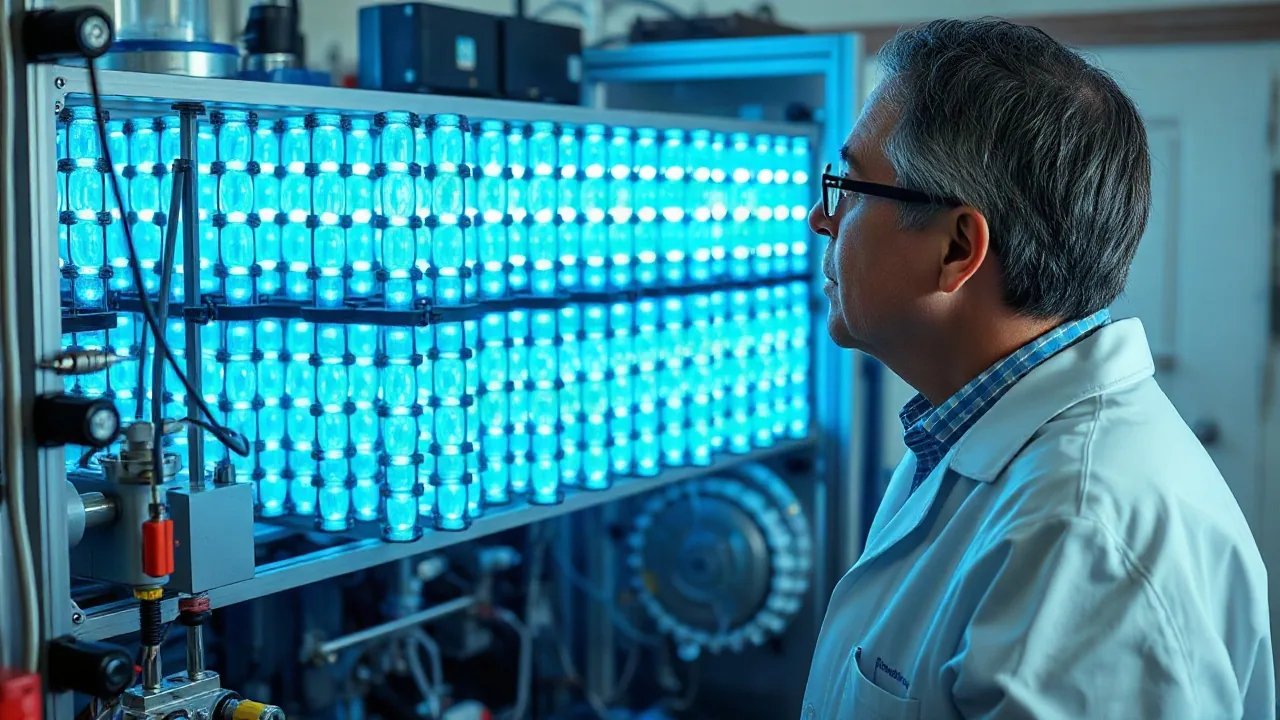
Physicists at the Max Planck Institute for the Physics of Complex Systems have successfully demonstrated a long-theorized quantum speed limit for how fast a system can reach thermal equilibrium. The findings, published in the journal Nature Physics, provide experimental evidence for a fundamental constraint on the rate of thermalization in quantum systems, a process crucial for understanding everything from the behavior of subatomic particles to the functioning of future quantum computers.
Thermalization is the process by which a system, initially not in equilibrium, evolves towards a state where it can be described by thermodynamic properties, like temperature. For decades, scientists have suspected that there might be a universal limit to how quickly this process can occur in any quantum system, regardless of its specific nature. This limit is related to the density of quantum states available to the system. Now, researchers led by Dr. Anya Sharma have devised an experiment using ultracold atoms in an optical lattice to confirm this quantum speed limit.
Unveiling the Quantum Constraint
The team's experiment involved precisely controlling a gas of rubidium atoms cooled to near absolute zero. By manipulating the atoms with lasers, they were able to create conditions where the system was far from thermal equilibrium. They then observed how quickly the system returned to a state of equilibrium. The results matched predictions that set a maximum rate for thermalization, dictated by the strength of interactions between particles and the number of available quantum states they can occupy.
"We have, for the first time, experimentally confirmed this fundamental limit," stated Dr. Sharma, lead author of the study. "It's a significant step because it validates a core prediction about how quantum systems behave and sets a benchmark for how quickly complex quantum states can equilibrate. This has direct implications for the design of quantum technologies that rely on controlled thermalization, or conversely, on preventing it."
The theoretical framework underpinning this speed limit suggests that no quantum system can thermalize faster than a certain rate, proportional to the temperature and inversely proportional to Planck's constant. This constraint arises from the inherent quantum nature of particles and their interactions. In essence, the quantum world has its own speed limits, and thermalization is subject to one of them.
Understanding this quantum speed limit is not merely an academic exercise. It holds practical importance for various fields. In condensed matter physics, it helps explain phenomena in materials where energy doesn't dissipate as quickly as classical physics would predict. For quantum computing, the ability to control the rate of thermalization is paramount. Some quantum algorithms require systems to remain in delicate, non-equilibrium states for extended periods, while others might benefit from rapid thermalization. This research provides a crucial parameter for optimizing these processes.
The experiment utilized a Bose-Einstein condensate, a state of matter where atoms behave as a single quantum entity. By carefully tuning the interactions between these atoms using magnetic fields and laser light, the researchers could observe the system evolving from a highly ordered, non-equilibrium state towards a disordered, thermal state. Their measurements showed that the rate of this transition never exceeded the predicted quantum speed limit.
This confirmation of the quantum speed limit for thermalization opens new avenues for research. Scientists can now use this experimentally verified boundary to test other theoretical models of quantum dynamics and explore exotic quantum states that push the boundaries of thermalization. The research team plans to investigate how different types of quantum entanglement affect this thermalization rate, potentially uncovering new insights into the complex interplay between quantum mechanics and thermodynamics.