
Fairphone Gen 6+: Ethical, Repairable Smartphone Arrives in US
Dutch company Fairphone enters the US market with the $650 Gen 6+ smartphone, prioritizing sustainability, ethical sourcing, and user repairability.

The Dutch smartphone manufacturer Fairphone has officially launched its latest device, the Fairphone Gen 6+, in the United States. Priced at $650, the new model emphasizes ethical sourcing, environmental sustainability, and user repairability, a stark contrast to the trend of increasingly integrated and disposable mobile devices. Fairphone Chief Technology Officer Chandler Hatton stated the company's ambition is to enable users to "fully own" their technology.
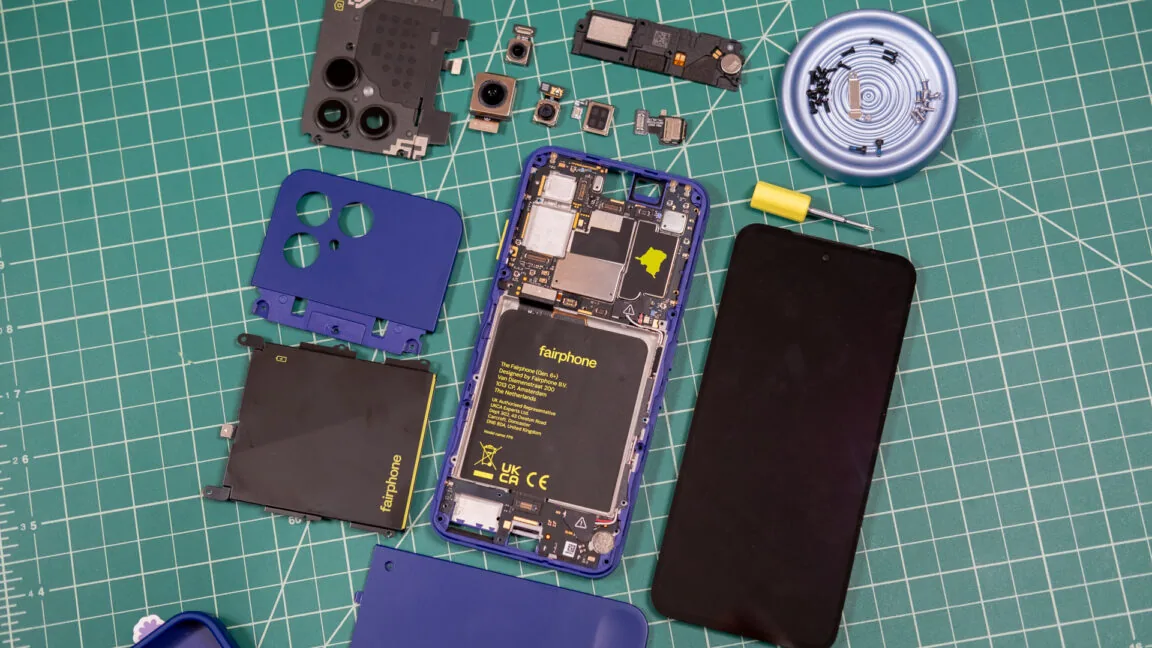
Fairphone's approach challenges the industry norm, where smartphones are often sealed with glue and intricate screw systems, making repairs costly and difficult. The Gen 6+, however, is designed for modularity, allowing users to replace up to 12 components, including the battery, display, and camera modules, using a single included screwdriver. This focus on longevity aims to reduce electronic waste and save consumers money over the lifespan of the device. "We're doing something that was long thought to be nearly impossible," Hatton said. "Which is delivering high-performing modular smartphones that can last for a very long time."
Designed for Longevity, Built for Repair
The company's commitment extends beyond simple repairability. Fairphone prioritizes the use of recycled materials, avoids conflict minerals, and ensures fair wages for its factory workers. The core philosophy is to encourage consumers to keep their phones for an extended period. "Our goal is that every single person that purchases a Fairphone uses it for at least five years, and we track that as a KPI," Hatton explained. This contrasts with the industry's often implicit model of planned obsolescence. "There is an incentive in terms of planned obsolescence to replace your device," Hatton noted. "On the one hand, it's a good way to keep selling devices, but that's simply not the proposition that we have."
The internal design of the Fairphone Gen 6+ is intentionally uncluttered, facilitating disassembly. Removing just two T5 Torx screws on the back cover allows access to the battery. Further screws grant access to other user-replaceable parts. While this modularity might make the phone slightly thicker than conventionally constructed smartphones, it supports the primary goal of extended usability. "We know that after about three years, it will be wise to replace your battery with a new one," Hatton said. "Batteries aren't meant to last forever, but your phone on the whole can last a lot longer than a battery."
Fairphone also subjects its designs to rigorous testing to ensure durability through repeated disassembly and reassembly. Tests are conducted to assess the impact of actions like over-tightening screws, which could potentially damage the casing or internal components. While a company executive like Hatton can disassemble the phone in about 15 minutes, the company estimates that a novice user could complete the task in under 30 minutes, aided by straightforward documentation and easily managed connectors. Even the 6.31-inch OLED display, a component often challenging to replace on other smartphones, is designed for relatively simple user replacement, secured by a few screws and featuring an accessible ribbon cable.
The Fairphone Gen 6+ specifications include a Snapdragon 7s Gen 4 SoC, 12GB of RAM, and 256GB of internal storage expandable via microSD. Its 6.31-inch LTPO OLED display offers a 1116x2484 resolution with a refresh rate up to 120 Hz. The camera system features a 50MP primary sensor and a 13MP ultrawide lens, with a 32MP selfie camera. The device runs on Android 16 and is powered by a 4415 mAh removable battery with 30W wired charging support. Notably, unlike many contemporary smartphones, the Gen 6+ retains a physical SIM card slot alongside eSIM support, and a microSD card slot, features often omitted by other manufacturers due to space constraints. "There's a reason that most phone manufacturers prefer slightly larger footprints—because you can fit more stuff in there," Hatton acknowledged regarding feature omissions by competitors. "So yes, it is legitimate if phone manufacturers are saying, ‘Hey, we dropped this feature to save space inside the device.’"
Despite the focus on user needs and longevity, the Fairphone Gen 6+ does not include a headphone jack, a feature that remains a point of discussion for a segment of consumers. "In terms of how to actual...