
Hengefinder App Reveals Perfectly Framed Sunsets in City Streets
A new app called Hengefinder uses astronomical calculations and road data to identify precise moments when the sun or moon aligns perfectly with city streets. It's available on web and mobile.

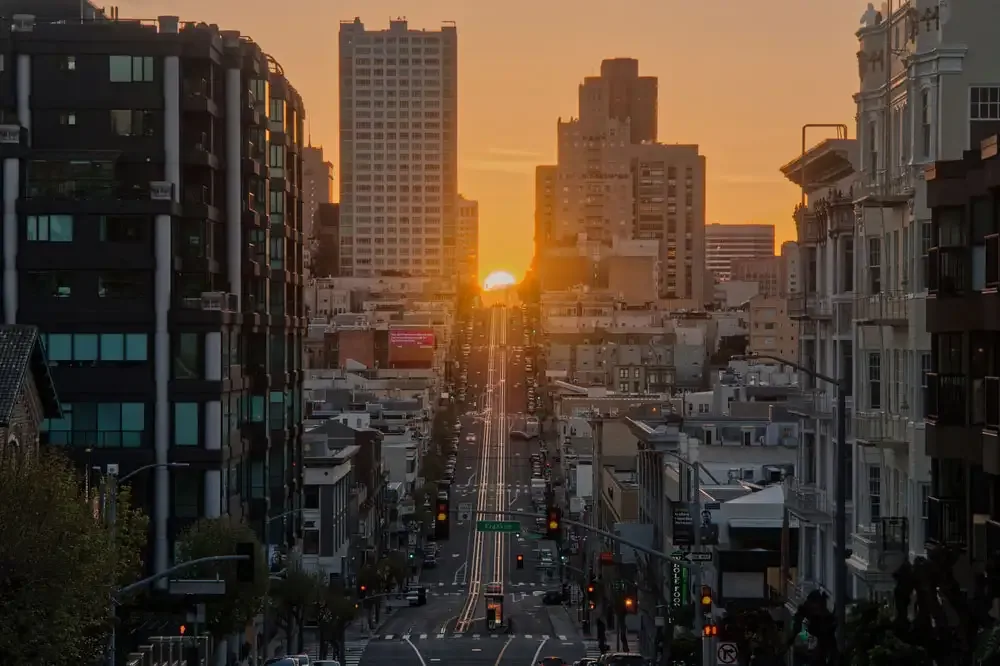
A new application named Hengefinder is making it possible for users to discover and experience remarkable celestial alignments within urban landscapes. The app identifies specific times and locations where the sun or moon appears perfectly framed by city streets or positioned atop buildings, a phenomenon the developers have dubbed a "henge." This innovative tool combines complex astronomical calculations with detailed road data to provide instant results for locations worldwide, covering sunrises, sunsets, moonrises, and moonsets.
Hengefinder is accessible via its website at hengefinder.rcdis.co and also as mobile applications for both iPhone and Android devices. The underlying technology is built upon open-source software initially developed by Victoria Ritvo. Ritvo detailed the intricate process behind the app, explaining that the project involved breaking down a multifaceted problem into smaller, manageable components. "It was appealing to me that this was mostly made up of many sub problems I could either think through thoroughly, or choose to mostly skip (by handing off to a library, a brute-force solution, an approximation, etc.)," she stated.
Behind the Astronomical Calculations
While some aspects of the app leverage existing libraries to handle complex astronomical modeling, Ritvo delved into other areas to refine the user experience and accuracy. The development process encountered unexpected complexities as initial assumptions about real-world conditions were challenged. For instance, roads could not be treated as simple flat lines, and the spherical nature of the Earth meant that latitude and longitude coordinates did not behave like a standard Cartesian grid. Furthermore, the very definition of "sunset" proved to be more ambiguous than initially anticipated.
"Other boxes I opened. And then I found many things I thought would be straightforward that turned out to be somewhat less trivial in practice as my assumptions broke," Ritvo explained. "Like, in reality, you can't treat roads like flat lines, latitude and longitude don't behave like a Cartesian grid, and the word 'sunset' is more ambiguous than I initially thought." The developer found satisfaction in bridging the gap between these initial assumptions and the complex reality of celestial mechanics and urban geography.
The concept of a "henge," in this context, is a neologism coined by the app's creators, drawing inspiration from Stonehenge. While Stonehenge itself refers to ancient circular earthworks, this modern interpretation focuses on the visual alignment of celestial bodies with man-made structures. The app aims to bring these moments of natural beauty into everyday urban life, offering a new perspective on familiar surroundings. Users can input their location and desired time frame to see if their streets are due for a celestial spectacle in the coming months. The success of these alignments is, of course, dependent on clear weather conditions, adding an element of anticipation and chance to the experience.
Hengefinder's success in mapping these precise alignments demonstrates the power of combining sophisticated algorithms with accessible technology. The application offers a unique way for people to connect with astronomy and their environment, transforming ordinary streets into potential vantage points for extraordinary natural events. The project highlights how open-source contributions can lead to innovative consumer applications, making complex scientific principles more understandable and engaging for the public. The app is a testament to the continuous effort to merge technology with the appreciation of natural phenomena, encouraging users to look up and observe the sky from new perspectives.