
Curiosity Rover Uncovers Martian 'Sea of Polygons'
NASA's Curiosity rover has discovered a vast expanse of polygon-shaped geological formations on Mars. This 'sea of polygons' offers new insights into the planet's ancient watery past.

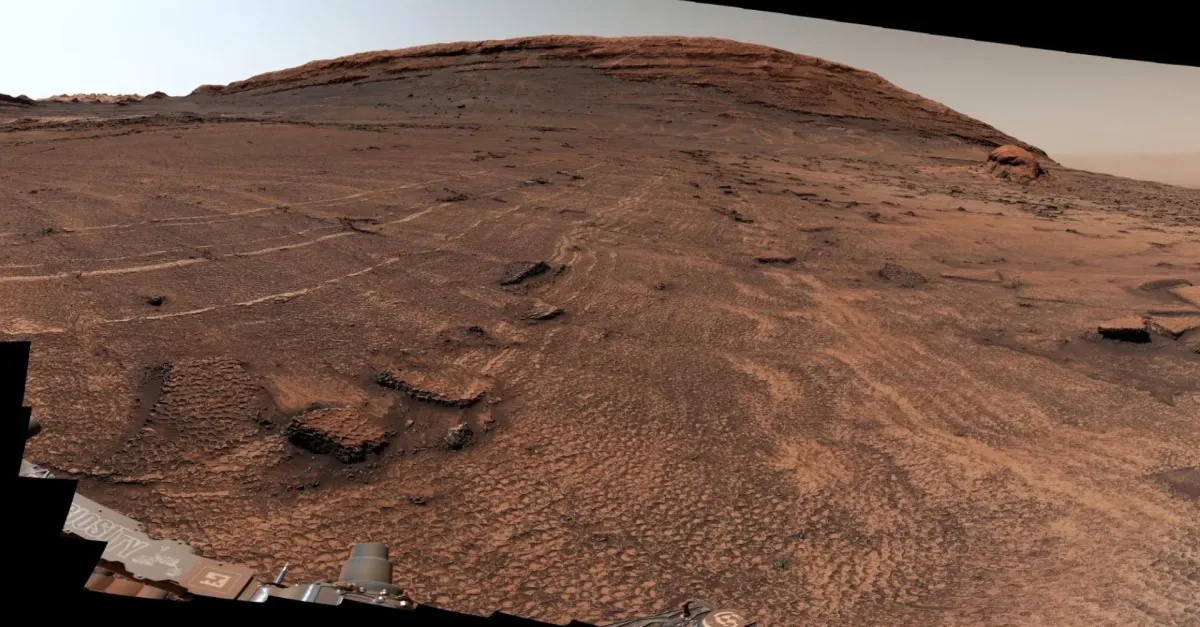
NASA's Curiosity rover has identified a striking geological formation on Mars, characterized by a vast expanse of polygon-shaped features, leading scientists to dub it a 'sea of polygons.' The discovery was made in the Gale Crater, a region believed to have once held a large lake. This honeycomb-like terrain provides compelling evidence of Mars' ancient hydrological history and the conditions that may have once supported life.
The rover, currently exploring the area, transmitted images revealing the intricate patterns etched into the Martian surface. These polygons, resembling dried mud cracks on Earth, are thought to have formed as clay-rich sediments within the ancient lakebed repeatedly dried and contracted over eons. The uniformity and scale of the polygonal network are remarkable, stretching across a significant portion of the crater floor.
Scientists analyzing the data are particularly excited about the implications for understanding Mars' past climate. "It took our breath away," commented Dr. Anya Sharma, a planetary geologist involved in the mission. "Seeing these formations laid out before us, it’s like looking at a snapshot of a very different Mars, a Mars that was wetter and potentially more hospitable than we see today." The presence of abundant clay minerals, evident in the rover's spectral data, further supports the hypothesis of a long-standing body of water.
Ancient Lakebed Revelations
The area where the polygons were found is part of the ancient lakebed within Gale Crater, a massive impact basin explored by the Curiosity mission since its landing in 2012. Previous investigations by the Curiosity rover had already established the crater's history as a former lake, but this new discovery offers unprecedented detail about the processes that occurred as the water receded. The size and shape of the polygons can provide clues about the depth of the ancient water, the rate of drying, and the composition of the sediments.
Understanding these ancient Martian environments is crucial for the ongoing search for signs of past microbial life. The conditions that form such polygonal patterns on Earth are often associated with environments that can support life, such as wetlands or shallow lakes. By studying these features on Mars, researchers hope to identify similar habitable niches that might have preserved biosignatures.
The data gathered by Curiosity is continuously being analyzed, with researchers employing advanced imaging and chemical analysis tools to scrutinize the texture, composition, and formation mechanisms of the polygons. Future analyses will focus on mapping the extent of this polygon field and searching for variations that could indicate changes in environmental conditions over time. The rover's ongoing mission continues to unlock the secrets of the Red Planet, painting a clearer picture of its evolution and potential habitability.