
Four-Carbon Sugar Erythrulose Detected in Interstellar Space
Astronomers have detected erythrulose, a four-carbon sugar, in a molecular cloud near the Milky Way's center. This discovery offers new insights into the origins of life and the chemical building blocks available in space.

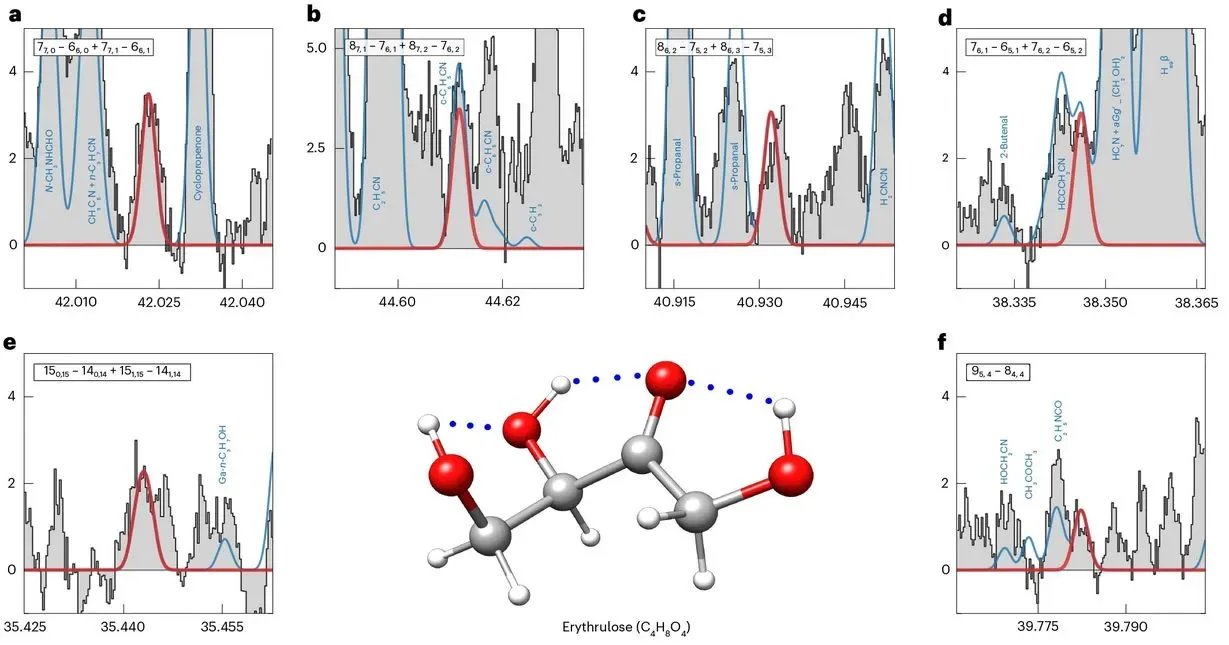
Astronomers have detected a crucial four-carbon sugar, erythrulose, in the vast expanse of interstellar space, a finding that could shed new light on the origins of life. The detection was made in a dense molecular cloud located near the center of the Milky Way galaxy.
The discovery, reported by a team led by Izaskun Jiménez-Serra, utilized observations from the 40-meter radio telescope at Yebes and the 30-meter radio telescope at Granada. These powerful instruments allowed researchers to identify the spectral signature of erythrulose amidst the complex chemistry of the interstellar medium.
Sugars are considered fundamental building blocks for life as we know it, playing essential roles in DNA, RNA, and energy transfer within cells. While simpler sugars like glycolaldehyde have been found in space before, the detection of a more complex molecule like erythrulose is particularly significant. Scientists theorize that such precursor molecules could have been delivered to early Earth via asteroids and comets, providing the necessary ingredients for life to emerge.
Implications for Astrobiology
This groundbreaking detection fuels theories suggesting that the necessary chemical components for life may be readily available throughout the cosmos. "Understanding the chemical complexity of the interstellar medium is key to understanding our origins," stated a researcher involved in the study. "Finding molecules like erythrulose, which are precursors to biological molecules, in such environments suggests that the pathway to life might be more common than previously thought."
The team focused their observations on a specific molecular cloud known for its rich chemical inventory. The cold, dense conditions within these clouds are conducive to the formation of complex organic molecules. Radio telescopes are ideal for this kind of research because molecules in space emit radio waves at specific frequencies as they rotate and vibrate, creating unique spectral fingerprints that scientists can analyze.
The presence of erythrulose in interstellar space provides compelling evidence for the abiotic synthesis of complex sugars. This means these molecules can form through natural chemical processes without the involvement of living organisms. Such findings are critical for astrobiology, the field dedicated to studying the potential for life beyond Earth. It bolsters the idea that the universe may be seeded with the fundamental ingredients for life, waiting for the right conditions to spark biological activity.
Future research will likely involve searching for other complex sugars and organic molecules in different interstellar environments. The ongoing work by astronomers continues to expand our understanding of the chemical universe and the tantalizing possibility of life elsewhere.