
Hera Spacecraft Reveals Stadium-Sized Crater From NASA Asteroid Crash
The European Space Agency's Hera mission has captured close-up images of asteroid Dimorphos, revealing a massive crater left by NASA's 2022 DART impact.

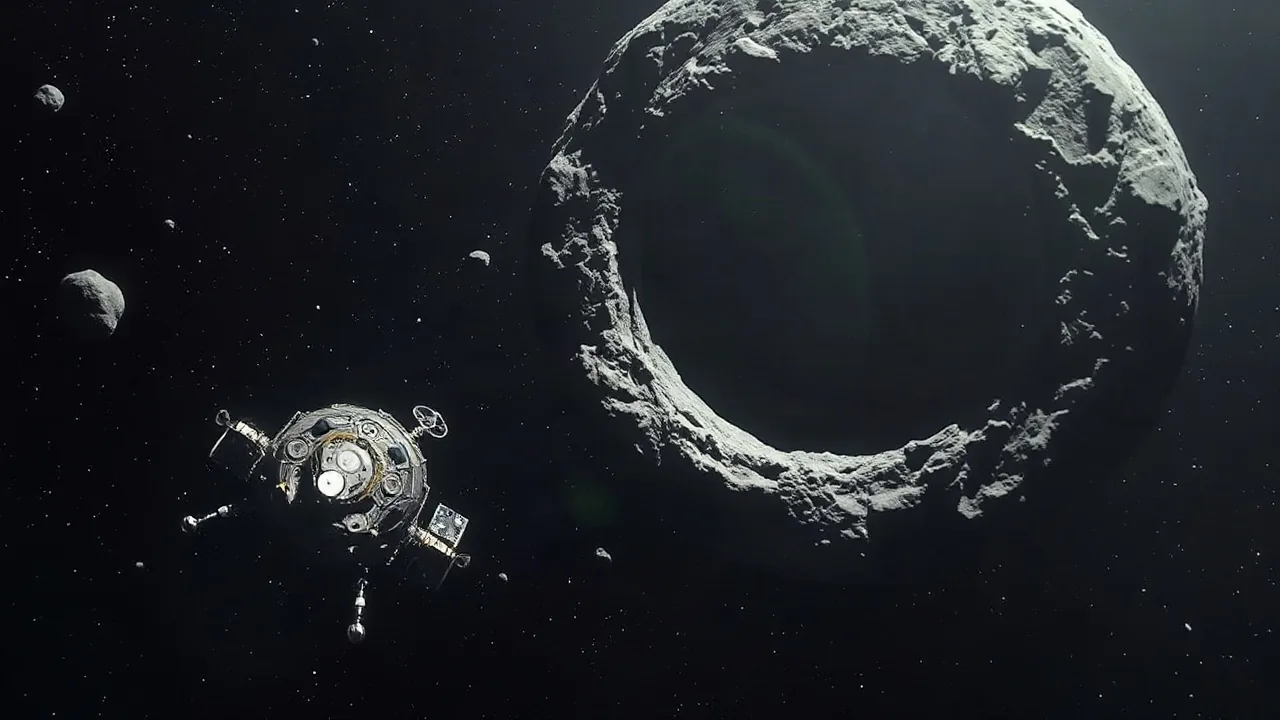
The European Space Agency Hera spacecraft has captured the first detailed images of the asteroid Dimorphos, revealing a massive, stadium-sized crater on its surface following a deliberate collision by NASA in 2022. The planetary defense test, which involved flying a spacecraft directly into the space rock, aimed to determine whether humanity could successfully alter the trajectory of a potentially threatening asteroid.
Four years after the initial test, the Hera mission arrived at the crash site to thoroughly examine the aftermath. “The crater is almost as large as the body itself, which is really, really spectacular,” said Dr Sabina Raducan, a planetary scientist on the science team. “It's hard to describe in words all the excitement to actually finally see what happened. And as a crater person, I can also say it's beautiful.”
During the 2022 test, NASA's Dart spacecraft slammed into Dimorphos at 14,000mph, generating a debris trail stretching 6,200 miles long. The target asteroid measures roughly 150 meters wide and orbits a larger companion rock named Didymos, which spans 730 meters across. Prior to the impact, Dimorphos took 11 hours and 55 minutes to complete an orbit, but the collision shortened its orbital duration by approximately 33 minutes, proving that deflecting a space rock is feasible.
Investigating Orbital Changes and Surface Geology
In addition to altering its path, the collision dramatically changed how the asteroid moves through space. “Before the Dart impact, Dimorphos was more like our own Moon - so it was always showing the same face to Didymos, and it was behaving quite nicely,” Raducan explained. “Now it's very, very chaotic - it's tumbling. Imagine a barrel that you throw down the stairs, and the barrel is rolling and it's moving, and basically that's what Dimorphos does right now around Didymos.”
Observations of Didymos have revealed a surface characterized by extremely low gravity—about 40,000 times weaker than Earth's—and complex geology featuring car- and bus-sized boulders measuring between 3 meters and 10 meters across. Researchers plan to spend the next six months studying both bodies while navigating a hazardous field of hundreds of loose rocks surrounding the system. Ultimately, measuring the mass of Dimorphos will help scientists calculate the exact efficiency of the kinetic shove, providing vital data for future planetary defense strategies.