
Japan's Phobos Sample Return Mission Lifts Off
Japan's Aerospace Exploration Agency has launched a groundbreaking mission to collect samples from Phobos, one of Mars's moons. The spacecraft will aim to bring a piece of the Martian moon back to Earth for study.

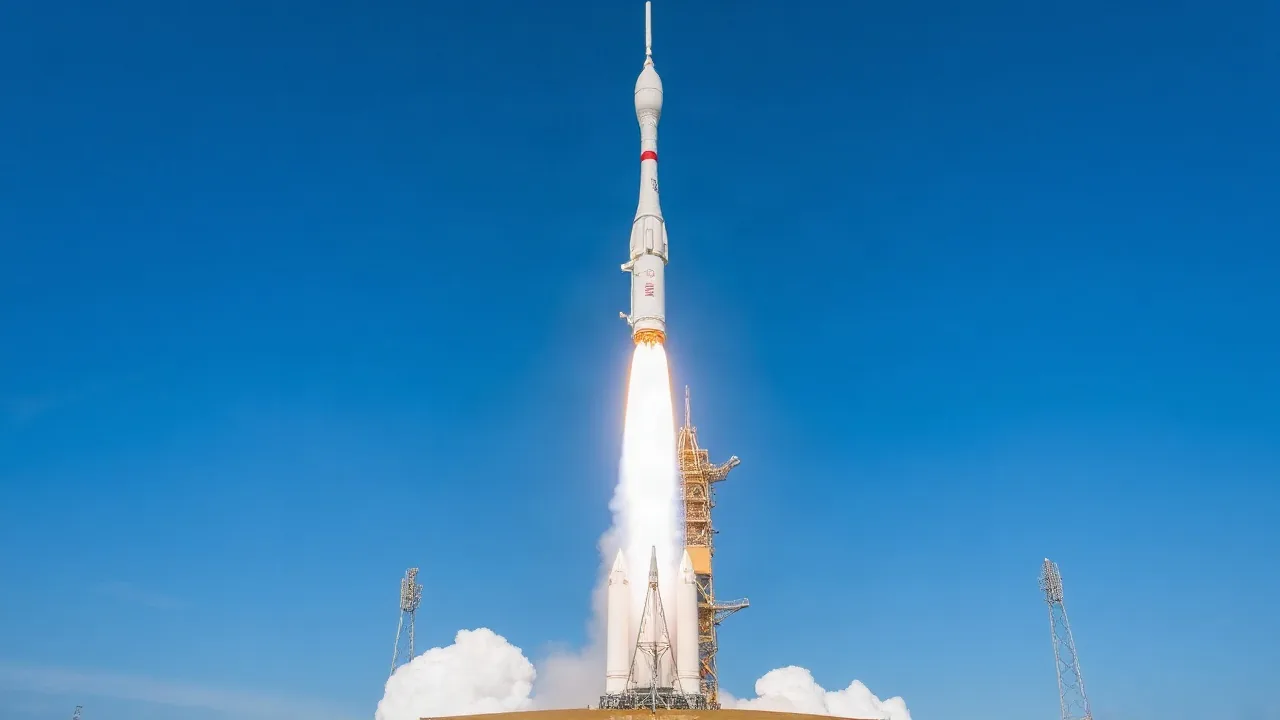
Japan's ambitious quest to retrieve samples from Phobos, one of Mars's two moons, officially began on October 20, 2026, as the country's Aerospace Exploration Agency (JAXA) successfully launched its Martian Moons eXploration (MMX) mission. The spacecraft lifted off from the Tanegashima Space Center aboard an H-IIA rocket, embarking on a multi-year journey to Mars and its enigmatic moon.
The MMX mission represents a significant leap in planetary science, aiming to collect Martian regolith from the surface of Phobos and return it to Earth for detailed analysis. Scientists are particularly interested in understanding the origin of Phobos and its smaller companion, Deimos, which current theories suggest may be captured asteroids rather than celestial bodies formed alongside Mars. The mission's success could provide crucial insights into the early solar system and the formation of terrestrial planets.
"This is a historic moment for Japanese space exploration," stated Dr. Hiroshi Yamakawa, President of JAXA, during a post-launch briefing. "The MMX mission will not only push the boundaries of engineering and scientific inquiry but also deepen our understanding of the red planet and its intriguing moons. It's a once-in-a-lifetime opportunity to bring a piece of another world back to Earth."
Unraveling the Mysteries of Phobos
Phobos, meaning 'fear' in Greek, is the larger and closer of Mars's two moons. It orbits Mars at an altitude of about 6,000 kilometers (3,700 miles), much closer than Earth's Moon. Its surface is covered in craters, the most prominent being the Stickney crater, which is almost a third of Phobos's diameter. Scientists believe Phobos is geologically inactive, but its irregular shape and low density have long puzzled astronomers.
The MMX spacecraft will first travel to Mars, entering orbit around the red planet. It will then conduct extensive observations of Phobos from orbit for approximately 18 months, meticulously mapping its surface and selecting a suitable landing site. The mission plans to land on Phobos in 2028, briefly touch down to collect surface material, and then ascend back into orbit to rendezvous with the return vehicle.
This complex maneuver involves the use of a sample collection system designed to scoop up regolith. The collected material will be sealed in a specialized capsule for its long journey back to Earth. The return journey is slated to begin in 2029, with the capsule expected to land in Japan in 2031. The sample return represents the most challenging aspect of the mission, requiring precision navigation and robust spacecraft design.
The scientific payload on MMX includes a suite of instruments to study the Martian moons and their environment. These include cameras for imaging, spectrometers for analyzing composition, and a radiation detector. By studying the composition of the samples, scientists hope to determine if Phobos originated from Mars itself or if it's an ancient asteroid captured by the planet's gravity. Understanding Martian moons could shed light on the conditions present in the solar system during its formative years and potentially offer clues about the habitability of Mars in its ancient past.
JAXA is collaborating with international partners on the MMX mission, reflecting the global nature of space exploration. NASA is providing support for ground operations and data analysis, while other space agencies are contributing to scientific instrument development. This collaborative spirit is crucial for tackling the immense challenges and costs associated with deep-space missions.
The mission faces considerable risks, including the harsh radiation environment around Mars, the unpredictable nature of a low-gravity landing, and the complexities of autonomous operations. However, the potential scientific rewards are immense, offering a unique opportunity to study extraterrestrial material up close. The successful return of samples from Phobos would be a landmark achievement for Japan and a significant contribution to humanity's ongoing exploration of the cosmos and the search for life beyond Earth.