
NASA's Perseverance Rover Breaks Mars Driving Record
NASA's Perseverance rover has achieved a significant milestone, setting a new record for the longest distance driven by a vehicle on another planet. The rover continues its exploration of Mars.

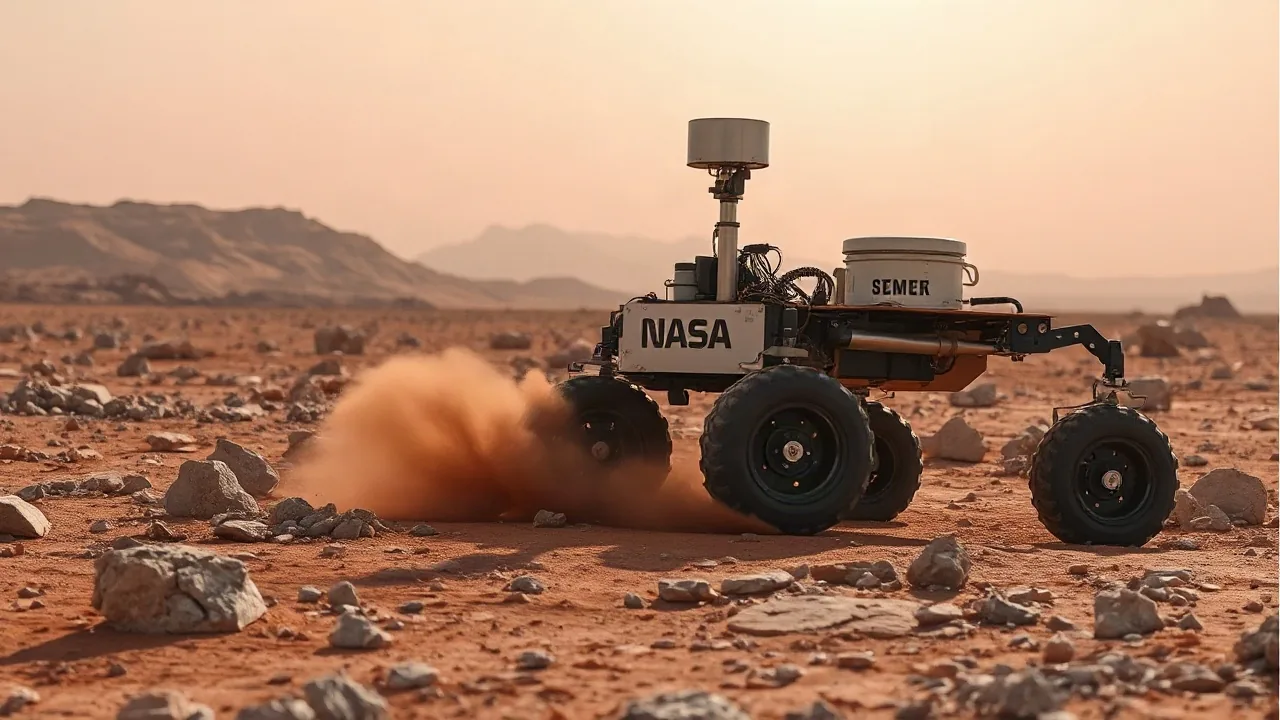
NASA's Perseverance rover has officially become the most-traveled vehicle on another world, surpassing previous off-world distance records. The six-wheeled robot, currently exploring the Jezero Crater on Mars, has now driven over 28 miles (45 kilometers) since its landing in February 2021. This milestone underscores the rover's remarkable durability and the success of its ongoing scientific mission.
The achievement was confirmed by NASA's Jet Propulsion Laboratory (JPL), which manages the Perseverance mission. The rover's primary objective is to seek signs of ancient microbial life and collect samples of rock and regolith that could be returned to Earth for detailed analysis. Its extended journey across the Martian terrain is crucial for reaching scientifically interesting locations.
Continued Exploration and Scientific Discoveries
Perseverance has been methodically traversing the Jezero Crater, a site believed to have once held a lake and river delta. Its advanced instruments, including cameras, spectrometers, and drills, allow scientists to analyze the geological history of the planet and search for biosignatures. The rover's ability to cover significant distances is key to its exploration strategy, enabling it to visit diverse geological units.
"This is a testament to the engineering and dedication of the teams at NASA and JPL," said Dr. Lori Glaze, director of NASA’s Planetary Science Division, in a statement. "Every mile driven by Perseverance brings us closer to understanding Mars's potential for past life and provides invaluable data for future human exploration." The rover's journey is not just about distance; it's about the scientific discoveries made along the way.
The previous record for distance driven on another celestial body was held by the Soviet Union's Lunokhod 1 rover, which operated on the Moon between 1970 and 1971, covering approximately 23.6 miles (38 kilometers). Perseverance's current traverse far exceeds this long-standing record, highlighting advancements in rover technology and mission planning. The rover's autonomous navigation capabilities and robust design have been critical factors in its success.
The mission continues to face the harsh Martian environment, including extreme temperatures, dust storms, and radiation. Despite these challenges, Perseverance has maintained operational efficiency, thanks to its sophisticated power system and resilient construction. The Jezero Crater, with its complex geology, offers a unique opportunity to study ancient Martian processes. Scientists anticipate that further exploration will yield more significant findings.
Future objectives for the Perseverance rover include ascending the Jezero delta to analyze its sedimentary layers and eventually reaching its summit. The samples collected here are considered prime candidates for containing evidence of ancient life. The NASA rover's record-breaking journey is a crucial phase in humanity's quest to explore the Red Planet and answer fundamental questions about life beyond Earth.