
See 3 Planets After Sunset This Week in May 2026
Skygazers can spot Mercury, Venus, and Jupiter aligning in the western sky for a spectacular celestial display shortly after sunset throughout the week of May 24, 2026. Look for Venus and Jupiter to be easily visible, with Mercury requiring a bit more effort.

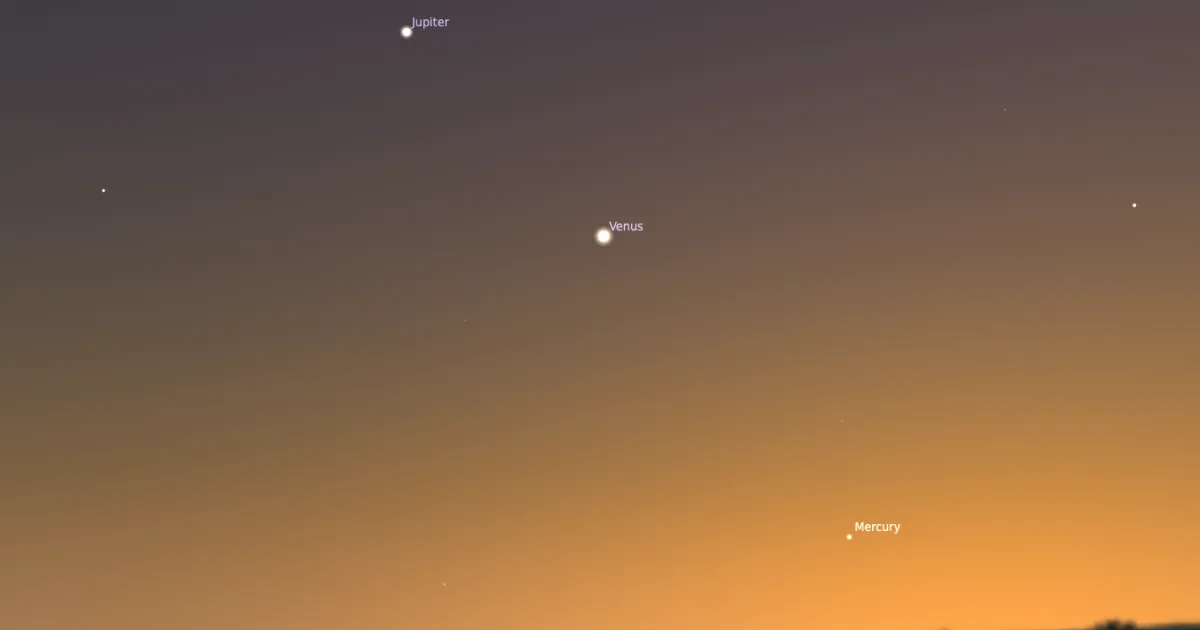
For stargazers in the Northern Hemisphere, a treat awaits in the evening sky this week as three planets — Mercury, Venus, and Jupiter — will be visible shortly after sunset. The celestial lineup offers a prime opportunity to observe these bright worlds following the sun's descent below the horizon, particularly in the western sky.
As of May 24, 2026, Mercury, previously hidden by the sun's glare, is emerging and should be readily identifiable. The smallest planet in our solar system will shine at a magnitude of -1.1, approximately 6 degrees above the western horizon just 30 minutes after sunset. For those struggling to locate it, observers can use brighter planets Venus and Jupiter as a guide. Drawing a line from Jupiter, which will be positioned high in the eastern Gemini constellation, down through Venus, and continuing toward the horizon, will lead the eye towards Mercury.
Jupiter, currently shining at a magnitude of -1.9, will be the highest of the three planets, situated in the eastern reaches of Gemini. Venus, positioned slightly lower and closer to the 'Twins' feet', will be the brightest object in the sky, boasting a magnitude of -3.9. Its brilliance often makes it the easiest of the three to spot.
Planetary Comparison and Telescope Views
For those equipped with a telescope, comparing Venus and Mercury offers a fascinating study in planetary contrasts. Venus will appear about 13 arcseconds across, with 81 percent of its visible disk illuminated. Its cloudy atmosphere will be readily apparent. Mercury, while appearing less than half the size of Venus at just 6 arcseconds wide, will be slightly more illuminated, with 84 percent of its disk lit. This difference in apparent size and illumination highlights the distinct characteristics of each planet as seen from Earth.
This planetary alignment is a recurring phenomenon, driven by the orbital mechanics of our solar system. The positions of planets in the sky are constantly changing, making events like these valuable opportunities for both casual observers and dedicated astronomers. Mercury, being the closest planet to the sun, has a very fast orbit and is often difficult to spot due to its proximity to the sun's intense light. Venus, the second planet from the sun, is renowned for its extreme brightness, often referred to as the 'Evening Star' or 'Morning Star' when it is visible.
Jupiter, the largest planet in our solar system, commands a significant presence in the night sky. Its visibility and position in constellations like Gemini are predictable based on its orbit, which takes nearly 12 Earth years to complete. Observing these three planets together provides a tangible connection to the vastness of space and the intricate dance of celestial bodies. The best viewing conditions will be on clear, dark nights away from city lights, allowing for optimal observation of these distant worlds.