
Roman Space Telescope Launched to Study Dark Energy and Dark Matter
The Nancy Grace Roman Space Telescope has been launched from Kennedy Space Center, beginning a five-year mission to explore dark matter and dark energy. The observatory aims to study billions of galaxies and millions of stars.

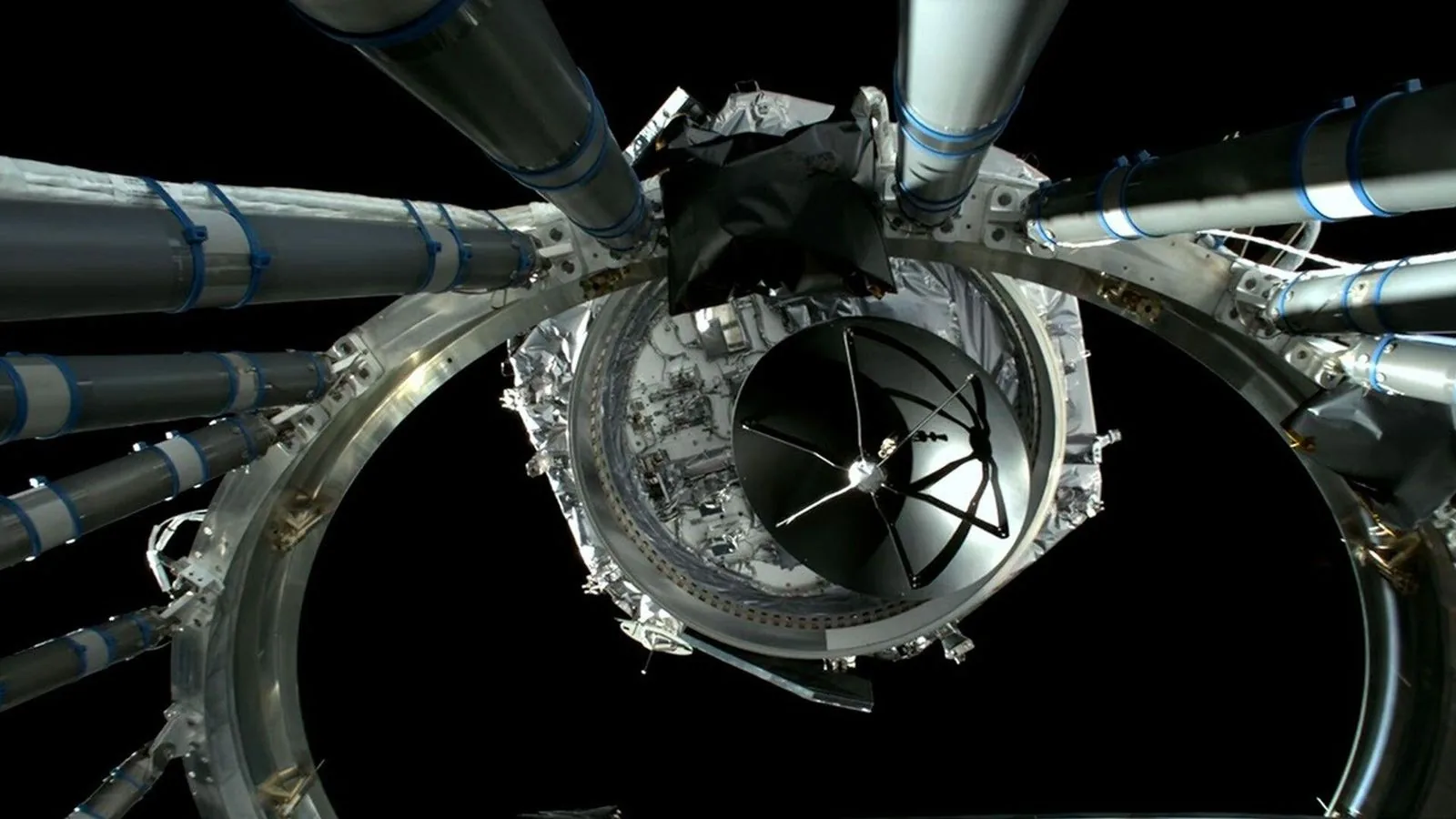
The Nancy Grace Roman Space Telescope successfully launched Sunday at dawn from Kennedy Space Center, embarking on a journey to its distant orbit approximately one million miles from Earth. With its solar panels and sun shade already deployed, and its high-gain antenna nearing activation, the observatory is on track for a three-month commissioning period. The first scientific images are anticipated in early 2027, marking the start of a comprehensive five-year survey dedicated to unraveling the profound mysteries of dark matter and dark energy.
Named in honor of Nancy Grace Roman, NASA's inaugural chief astronomer, the telescope is equipped with a 2.4-meter mirror, comparable to the Hubble Space Telescope's, but designed to capture images with significantly wider fields of view. Each exposure will encompass at least 100 times more of the sky than Hubble. Over its operational lifespan, Roman is expected to survey more than a billion galaxies, chart up to 20 billion stars within our Milky Way, and identify between 50,000 and 200,000 exoplanets. The mission's advanced hardware and software are engineered to transmit an unprecedented 1.4 terabytes of data daily, setting a new benchmark for NASA astrophysics missions.
The Roman mission is a critical component of a broader international endeavor aimed at probing the fundamental structure and historical evolution of the universe. Scientific understanding has evolved significantly since the early 20th century, with the discovery of the universe's expansion pointing to an origin approximately 13.8 billion years ago. This foundational discovery ignited further questions about the universe's ultimate fate: whether expansion would continue indefinitely or if gravity would eventually force a collapse.
Exploring the Cosmic Unknowns
Subsequent decades brought surprising revelations. Around 1970, astronomers identified that galaxies contained far more mass than could be accounted for by visible stars and gas. This unseen component, termed "dark matter," possesses gravitational influence but does not interact with light. Later, observations of distant exploding stars, known as Type Ia supernovae, revealed that the universe's expansion is not slowing down but accelerating. This acceleration is attributed to a repulsive force on a cosmic scale, now identified as "dark energy." Both dark matter and dark energy constitute the overwhelming majority of the universe's mass-energy content, with dark matter comprising approximately 27 percent and dark energy about 68 percent, leaving ordinary baryonic matter to make up the remaining 5 percent.
Julie McEnery, Roman's senior project scientist, explained the impetus behind the mission in a pre-launch interview on NASA's Curious Universe podcast. "In the late 90s, we realized that the universe was behaving much more strangely than we imagined, and that instead of coasting out at a constant speed forever or slowing down, it in fact is accelerating," she stated. "It was a huge, unexpected mystery. Many scientists wanted to figure out what can we do to take the next step to understand the fundamental nature of our universe?"
A primary objective for both astronomy and physics in recent decades has been to pinpoint the origins and characteristics of these dominant, yet elusive, cosmic components. Recent measurements from the Dark Energy Spectroscopic Instrument (DESI) in Arizona suggest a potential weakening of dark energy over cosmic time, a finding that could challenge the current cosmological model where dark energy is considered a fixed constant. Such a revelation would have profound implications for fundamental physics.
Settling these questions requires multiple observational approaches, as different methods of measuring cosmic expansion yield varied results. The Roman telescope is specifically designed to meticulously study Type Ia supernovae, whose consistent intrinsic luminosity allows for precise distance calculations. Concurrently, Roman will analyze gravitational lensing effects, measuring how the gravity of intervening matter distorts the images of hundreds of millions of distant galaxies. By combining these datasets, scientists aim to gain a more comprehensive understanding of both the universe's expansion rate and the evolution of large-scale structures like galactic superclusters and cosmic filaments. Other observatories contributing to this research include HETDEX in West Texas, 4MOST in Chile, WEAVE in Spain's Canary Islands, the Vera C. Rubin Observatory in Chile, and the European Euclid telescope, which will operate from a similar vantage point a million miles from Earth.
The development and operation of these sophisticated instruments represent a significant international collaboration, underscoring the global nature of scientific inquiry. Decades of work by thousands of researchers, technicians, and engineers have culminated in these missions, with none built or operated by a single nation. Historically, international space science projects often included proprietary periods, granting exclusive data access to sponsoring institutions before public release. For instance, the European Hipparcos mission had a catalog embargo of nearly four years, and Planck's cosmological results were withheld for over three years. Hubble's data also faced extended periods of restricted access. However, the Roman mission's design eliminates such proprietary periods for its large-scale surveys, making all processed observations publicly available almost immediately. This decision, codified by the mission's science definition team prior to launch, acknowledges the immense scale of the dataset, which is far too vast for any single research group to fully analyze.