
SpaceX NASA Roman Space Telescope Launch Marks New Era
SpaceX successfully launched NASA's Nancy Grace Roman Space Telescope in September 2026, opening a new window for deep-space astronomy and dark energy research.

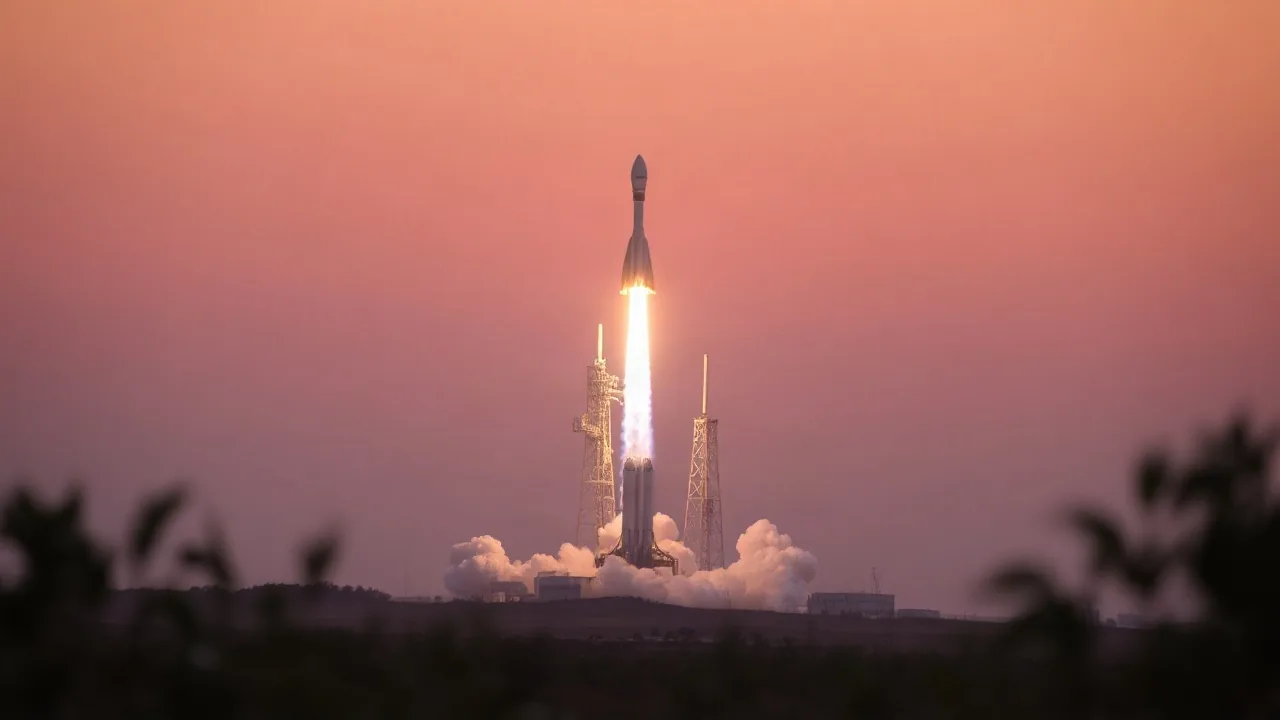
A SpaceX Falcon Heavy rocket lifted off from Kennedy Space Center on September 2, 2026, carrying NASA's Nancy Grace Roman Space Telescope into orbit. The launch marked a milestone in space exploration, delivering a flagship observatory designed to revolutionize how astronomers study distant galaxies, exoplanets, and the universe's largest-scale structure.
The Roman telescope, named after Nancy Grace Roman, a pioneering NASA astrophysicist, will operate from a vantage point 1 million kilometers from Earth. Unlike the James Webb Space Telescope, which focuses on infrared light from the earliest galaxies, Roman will survey the sky in visible and near-infrared wavelengths with an exceptionally wide field of view.
"This launch represents a transformative moment for astronomy," said Dr. Thomas Zurbuchen, Associate Administrator for NASA's Science Mission Directorate, in a statement to the press. "Roman will enable us to map the geometry of the universe and understand dark energy in ways we simply cannot achieve from the ground."
Mission Objectives and Scientific Capabilities
The Roman Space Telescope carries two primary instruments: a coronagraph designed to image nearby exoplanets and a wide-field instrument for surveying billions of galaxies. Its 2.4-meter primary mirror matches the size of the Hubble Space Telescope, but its wide-field camera covers a patch of sky 100 times larger in a single observation.
Roman's mission objectives include:
- Measuring the expansion history of the universe to constrain dark energy models
- Detecting and characterizing thousands of exoplanet systems
- Mapping the distribution of dark matter through gravitational lensing
- Cataloging supernovae across cosmic time
- Studying star formation in nearby galaxies
The coronagraph instrument will block out starlight to reveal planets orbiting nearby stars, complementing ground-based telescope surveys and paving the way for future missions to study habitable-zone worlds. This capability addresses a longstanding gap in exoplanet science: the ability to directly image planets in the habitable zone around sun-like stars.
NASA estimates the Roman mission will operate for at least five years, with a design life of 10 years. The total program cost, including development, launch, and operations, reaches approximately $2.4 billion.
SpaceX's Role and Launch Success
SpaceX was selected through a competitive procurement process to provide launch services for Roman. The company's Falcon Heavy, the world's most powerful operational rocket, was the natural choice for the 1,350-kilogram observatory and its payload of fuel and instruments.
The rocket lifted off at 5:15 a.m. EDT, with all three first-stage cores performing as expected. The upper stage achieved a precise burn trajectory toward the Sun-Earth L2 Lagrange point, where Roman will maintain its operational position. Deployment and instrument activation are scheduled to occur over the next 30 days.
"SpaceX's Falcon Heavy continues to prove itself as a versatile heavy-lift platform," said Jonathan McDowell, an astrophysicist and spaceflight analyst at the Harvard-Smithsonian Center for Astrophysics. "The Roman mission showcases how commercial aerospace providers are essential to modern space science."
Implications for Future Astronomy and Space Science
Roman's arrival in orbit comes at a pivotal moment for observational cosmology. With both Hubble and the James Webb Space Telescope in operation, astronomers will gain unprecedented capability to study the universe across multiple wavelengths and timescales simultaneously.
The telescope's dark energy measurements will test competing theories about the nature of cosmic acceleration. Current observations suggest the expansion rate of the universe is accelerating, driven by an unknown component called dark energy. Roman's data will either strengthen the leading "Lambda-CDM" model or point toward new physics.
For NASA and the international astronomical community, Roman represents a generational investment. The mission employs technology developed over more than 20 years, drawing on lessons from Hubble, WFIRST (an earlier conceptual mission), and collaborations with partners including the European Space Agency and Japanese space agencies.
The first science data from Roman is expected to arrive in late 2026, with full commissioning complete by mid-2027. Early observations will focus on characterizing instrument performance and validating calibration. Public data releases will follow a staggered schedule, ensuring that principal investigators and collaborating scientists gain initial access to support published results.
Astronomers worldwide have already submitted over 1,200 observation proposals for the first year of science operations. The demand far exceeds available observing time, underscoring the high expectations for Roman's transformative impact on modern Roman space telescope science.