
SpaceX Rocket Creates 'Space Jellyfish' Over Florida
A SpaceX Falcon 9 rocket launch created a mesmerizing 'space jellyfish' phenomenon visible across Central Florida. The unusual sight is a temporary effect of rocket exhaust interacting with the atmosphere at high altitudes.

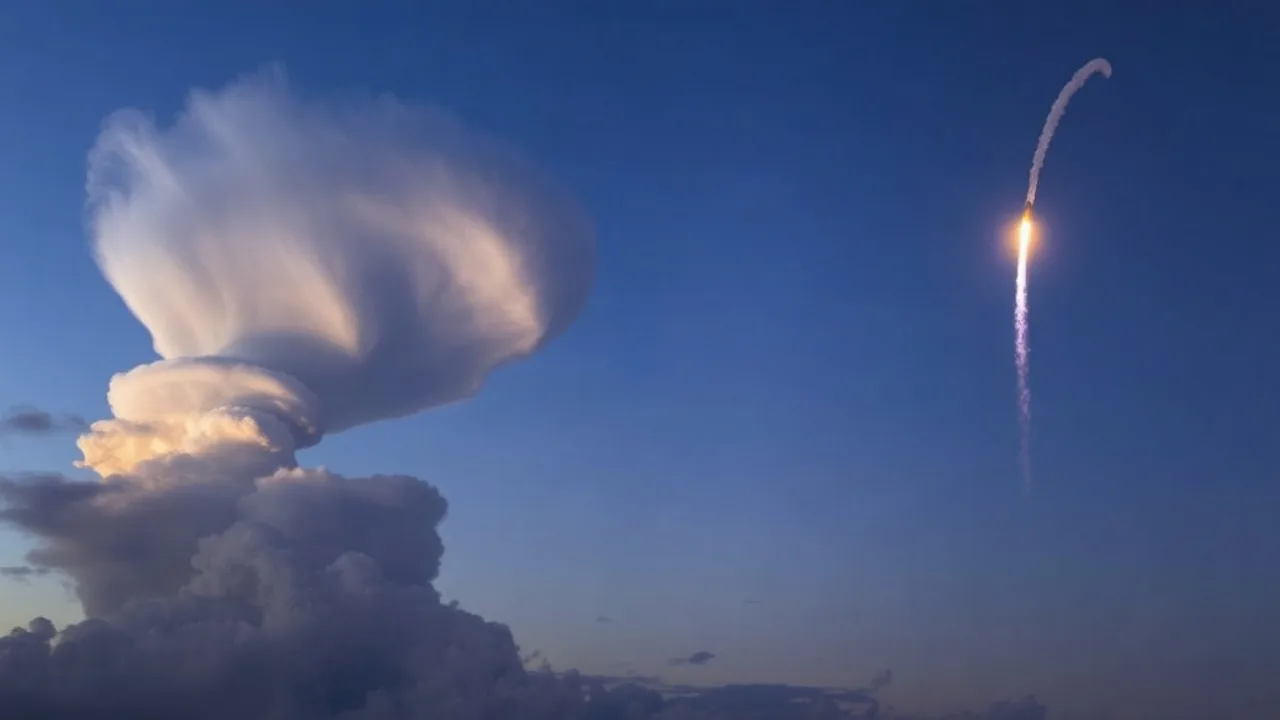
A SpaceX Falcon 9 rocket launch on October 19, 2026, created a stunning visual spectacle dubbed the 'space jellyfish' phenomenon, visible to residents across Central Florida. The unusual atmospheric display occurred shortly after the rocket ascended into the upper reaches of the atmosphere, leaving behind a luminous, ethereal cloud formation.
The 'space jellyfish' effect is a rare but beautiful consequence of rocket launches, particularly those occurring at night or during twilight hours. As the Falcon 9 rocket accelerated into orbit, its engine exhaust, primarily composed of water vapor and carbon dioxide, was released at high altitudes. When this supercooled exhaust interacts with the extremely cold and thin upper atmosphere, it can freeze into ice crystals. These crystals then refract sunlight, creating iridescent, jellyfish-like shapes that can linger in the sky for several minutes.
Atmospheric Optics and Rocketry Intersect
Dr. Evelyn Reed, an atmospheric physicist at the Florida Institute of Technology, explained the science behind the phenomenon. "The exhaust plumes from rocket engines are essentially massive amounts of water vapor expelled at supersonic speeds into a near-vacuum," Dr. Reed said. "At the altitudes where these launches occur, typically above 50 miles, the atmospheric pressure is incredibly low, and temperatures can plummet below -100 degrees Fahrenheit. This rapid expansion and cooling causes the water vapor to nucleate and form ice crystals, similar to how contrails form behind aircraft, but on a much grander scale and with more complex structures."
While visually striking, the 'space jellyfish' is a temporary byproduct of spaceflight. Its appearance and duration depend on various factors, including the rocket's trajectory, the amount of fuel burned, atmospheric conditions at the time of launch, and the angle of sunlight. The specific launch on October 19th, part of the Bandwagon-5 Mission, provided the perfect conditions for the phenomenon to be captured by numerous photographers and skywatchers.
This celestial display serves as a stark reminder of the intersection between cutting-edge technology and natural atmospheric processes. SpaceX, a leading private aerospace manufacturer, has been instrumental in increasing the frequency of launches from the United States, particularly from Florida's Space Coast. The company's reusable rocket technology has significantly reduced the cost of access to space, enabling more frequent missions for scientific research, satellite deployment, and space exploration.
The visual spectacle provided a unique opportunity for amateur and professional photographers alike. Social media platforms were quickly flooded with images and videos of the glowing cloud formation. Many observers marveled at the sight, comparing it to otherworldly phenomena or deep-sea bioluminescence. For residents of Central Florida, witnessing such an event firsthand offered a novel perspective on the expansive nature of space exploration activities happening just miles above their homes.
The SpaceX Falcon 9 rocket used in the mission is a two-stage, 229-foot-tall vehicle capable of lifting payloads of up to 50,265 pounds to orbit. Its successful ascent for the Bandwagon-5 Mission underscores the reliability and performance of the SpaceX launch vehicle. The company continues to push the boundaries of aerospace engineering, with ambitious plans for future missions, including crewed flights and interplanetary travel.