
SpaceX Tests Starship Return Capsule on Second Orbital Flight
SpaceX successfully launched its Starship return capsule, Starfall, for its second test flight. The mission also carried 31 customer payloads on a rideshare flight.

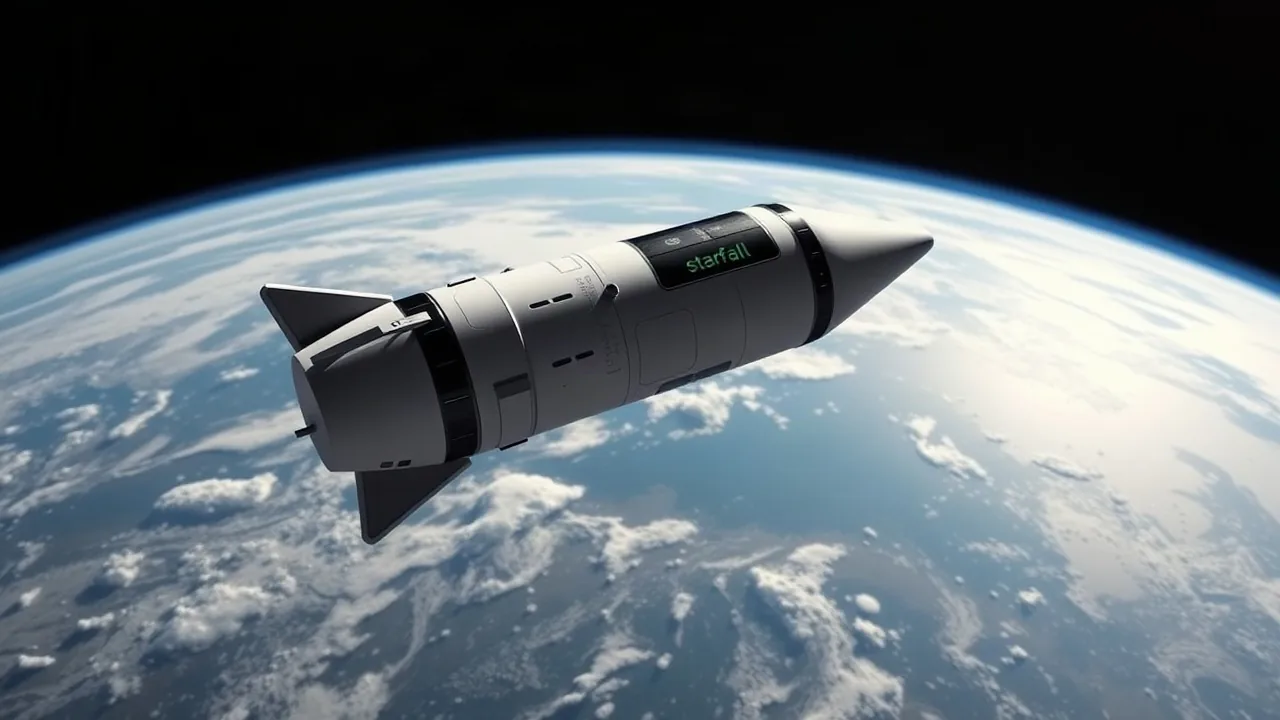
SpaceX conducted the second-ever flight test of its Starship return capsule, named Starfall, on October 19, 2026. The reusable spacecraft lifted off from the company's Starbase facility in Boca Chica, Texas, as part of the Bandwagon-5 rideshare mission. This orbital test is a crucial step in SpaceX's development of its next-generation Starship system, designed for deep space exploration and rapid point-to-point travel on Earth.
The Starfall capsule, a scaled-down prototype representing a key component of the larger Starship vehicle, is designed to demonstrate the capability of returning sensitive payloads from orbit safely. This particular mission carried 31 customer payloads, showcasing SpaceX's growing capabilities in the rideshare missions market, which offers more affordable access to space for smaller satellites and experimental technology.
The successful launch and anticipated return of the Starfall capsule are vital for validating SpaceX's orbital mechanics and reentry technologies. Unlike traditional capsules that are often expendable or require extensive refurbishment, Starship is engineered for rapid reusability, aiming to dramatically reduce the cost of space access. "Our goal with Starship is to make humanity a multi-planetary species, and that requires rapid, reliable, and cost-effective transportation to orbit and beyond," stated a SpaceX representative during a pre-launch briefing. "Every test flight, especially of critical components like the return capsule, brings us closer to that reality."
Advancing Reusable Spacecraft Technology
The development of Starfall is intrinsically linked to the broader ambitions for the full-scale Starship program. SpaceX founder Elon Musk has envisioned Starship as a fully reusable launch system capable of carrying both crew and cargo to Earth orbit, the Moon, Mars, and eventually, other celestial bodies. The success of Starfall's reentry and landing would provide invaluable data for refining the design and operational procedures for the entire Starship architecture.
This second test flight follows an initial orbital attempt earlier in 2026, which provided essential learning experiences for the engineering team. SpaceX is known for its iterative development process, often incorporating rapid design changes based on flight data. The company aims to leverage the insights gained from this mission to further optimize the capsule's thermal protection system, aerodynamic controls, and landing sequence. The reusable spacecraft technology being pioneered by SpaceX has the potential to revolutionize not only space exploration but also applications like high-speed global travel on Earth.
Beyond the Starfall capsule, the Bandwagon-5 mission highlights the increasing demand for commercial launch services. The diverse array of payloads suggests applications ranging from Earth observation and scientific research to technology demonstrations for future space-based infrastructure. SpaceX's ability to integrate multiple customer payloads onto a single launch vehicle reinforces its position as a dominant player in the global launch market. The data returned from these varied payloads will contribute to a growing understanding of microgravity environments and their potential uses.
The company is preparing for further Starship test flights, including tests of the fully integrated Starship/Super Heavy booster system. Each launch is a high-stakes endeavor, crucial for gathering the data needed to achieve full operational capability. The successful execution of missions like Bandwagon-5, featuring the Starfall return capsule, demonstrates steady progress toward SpaceX's ambitious long-term goals in space exploration and commercialization.