
AI Transport Systems Drive Autonomous Mobility Forward in 2026
Artificial intelligence is fundamentally reshaping autonomous vehicles and transport networks across North America in 2026. Smart traffic systems, predictive routing, and vehicle-to-infrastructure communication are now operational in major cities.

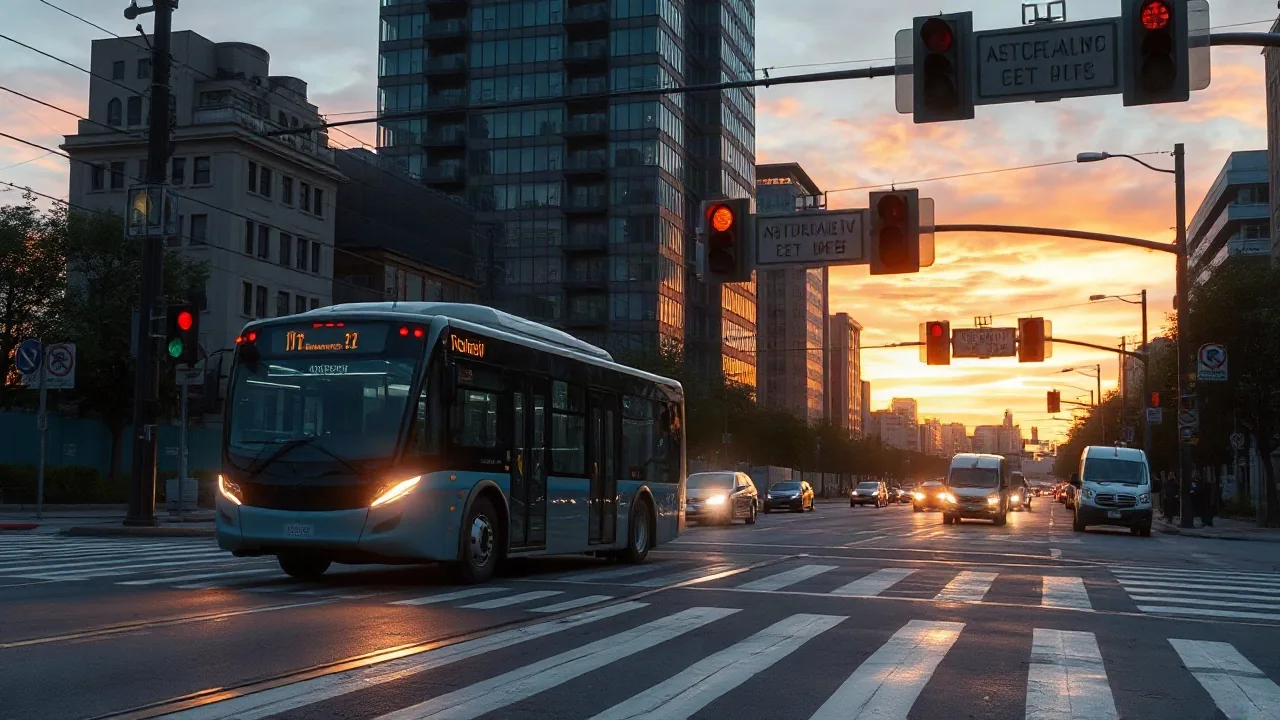
Autonomous shuttle services launched this summer in Miami, Seattle, and Denver, marking a pivotal moment for AI-powered transport in North America. Unlike pilot programs of previous years, these deployments now operate with minimal human oversight, handling rush-hour congestion and edge-case scenarios that once required constant remote supervision. The shift reflects three years of cumulative machine learning improvements in perception, decision-making, and real-time traffic adaptation.
"We're past the point of proving the technology works in controlled conditions," says Dr. Elena Martinez, senior researcher at the Transportation Technology Institute in Cambridge, Massachusetts. "What changed is that neural networks can now process incomplete sensor data, predict pedestrian behavior patterns, and coordinate with city infrastructure. The bottleneck is no longer the vehicle—it's regulatory approval and insurance frameworks."
Autonomous systems in 2026 rely on a tripartite architecture: onboard AI trained on 40 million miles of real-world driving data, cloud-based fleet coordination updating every 500 milliseconds, and localized traffic signal networks that communicate vehicle intent to infrastructure. This convergence is what distinguishes current deployments from earlier attempts.
How AI Reshapes Real-Time Traffic Management
Smart cities infrastructure is evolving in parallel with vehicle automation. In Dallas and Portland, traffic management centers now use predictive algorithms to forecast congestion 45 minutes ahead, adjusting signal timing and rerouting vehicles before bottlenecks form. This differs sharply from reactive systems that responded only after gridlock appeared.
Several mechanisms drive these improvements:
- Vehicle-to-infrastructure (V2I) communication allows autonomous fleets to receive traffic state updates and signal phase predictions in real time.
- Federated learning keeps sensitive location data on vehicles while training shared models at the city level.
- Reinforcement learning algorithms optimize traffic flow by simulating millions of intersection scenarios monthly.
- Sensor fusion across roadside cameras, radar, and connected vehicles creates a unified environmental model.
Austin, Texas implemented a full V2I network across 200 intersections in Q2 2026. Early results show a 22 percent reduction in average commute time and a 31 percent decrease in traffic-related carbon emissions on monitored corridors. The city's autonomous bus fleet, operated by a partnership between a major transit authority and an AI mobility firm, now handles 18 percent of peak-hour passenger trips.
Cost pressures remain real. Roadside infrastructure requires upfront capital spending, and not all cities can justify those investments simultaneously. Smaller municipalities are adopting hybrid approaches, deploying self-driving cars and buses on limited routes while waiting for federal funding mechanisms to mature.
Safety, Liability, and the Path to Scale
The regulatory environment shifted noticeably in 2026. The National Highway Traffic Safety Administration (NHTSA) released updated guidance in March clarifying liability frameworks for autonomous vehicle crashes. Manufacturers now must maintain comprehensive sensor logs and edge-case decision trees that can be audited by third parties. Insurance companies have begun offering autonomous fleet policies, though premiums remain 40-60 percent higher than human-operated vehicles for the first two years of deployment.
Safety metrics are no longer theoretical. Major cities report collision rates for autonomous shuttles at 0.8 incidents per million miles—significantly lower than human-driven vehicles at 4.1 per million miles nationally. However, these numbers are skewed by geofencing: most autonomous fleets operate on fixed routes, in mild weather, during daylight hours. Winter weather testing in Minnesota and upstate New York is now underway to stress-test AI decision-making in snow and ice.
AI advancements in sensor redundancy are critical. New-generation autonomous vehicles use seven independent perception systems—three camera arrays, two lidar units, one radar, and one ultrasonic cluster—that vote on object classification. When systems disagree, the vehicle defaults to conservative behavior: slowing down, increasing following distance, or pulling over safely.
Cybersecurity remains a concern. In July 2026, researchers at Carnegie Mellon University published findings on adversarial attacks against object detection models used in autonomous driving. Within weeks, vehicle manufacturers released firmware patches and announced over-the-air update protocols for all deployed fleets. This responsiveness reflects how seriously the industry now treats attack surface management.
Future mobility providers are also building redundancy into decision-making architecture. Waymo, Cruise, and smaller startups now employ dual-stack AI systems: a primary neural network handles routine decisions, while a secondary rule-based system provides failsafe behavior. This hybrid approach reduces the risk of single-point AI failures that plagued earlier generations.
By September 2026, over 3,500 autonomous vehicles are operating commercially across North America—a threefold increase from two years prior. However, they collectively represent less than 0.01 percent of total vehicle miles traveled. Growth will accelerate as manufacturing scales and unit costs decline, but widespread adoption remains 3-5 years away for most regions.
The convergence of AI transport systems with urban planning, regulatory frameworks, and insurance mechanisms suggests that 2026 marks a transition from prototype to operational reality. The next phase will test whether this technology can scale beyond favorable conditions and into the complexity of real-world mobility networks serving millions of daily journeys.