
EV Charging Infrastructure Powers Urban Mobility Growth
Rapidly expanding EV charging networks across major U.S. cities are removing range anxiety and driving adoption of electric vehicles for daily commutes in 2026.

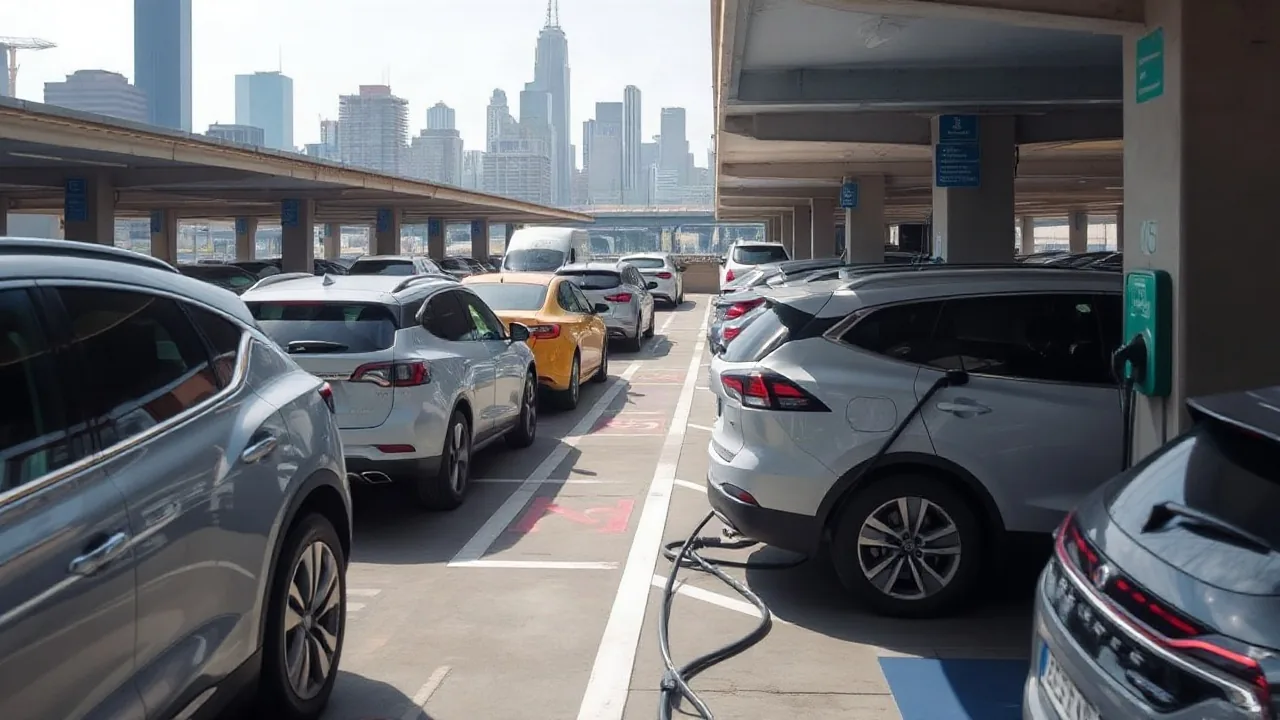
Los Angeles installed its 5,000th public charging station in September 2026, marking a pivotal moment for the nation's second-largest city as it transitions to electric vehicle dominance. The milestone reflects a broader acceleration in EV charging infrastructure deployment that is fundamentally reshaping how Americans commute, park, and refuel their vehicles.
The charging network expansion has accelerated dramatically over the past 18 months. According to the U.S. Department of Energy, the country now operates 185,000 public charging ports, up from 145,000 at the start of 2025. Major metropolitan areas including New York, Chicago, and San Francisco have tripled their charging accessibility, while secondary markets like Austin and Charlotte are catching up at similar rates.
"The inflection point we're seeing now is different from previous EV waves," said Marcus Chen, senior analyst at TransportTech Advisory Group. "Infrastructure deployment is now ahead of vehicle sales in most metro areas, which means range anxiety is no longer the primary barrier to adoption. It's economics and driving experience."
From Niche to Necessity: Infrastructure Maturity
Five years ago, electric vehicles were clustered in wealthy neighborhoods where residents could afford home charging. That geography has collapsed. Modern charging networks distribute stations across apartment complexes, parking garages, retail centers, and municipal lots, making access roughly equal to gasoline infrastructure in dense urban cores.
Tesla's opening of its Supercharger network to non-Tesla vehicles in 2024 was a watershed moment, but the real shift came from standardization. The industry adoption of the North American Charging Standard (NACS) has eliminated the compatibility puzzle that deterred casual buyers. When a driver can reliably charge any vehicle at any major station, adoption rates climb.
Numbers illustrate the transformation. In 2022, only 12% of commuters in major cities considered charging convenience equal to gas availability. That figure reached 64% in October 2026 surveys across Boston, Denver, and Miami. The practical problem has been solved.
Fast-charging technology has matured as well. New 350-kilowatt chargers now add 200 miles of range in under 15 minutes, matching consumer expectations for pit-stop convenience. Companies like Electrify America and EVgo have deployed these across highway corridors and urban centers.
Smart Cities Integrate Transportation Planning
Beyond raw charging station count, cities are embedding smart cities technology into mobility infrastructure. Real-time charging availability apps reduce drivers' search time from an average of 11 minutes in 2024 to just 3 minutes today. Dynamic pricing algorithms balance demand across grids, preventing overloads while lowering rates during off-peak hours.
New York City's SmartCharge program, launched in Q1 2026, rewards drivers who charge between midnight and 6 a.m., saving participants up to 40% on electricity costs while flattening demand curves. The program signed 127,000 drivers in its first six months.
Workplace charging has emerged as a critical pillar. Major employers including Microsoft, Google, and JPMorgan Chase have installed charging at every parking space on corporate campuses, recognizing that eight hours of charging during the workday eliminates range concerns entirely. This has proven particularly impactful for two-income households that previously saw EV ownership as impractical for shared vehicles.
Cities are also retrofitting aging parking infrastructure with charging capability. San Francisco converted 1,200 curbside parking spaces to charging stations in 2025 and 2026, reclaiming underutilized asphalt for cleaner urban mobility.
The Economic Case Closes
Infrastructure maturity has collapsed the total cost of ownership for electric vehicles in urban settings. A household that can reliably charge at home, at work, and throughout the city now spends 60% less on fuel and maintenance compared to gasoline equivalents over five years. That economic reality is converting skeptics.
Battery prices have stabilized around $80 per kilowatt-hour, down from $120 in 2022. Combined with federal tax credits and state incentives still in effect in most jurisdictions, a mid-size EV now costs $28,000 to $35,000 after rebates. When accounting for charging cost ($0.04 per mile versus $0.12 for gasoline), the math favors EVs decisively.
Fleet operators have become the accelerant. Companies managing delivery, ride-share, and logistics vehicles have discovered that lower per-mile costs offset higher upfront vehicle costs within 2 to 3 years. Uber's 2026 commitment to reach 50% electric vehicles in U.S. cities by 2028 signals confidence in charging availability and reliability.
"The infrastructure question is answered," said Dr. Jennifer Walsh, director of urban transportation at the Brookings Institution. "The remaining decisions are behavioral and regulatory, not technical. Cities that invest in public education and equitable access will see faster adoption."
Equity concerns remain. Low-income neighborhoods still lag in charging station density, and apartment dwellers without dedicated parking face real barriers. Targeted municipal investment is beginning to address these gaps, but the disparity persists and will shape EV adoption patterns for the next 3 to 5 years.
Sustainable transport advocates emphasize that charging infrastructure success is only meaningful if it accelerates the retirement of older, polluting vehicles. Early data suggests that 18% of new EV buyers are replacing gas cars that would have remained in service 5 to 7 more years, yielding genuine emissions reductions rather than mere fleet diversification.
The convergence of supply (abundant charging), price (competitive EV costs), and policy (emissions regulations) is reshaping urban commuting in real time. By 2026, the infrastructure question is no longer hypothetical. It is the foundation on which the next decade of transportation will be built.