
NYU Scientists Solve Reverse Sprinkler Puzzle Using 'Silly' Designs
Researchers at NYU's Courant Institute have experimentally resolved a fluid dynamics puzzle first pondered by Ernst Mach and Richard Feynman, using "silly sprinklers" to understand reverse water flow.

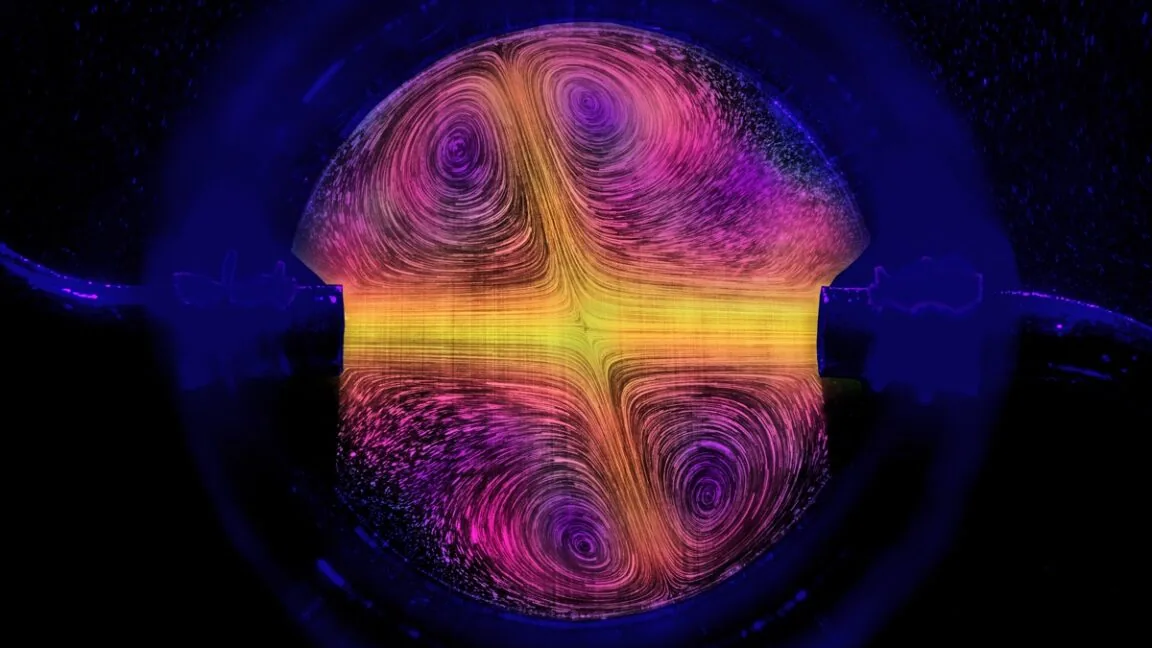
New York University scientists have finally unraveled the complex physics behind the "reverse sprinkler problem," a fluid dynamics puzzle that has intrigued physicists, including Richard Feynman, for decades. Using a series of carefully designed "silly sprinklers" – devices that create whimsical water patterns – researchers observed and modeled how water flowing inward causes rotation, providing new insights into fluid behavior that could inform future engineering.
The problem, which dates back to Ernst Mach's 1883 textbook "The Science of Mechanics," questions how a sprinkler that sucks water in, rather than spraying it out, would behave. While intuition might suggest no rotation, historical debate, including Feynman's own experiments in the 1940s, yielded mixed results, with some suggesting potential for reverse rotation under specific conditions. Experiments since Feynman's time have shown varying degrees of steady, transient, or unsteady rotation, or no rotation at all, leaving the phenomenon unsettled.
In 2024, a team led by NYU mathematician Leif Ristroph built a custom, low-friction sprinkler to meticulously study internal water flow. By injecting dyes and using lasers to visualize the movement of water and microparticles, they captured high-speed video of the sprinkler's behavior under controlled intake rates. These initial experiments, which supported Ristroph's "momentum flux theory," focused on sprinklers with S-shaped arms.
A Deeper Dive with Whimsical Designs
The latest research, published in the Proceedings of the National Academy of Sciences in 2026, extends these findings by examining the "silly sprinklers" themselves. These playful devices, designed to produce interesting water loops and spirals, provided a unique testbed for understanding reverse fluid dynamics. Ristroph and colleagues tested these designs in both forward (water spraying out) and reverse (water being sucked in) modes. The observations consistently supported Ristroph's momentum flux theory, which posits that internal jets colliding within the chamber generate the torque for reverse rotation, much like an "inside-out rocket." This contradicts earlier hypotheses by Mach and Feynman, who had suggested opposing forces or specific vortex formations might dictate the outcome.
The experiments revealed that the shape of the sprinkler's arms plays a crucial role in controlling the water jets and, consequently, the resulting torque and rotation. The team developed specific design guidelines based on their findings, offering engineers a clearer understanding of how to manipulate fluid flows for desired outcomes. "Our findings provide a firmer understanding of how components respond to fluid flows—knowledge that can guide future engineering and technological advances for devices, such as turbines, that convert these flows into energy," stated co-author Brennan Sprinkle of the Colorado School of Mines.
This work continues a pattern of Ristroph's lab tackling real-world, often whimsical, scientific puzzles. Previous studies from his lab have investigated topics ranging from the optimal recipe for bubbles to the complex aerodynamics of paper airplanes. In 2021, his team explored the formation of "stone forests," and later that year, they built and tested a working Tesla valve, measuring its fluid dynamics. In 2022, Ristroph examined the factors contributing to a well-gliding paper airplane, further showcasing the lab's diverse research interests at the intersection of physics and everyday phenomena.