
River Networks Follow Universal Mathematical Laws, New Study Confirms
Rivers, like veins and tree branches, exhibit complex yet predictable mathematical patterns. A 2026 study highlights how these natural drainage systems obey universal laws, revealing insights into chaotic Earth processes.

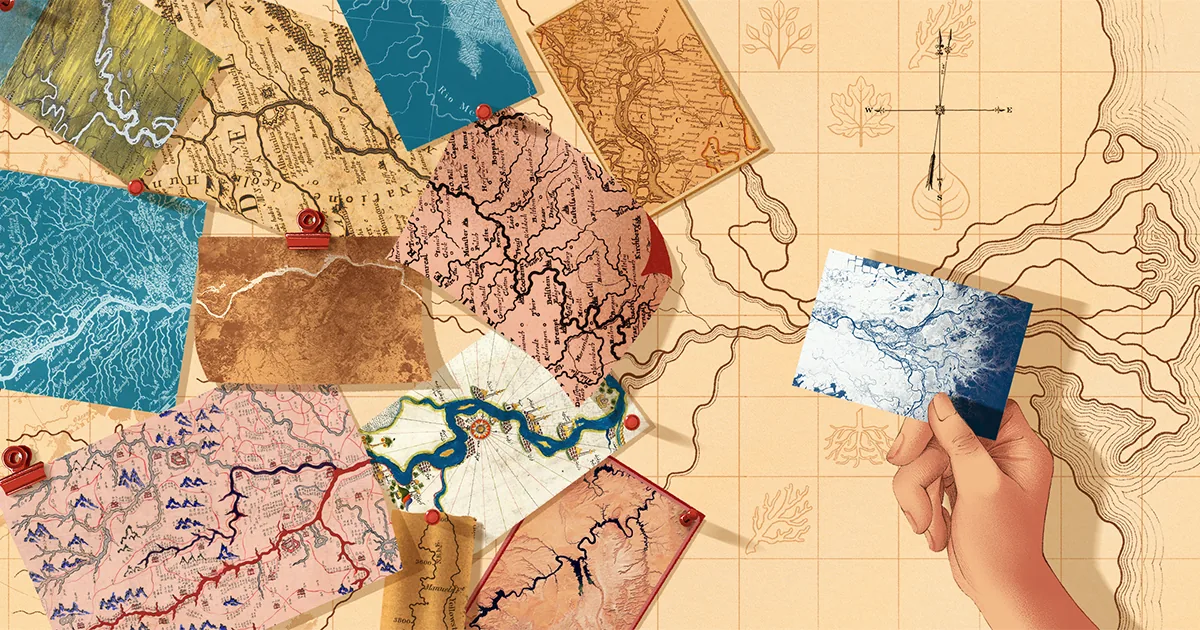
Rivers across the globe, from the meandering Blanco River in Texas to vast global networks, exhibit a surprising mathematical uniformity. These natural drainage systems, observed to resemble tree branches, blood vessels, and urban transit maps, all share a common branching structure that transports fluids to a central point. Scientists have long been fascinated by this ubiquitous pattern, with new research in 2026 further illuminating the underlying mathematical principles governing their formation.
The study reignited curiosity about the universal form and mathematical nature of river networks. While often perceived as chaotic, river systems are now understood to obey simple, universal laws. This phenomenon was a significant area of study in the 1980s and 1990s, when rivers were investigated as natural examples of "fractals"—mathematical objects exhibiting self-similarity across different scales. Geomorphologists, the scientists who study the Earth's surface and its transformations, have been analyzing the geometry of river networks for well over a century, with early research dating back to the late 1800s.
The Mathematics of Drainage
Chris Paola, a river scientist at the University of Minnesota, notes the captivating duality of these branching networks. "The shapes of rivers and leaf vasculature and so on — branching networks — you can just about grasp the pattern, but it’s still chaotic, so there’s something fascinating with that," he stated. These systems function as fundamental transport networks, efficiently moving a fluid substance—be it water, blood, or traffic—from numerous origin points to a single destination. Rivers, in particular, offer a unique window into these principles, as they emerge not from biological evolution or deliberate urban planning, but from the complex, often unpredictable processes of the Earth itself. Yet, despite their chaotic origins, they consistently adhere to elegant mathematical rules.
Every parcel of land on Earth receives precipitation, and a significant portion of this water inevitably flows into rivers, which then serve as the planet's essential drainage system, guiding water towards oceans and lakes. The intricate geometry of these systems has been a subject of intense scientific scrutiny for decades. While many specific behaviors of rivers are still subjects of active investigation, the cumulative body of research has provided a robust foundational understanding. The elegance of the mathematics involved, coupled with the intuitive nature of the underlying geophysics, continues to inspire a sense of wonder among researchers.
The research into river networks underscores a fundamental principle in natural systems: the emergence of order and predictability from apparent chaos. The mathematical models developed to describe these phenomena, often rooted in fractal geometry, allow scientists to predict how landscapes will evolve and how water will flow, even in complex terrains. This understanding is crucial not only for academic curiosity but also for practical applications such as flood control, water resource management, and understanding the long-term impacts of climate change on drainage systems worldwide. The consistent adherence to mathematical laws by these dynamic natural features highlights a deep, underlying order in the Earth sciences.