
Google Pixel 11: Refined Design, Familiar Features Raise Questions
Google's latest Pixel 11 smartphone series boasts sleek designs and impressive screens, but makes few hardware advancements, leading to questions about innovation.

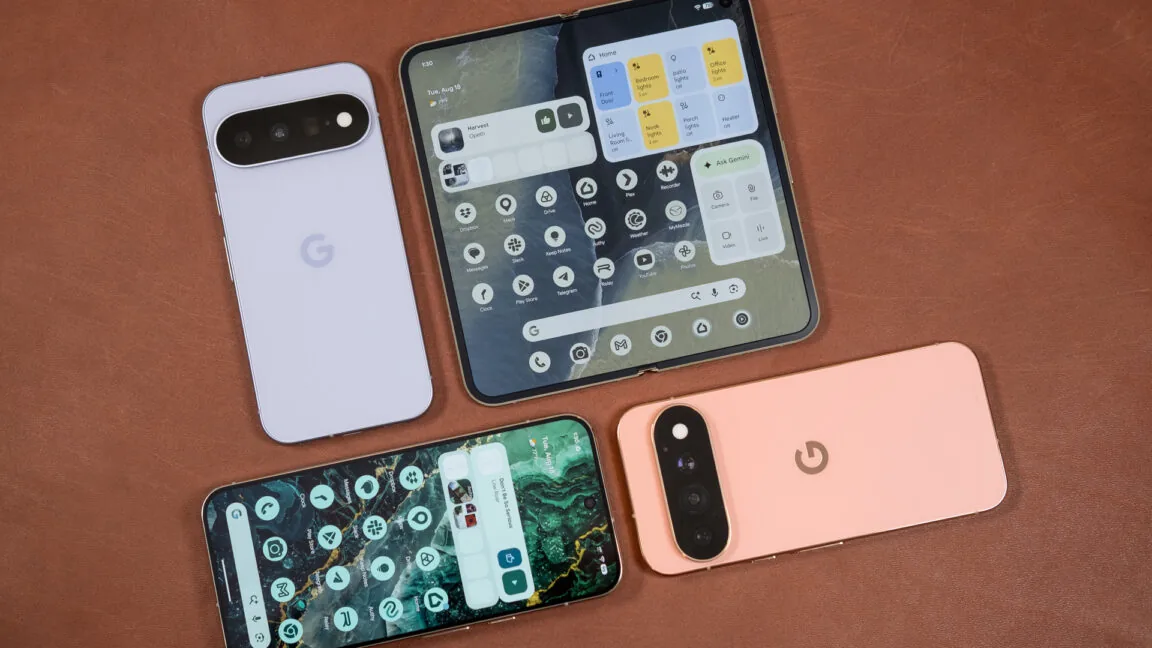
Google's new Pixel 11 series, released on August 19, 2026, offers a refined user experience with sleek designs and advanced software features. Despite incremental hardware updates and competitive pricing, the phones present a familiar aesthetic, prompting discussion about the evolution of Google's smartphone strategy in a less crowded market.
The Pixel 11 lineup comprises three flat models and one foldable, with the flat variants featuring nearly identical aluminum and glass sandwich designs to their predecessors. While aesthetically pleasing, the minimal physical changes have led some to question Google's commitment to hardware innovation. This year, the hardware has even seen regressions in specific areas. The base Pixel 11 starts at $899, the Pixel 11 Pro at $1,099, the Pixel 11 Pro XL at $1,299, and the foldable Pixel 11 Pro Fold at $1,899. All models are powered by the Google Tensor G6 system-on-chip and come with 12GB or 16GB of RAM. Storage options range from 256GB up to 1TB for the Pro models.
The displays across the Pixel 11 series are a highlight, offering vibrant visuals with up to 3600 nits peak brightness on the Pro models and a 120Hz adaptive refresh rate. Google claims these OLED screens are twice as scratch-resistant as previous generations. However, the Pixel 11 Pro Fold's internal screen remains notably reflective due to its plastic top layer, an issue that rivals like Samsung have begun to address more effectively in their foldable devices.
HiLight Module Sparks Controversy
A new addition to the Pixel 11 Pro phones is the HiLight module, an LED ring integrated into the camera flash. Designed to function like an old-fashioned notification LED, it primarily indicates when Google's Gemini AI is active or listening. It also signals incoming calls from favorite contacts, but only when the phone is face down. This limited functionality has been met with criticism, with many questioning its utility and lamenting the lack of features found in basic notification LEDs from two decades ago. "HiLight has been so hobbled that it might as well not exist," one review noted, suggesting that Google's approach to adding features is unnecessarily slow.
Battery life and charging also vary across the lineup. The base Pixel 11 features a 4,985 mAh battery with up to 30W wired charging and 25W wireless charging via Pixelsnap. The larger Pixel 11 Pro XL boasts a 5,115 mAh battery with up to 45W wired charging, while the Pro and Fold models have slightly smaller batteries but retain the same charging speeds. Connectivity is robust, with Wi-Fi 7, Bluetooth v6, and advanced 5G capabilities on the Pro models, alongside the standard USB-C 3.2 port.
The Pixel 11 Pro Fold, while thinner than its predecessor, still feels bulkier compared to competitors like the Samsung Galaxy Z Fold 8 Ultra. Its unfolded screen exhibits a noticeable crease, a drawback compared to the increasingly seamless displays of rival foldables. Despite these critiques, Google has focused on durability, with the Pixel 11 Pro Fold achieving an IP68 water and dust resistance rating and employing a new glass fiber composite back panel designed for extreme resilience.
The software experience on the Pixel 11 series runs Android 17, offering Google's clean and integrated approach to the operating system. Unlike some competitors, Pixels avoid excessive bloatware or sponsored content, providing a streamlined experience for users invested in the Google ecosystem. This consistent software polish, combined with the refined hardware, positions the Pixel 11 as a strong contender in the premium smartphone market, even as questions linger about the fading magic of Google's innovation.