
GPM J071507−114153 White Dwarf Emits Radio Pulses Every 8 Minutes
Astronomers have traced mysterious eight-minute radio pulses to a cosmic binary system containing a white dwarf and a sun-like star.

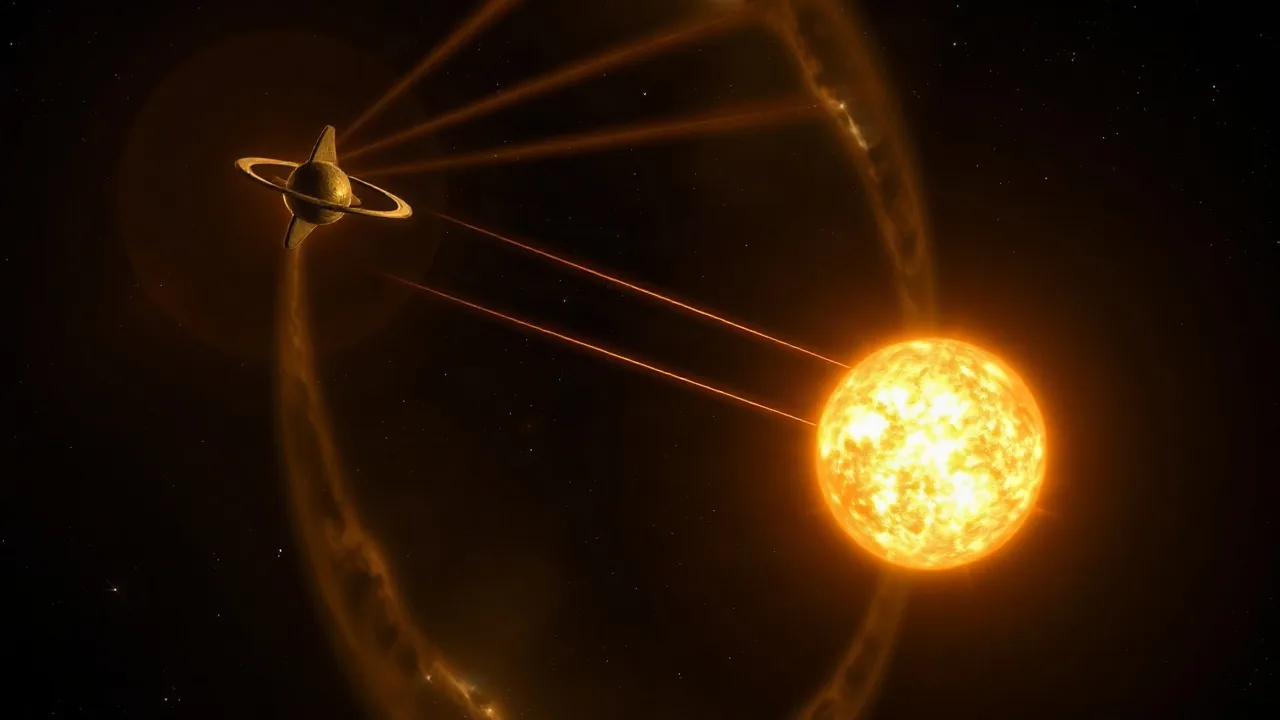
Astronomers have successfully traced a mysterious repeating radio signal back to a celestial pair consisting of a dead star known as a white dwarf and its stellar companion, a sun-like star. Located roughly 5,000 light-years away, the newly identified binary system has been designated as GPM J071507−114153.
Within this system, the white dwarf completes a spin once every eight minutes, emitting consistent radio pulses. While similar repeating signals have previously been documented in binary systems containing smaller and cooler red dwarf stars, finding such activity in a system like this remains unusual. The celestial object falls under a category referred to as long-period transients, or LPTs, which produce radio emissions that toggle on and off across intervals ranging from minutes to hours. Since the research team identified the first such object in 2021, approximately a dozen LPTs have been detected.
Although several previously known LPT systems feature both a white dwarf and a companion star, determining which of the two bodies generated the radio pulses had remained unclear. The identification of GPM J071507−114153 and the localization of the pulses near the white dwarf mark an important step in clarifying how these systems operate.
“This is the first time the pulses are clear enough to see the white dwarf moving in its orbit around its companion,” team leader and commissioning scientist with the Square Kilometre Array Observatory SKA, Sam McSweeney, said in a statement.
McSweeney added that this clarity confirms the pulsations originate from a region close to the white dwarf or potentially from the white dwarf itself.
Stellar Flares and Observations
The detected pulses additionally enabled researchers to spot stellar flares erupting from the sun-like companion star.
“As a bonus, we also saw the white dwarf moving behind a region with a strong magnetic field, most likely a 'stellar prominence,' which is a large loop of plasma erupting from a star's surface,” team member Natasha Hurley-Walker of the International Centre for Radio Astronomy Research ICRAR, Curtin University, Australia, said.
Hurley-Walker noted that detecting storms on a star located over 5,000 light-years away using radio wavelengths is remarkable. The team utilized the Murchison Widefield Array to scan the Milky Way visible from Australia, followed by the MeerKAT radio telescope in South Africa to establish its precise position. Confirmation was subsequently achieved utilizing the W.M. Keck Observatory on Maunakea in Hawaii, which verified that the companion star is a G-type star comparable to the sun. Both MeerKAT and the Murchison Widefield Array serve as precursors for the Square Kilometre Array project.
“If we are already making such discoveries with precursor telescopes, just imagine how many more star systems we will be able to find, and what a beautifully detailed view of their signals we will have, once the SKA telescopes are completely built,” McSweeney said. The findings were published in the journal Nature Astronomy.