
Honor's Gimbal Phone Experiment Delivers Impressive Stabilization
Honor's new "Robot Phone" integrates a tiny, three-axis gimbal directly into the device, offering advanced stabilization for smartphone videography.

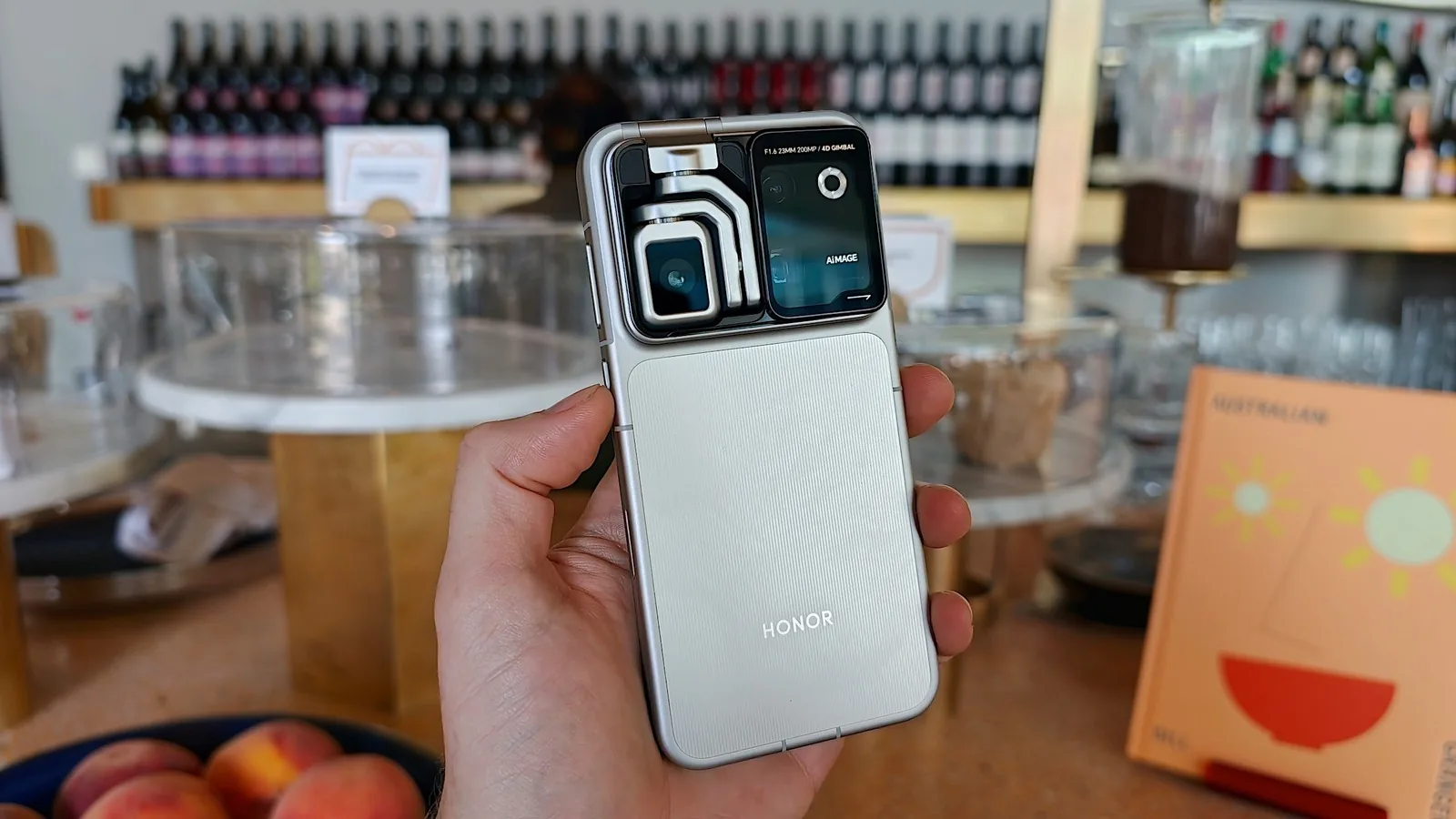
Honor has unveiled an ambitious new flagship smartphone in China, dubbed the "Robot Phone," which bravely integrates a miniaturized, three-axis gimbal directly into its chassis. Revealed earlier this year at MWC 2026 in Barcelona, this experimental device aims to eliminate the need for separate camera stabilizers, a move that could significantly appeal to mobile content creators. While currently exclusive to the Chinese market, the phone's innovative approach to mobile photography is generating considerable interest.
The standout feature is the world's smallest gimbal motor, developed by Honor itself, weighing just 2.6 grams. This tiny mechanism folds discreetly into a compartment on the phone's rear, allowing for a more streamlined design, though the device measures a still-substantial 9.6mm in thickness. When deployed, the gimbal provides three-axis stabilization for the phone's 200-megapixel primary camera. This main sensor, which also functions as a traditional camera when the gimbal is stowed, boasts an f/1.6 aperture and optical image stabilization (OIS). The phone further includes a 200MP telephoto lens with 2.7x optical zoom and a 50MP ultra-wide camera, alongside a 50MP front-facing camera.
Advanced Gimbal Features and User Experience
Activating the gimbal requires a manual slide of its protective cover, followed by launching an app. The arm then extends with a visual flourish, showcasing the internal mechanics. While the phone includes a "Robot" Yoyo AI assistant, its full functionality is currently limited to China. The primary focus for many users will undoubtedly be the camera capabilities. The integrated gimbal transforms the smartphone experience, offering a familiar interface for adjusting settings and shooting modes, a significant advantage over handling separate gimbal accessories.
Honor has incorporated several AI-guided shooting modes, including an impressive 180-degree video spin shot. The "super-steady" mode proved remarkably effective, maintaining stable footage even during vigorous movement, such as bouncing through London's King's Cross station. A notable benefit is the ability to shoot horizontal video while holding the phone vertically. However, the system's subject tracking occasionally prioritized unintended subjects, indicating a learning curve for optimal use. Honor collaborated with cinematic camera company ARRI on the user interface and included ARRI's LogC3 format for professional-grade video editing, allowing users to apply LUTs (Look-Up Tables) in real-time during capture.
The shooting experience effectively bridges the gap between using a standard smartphone and a dedicated gimbal. Users can adjust tracking speed and manually control the gimbal's angle via an on-screen joystick. The ability to track both humans and inanimate objects surpasses the capabilities of some external smartphone gimbals. Despite the miniaturized components, the stabilization performance is robust, with the super-steady mode proving particularly useful in demanding scenarios.
However, the Robot Phone is positioned as a premium, early-adopter product, a proof-of-concept with a significant price tag. Retailing for 9,999 yuan (approximately $1,500) in China, its cost is expected to be higher if it were to launch internationally. This positions it as a considerable investment, potentially exceeding the combined cost of a separate gimbal and a standard flagship phone. Durability is another consideration, as mechanical moving parts inherently introduce a risk of failure. The device offers IP54 dust and water resistance, but only when the gimbal is fully retracted, offering limited protection to the mechanical components themselves.