
Origami Rover Wheels Aid Moon Lava Tube Exploration
Engineers have developed innovative origami-inspired wheels designed to navigate the challenging terrain of lunar lava tubes. These flexible wheels promise enhanced mobility for future moon exploration missions.

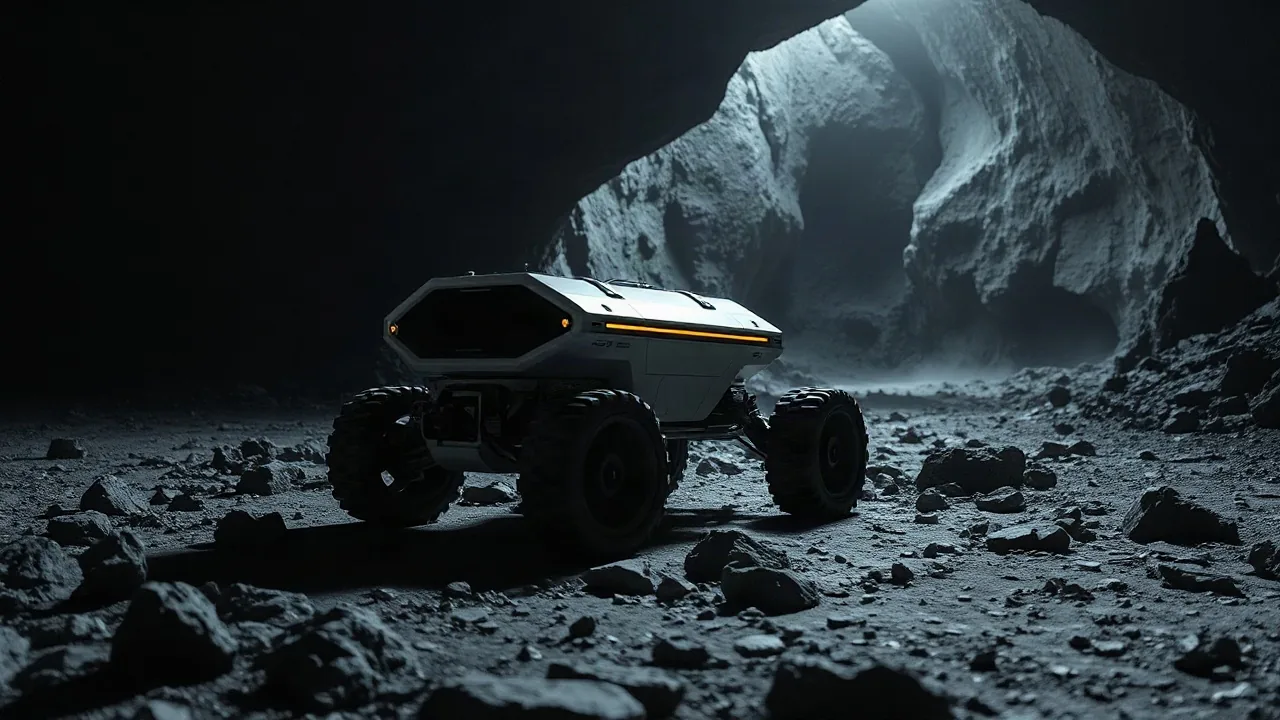
Engineers at the Korea Research Institute of Standards and Science (KRISS) have developed a novel set of origami-inspired wheels that could revolutionize how rovers explore the Moon, particularly its vast lava tubes. Unveiled recently, these unique wheels offer unprecedented flexibility and adaptability, addressing the long-standing challenge of traversing uneven and hazardous extraterrestrial terrain.
The concept draws inspiration from the Japanese art of paper folding, origami, to create a wheel that can dynamically change its shape and rigidity. Unlike traditional rigid wheels, these innovative designs can expand and contract, allowing them to absorb shocks, conform to irregular surfaces, and potentially even squeeze through narrow openings. This adaptability is crucial for navigating the complex and often unpredictable environments found within lunar lava tubes, which are large underground caverns formed by ancient volcanic activity and are considered prime targets for future scientific exploration and resource utilization.
Transforming Lunar Mobility
Lunar lava tubes, extending for kilometers beneath the Moon's surface, offer potential shelter from radiation and extreme temperature fluctuations, making them attractive sites for future human bases. However, their interiors are typically characterized by rugged floors, sharp obstacles, and steep inclines, posing significant difficulties for conventional wheeled robots. The KRISS team's origami wheels, however, are designed to overcome these obstacles. The wheels can adjust their diameter and stiffness in real-time, enabling a rover to maintain traction on loose regolith while also being able to compact itself to fit through tighter spaces.
Dr. Kim Min-cheol, the lead researcher on the project, stated, "Our goal was to create a wheel that behaves less like a rigid disk and more like a deformable, intelligent structure." He explained that the current prototypes are made from durable, lightweight composite materials capable of withstanding the extreme conditions of space. "The folding mechanism allows for a significant reduction in the wheel's effective diameter without compromising its load-bearing capacity," Kim added. This ability to 'shrink' is a significant advantage for accessing areas previously thought to be impassable.
The development is part of a broader effort to enhance the capabilities of robotic explorers. Current lunar rovers often rely on sophisticated suspension systems and robust wheel designs, but they can still become immobilized by unexpected terrain features. The new origami-inspired wheels could reduce the need for such complex mechanical systems by incorporating the adaptability directly into the wheel's structure. This could lead to lighter, more energy-efficient, and more resilient robotic explorers capable of undertaking longer and more ambitious missions.
Beyond lava tubes, the technology holds promise for exploration on other celestial bodies, including Mars, which also features extensive volcanic landscapes and subsurface caves. The ability to adapt to various terrains could significantly expand the operational range and scientific return of future planetary missions.
KRISS is reportedly working on further testing and refining the design, with plans for potential deployment on future lunar missions. The successful implementation of these origami wheels could mark a significant leap forward in the field of extraterrestrial exploration robotics.