
Milky Way Galaxy Structure Challenged by New Star Formation Shock Discovery
A recent study published in Nature Astronomy reveals that a rotating structure in the Milky Way drives enormous shock fronts, questioning the galaxy's spiral structure.

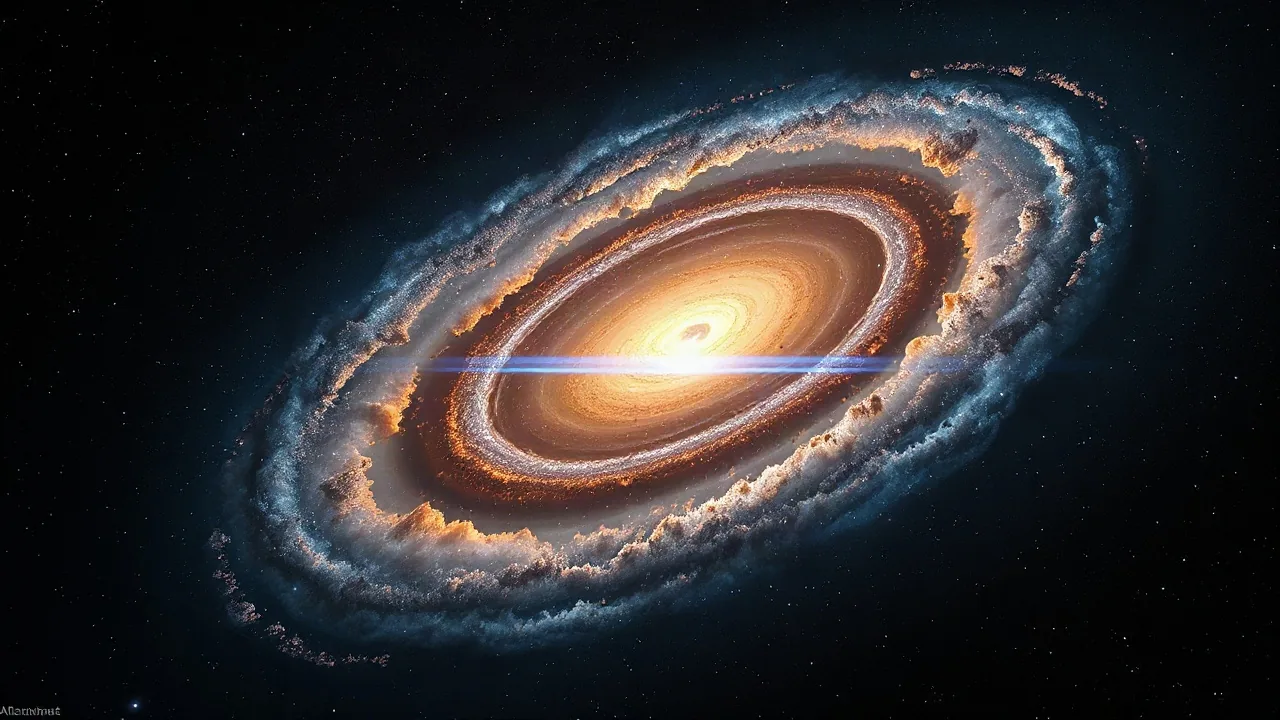
A recent discovery regarding a galactic shock wave is challenging our understanding of the Milky Way's structure and raising questions about the existence of the Norma spiral arm. The findings were uncovered by Dr. Hillary Davis, who recently completed her Ph.D. at the University of Sydney's School of Physics and Sydney Institute for Astronomy. Published in Nature Astronomy on November 20, 2026, the research shows that a vast rotating structure of stars near the center of our galaxy drives massive shock fronts through gas clouds, creating conditions for new stars to form in an unusual way compared with nearby galaxies.
Dr. Davis explained the mechanics of the discovery, stating, “At its heart, star formation is a process we understand from everyday physics. Forces set matter in motion. In this case, gas is compressed, and that compression can create the conditions for new stars to be born on a massive scale.” She added, “In most similar galaxies, star formation very commonly occurs along spiral arms. What's extraordinary is seeing this happen in a different region of our galaxy, where shocks are usually so strong that star formation is often suppressed.”
Understanding the Galactic Bar and the Norma Arm
The Milky Way is categorized as a barred spiral galaxy, featuring an elongated concentration of stars at its center known as the galactic bar. This bar rotates and exerts gravitational forces on surrounding gas, creating powerful shock fronts. Because dust obscures the view from Earth, the bar's properties have been intensely debated for decades. By comparing computer simulations of galaxies evolving over billions of years with astronomical observations of masers—concentrated microwave emissions associated with massive star formation—the researchers found that masers previously linked to the Norma arm closely align with the predicted shock front.
“We found that masers previously associated with the Norma arm closely align with the shock front predicted by our simulations,” Dr. Davis noted. “This suggests that at least part of the so-called Norma arm may not be a spiral arm at all, but a region of star formation along the leading edge of the galactic bar.” She further explained, “This raises questions about the galaxy's spiral structure and the bar region of the Milky Way, which needs further investigation.”
The study also provides new evidence regarding the dimensions and rotation of the central bar, which researchers estimate extends approximately 4.3 kiloparsecs, or about 14,000 light-years, from the galactic center along its long axis. “Our findings place further constraints on the size, angle and rotation speed of this central bar,” Dr. Davis concluded. “By comparing a new generation of large-scale computerized galaxy simulations, evolving over billions of years, against a more limited set of observations, we now have a stronger understanding of the bar and star formation processes in the Milky Way.”