
Firefox Smart Window Enhances AI Browsing with Web Data & Citations
Firefox's Smart Window beta now integrates live web data and provides source citations for AI chat responses through a partnership with Exa. New features also include AI-driven tab grouping and visual history previews.

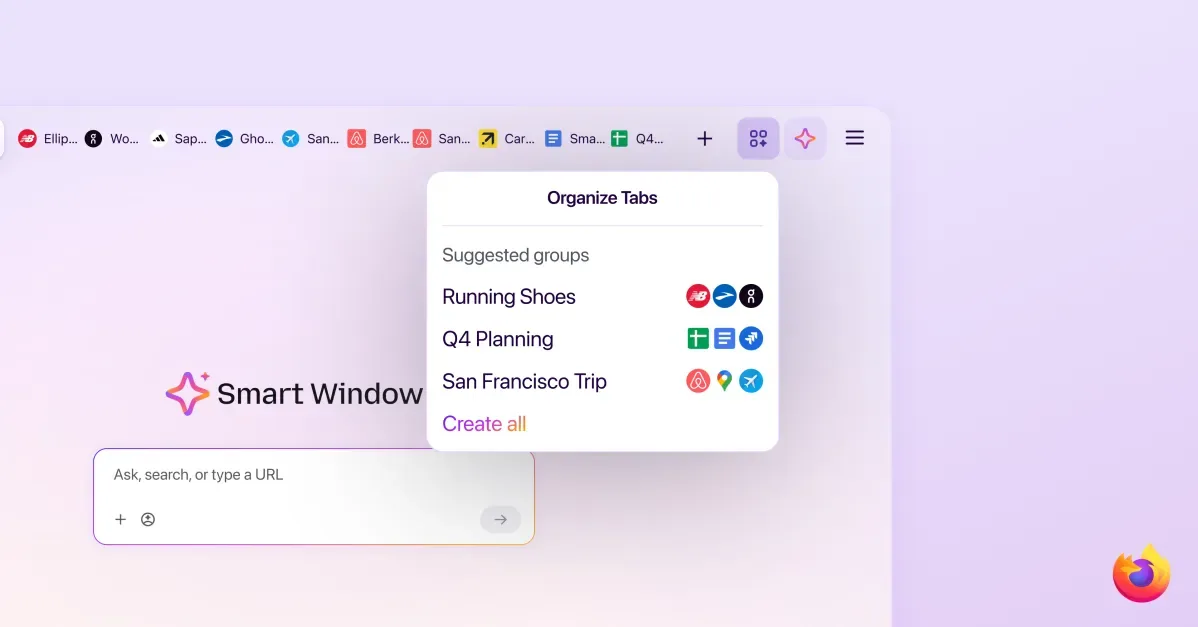
Mozilla's Firefox browser is rolling out significant enhancements to its experimental Smart Window AI feature, integrating real-time web data and offering source citations for its AI chat responses. This update, developed through a partnership with search technology company Exa, aims to provide users with more reliable and verifiable AI-generated information directly within their browsing experience. The Smart Window also gains the ability to automatically suggest relevant tab groups and display visual previews of previously visited pages when searching browsing history using natural language. Early feedback from beta users indicates these improvements help them maintain their train of thought more effectively.
During a demonstration, the Smart Window AI showcased its capability to sift through a user's browsing history, identifying specific items like previously viewed running shoes. It then presented visual snapshots pulled from those visited sites, offering a powerful way to resurface forgotten information. Beyond just recalling past browsing, the system can also intelligently identify and close duplicate tabs within suggested groups, thereby streamlining organization and reducing clutter. This shift from solely presenting new search results to actively organizing and referencing existing user data marks a notable evolution for the browser's AI integration.
Contextualizing AI in the Browser Experience
Mozilla's approach with Smart Window is to offer advanced AI capabilities as an opt-in feature, ensuring users have control over their browsing environment. Ajit Varma, head of Firefox, emphasized this philosophy in an interview, stating that the company is pursuing an "agnostic" stance on AI integration. Unlike other browsers that might prioritize LLM queries, Firefox aims to enhance the core browser and user experience. "We’re looking at making sure that there is a possibility for digital sovereignty, so you can choose local AIs and AI from companies that are maybe based in your region that have different views than maybe some of the big tech companies," Varma explained, highlighting a commitment to user choice and privacy.
Future iterations of Smart Window are planned to introduce features akin to Chrome's recent browsing journey surfacing and AI-powered autofill for online forms. While the feature remains in beta with no precise public release date confirmed, its development is guided by user feedback. For instance, the addition of a top navigation bar within Smart Window directly addressed requests from beta testers. This user-centric development cycle underscores Mozilla's dedication to refining the feature based on practical application and user needs.
Firefox is providing users with a selection of AI models to power Smart Window, including options like Google's Gemini 3.1 Flash Lite, OpenAI's oss-gpt-120b, Alibaba's Qwen3-235B-A22B-Instruct-2507, and the possibility of using local AI models. Steve Truong, senior staff product manager for Firefox AI, assured that all chosen models operate under strict zero-data-retention contracts. This ensures that third-party providers process user prompts only in memory, without storing data for model training, advertising, or human review. Mozilla itself also refrains from retaining user chats on its servers without explicit user permission, reinforcing a strong stance on privacy and data security. This careful curation of AI partnerships and data handling policies reflects a broader strategy to build trust and offer a secure, user-controlled AI browsing tool, empowering individuals to navigate the web with greater efficiency and confidence.