
Ugreen Launches Local AI Smart Home Hubs for Enhanced Privacy
Ugreen has introduced a new line of smart home devices centered around local AI hubs, aiming to compete with Amazon and Google by keeping user data off the cloud. The AIoT ecosystem includes hubs, cameras, a smart speaker, and a unique picture frame.

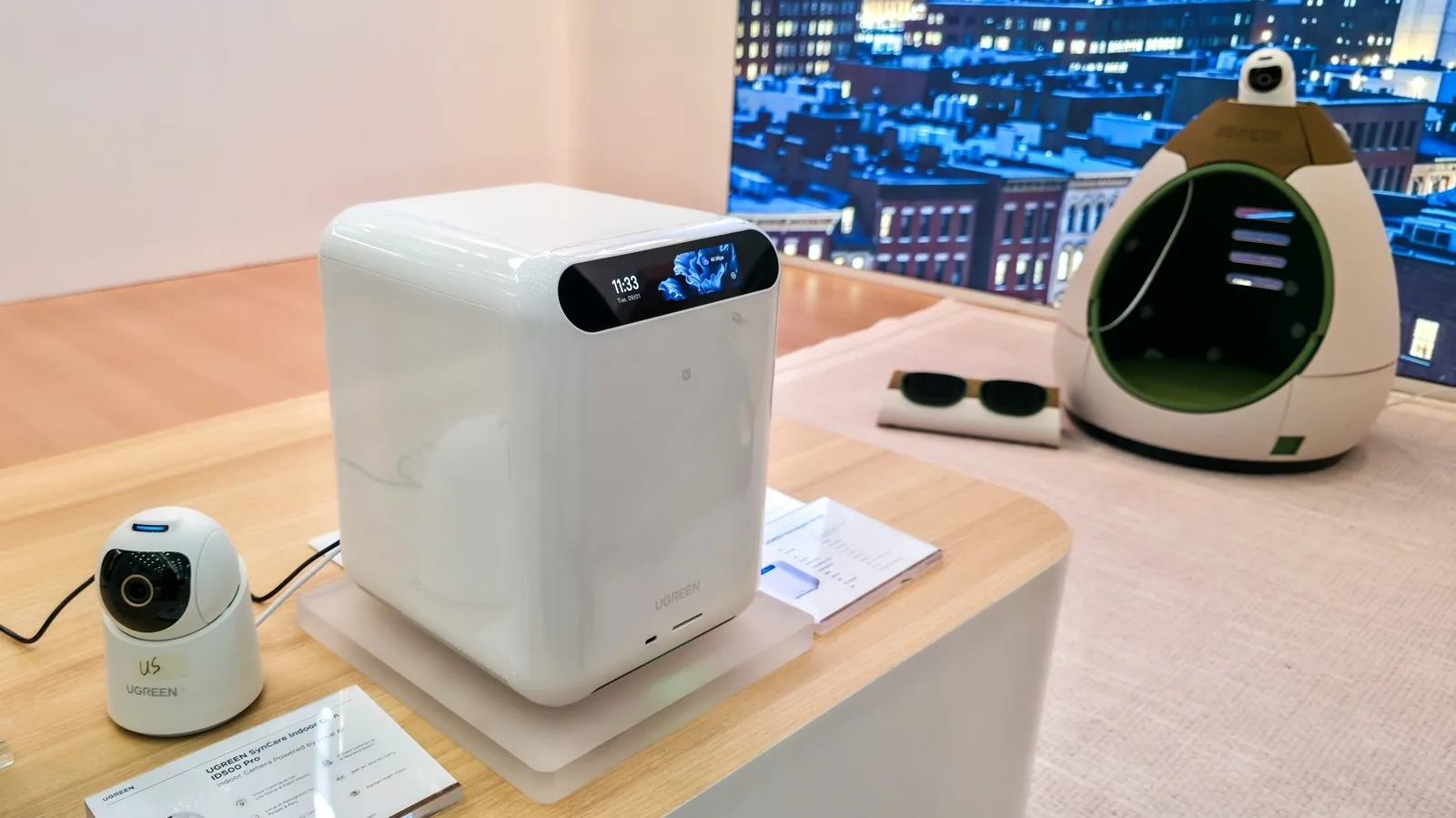
Ugreen officially entered the local artificial intelligence market on September 4, 2026, with the debut of its smart home product lineup. Leading the collection are HomeAgent and MasterAgent, new smart home hubs powered by local AI and built on ARM architectures. The company announced these hubs, alongside three new security cameras, a smart picture frame, and a smart speaker, at a launch event held at Gillette Stadium in Foxborough, Massachusetts. Ugreen's strategy is to offer smart home features comparable to those from major players like Amazon and Google, but with a strong emphasis on user privacy by processing sensitive data locally rather than sending it to the cloud.
This new "AIoT" line marks a significant expansion for Ugreen, a company more widely recognized for its accessories such as fast chargers, USB cables, and network-attached storage (NAS) devices. The smart home ecosystem aims to differentiate itself through its privacy-first approach. The HomeAgent hub comes in two models: the baseline HA100 and the more powerful HA100 Pro. The standard HA100 provides essential features like rule-based automation for home routines, object recognition, and device command control. The HA100 Pro builds upon these capabilities, enabling it to understand motion, infer user behavior, and allow for the creation of automation rules using natural language voice commands. Internally, the HA100 utilizes an RK3588 platform with 16GB of LPDDR5 memory and a combined 26 TOPS of AI performance. The HA100 Pro features the more advanced CIX-CP8180(P1) SoC, doubles the RAM to 32GB, and achieves 205 TOPS.
For users requiring even greater processing power for demanding AI models, Ugreen is introducing the MasterAgent MA100, a flagship hub. This high-end device runs on the Nvidia Jetson Thor platform, a Blackwell system-on-module with 128GB of unified memory, and offers up to 2,070 TOPS of AI performance. This unit is positioned as a compact, living-room-friendly AI server. Ugreen is emphasizing that this local processing comes at a premium, with the HA100 retailing for $1,799 (early bird $899), the HA100 Pro for $5,999 (early bird $2,999), and the MasterAgent MA100 for $20,000 (early bird $10,000). Ugreen NAS community manager Thomas Brown suggested during a panel at the launch that the long-term savings from running local AI models, compared to cloud inference costs, would justify the initial investment, alongside potential reductions in cloud storage expenses. However, the substantial upfront cost presents a significant barrier.
Expanding Connectivity and Device Integration
The new Ugreen hubs are designed for broad compatibility, working out of the box with ONVIF and Matter-compatible devices. According to product planning manager Markus Xie, support for Zigbee and Thread protocols is also planned. This interoperability means users can integrate devices from competitors, including Anker, whose subsidiary Eufy also announced a rival AI-powered smart home hub on the same day. Notably, Ugreen's system does not currently offer official support for Home Assistant, a popular open-source platform that is available on Anker's hub. Similar to Ugreen's NAS offerings, users will need to provide their own SATA hard drives for storage expansion, with additional slots for M.2 and SD cards. Connectivity options include HDMI, Ethernet, and various networking ports.
During the launch event, a single functional model of the HomeAgent was demonstrated, showcasing control of smart curtains and lights. However, more advanced features, such as voice-based rule creation, were not publicly demonstrated. Among the most anticipated products are three SynCare branded security cameras: the Indoor Cam ID500 Pro, the PoE Cam OD600 Pro, and the Battery Cam OD800 Pro. These cameras appear to be the final versions of models first previewed at CES earlier in 2026, with a release slated for the latter half of the year. Features like facial recognition and package detection, often requiring cloud processing from providers like Ring or Nest, are emphasized for local execution in Ugreen's SynCare cameras. Xie confirmed that any remote access will utilize end-to-end encryption, with local data secured by AES-256 encryption. A demonstration at the event showed the camera's security capabilities, including escalating warnings and an audible alarm when an individual approached a door, identifying them as a trespasser.
Ugreen also highlighted non-security applications for its cameras. In a promotional video, New England Patriots cornerback Christian Gonzalez, a newly appointed global brand ambassador for Ugreen, was shown using the indoor camera to capture candid family moments. This concept of cameras continuously recording and identifying highlights, even if processed locally, raises privacy considerations for some users. The SynCare cameras are priced at $149 for the ID500 Pro (early bird $89), $269 for the OD600 (early bird $159), and $399 for the OD800 Pro (early bird $199).
The smart home ecosystem includes a voice assistant named Uliya, accessible through the Smart Speaker for Uliya. This speaker features a fabric-coated design and an LED ring, functioning as both an audio playback device and the primary interface for the HomeAgent. The wake word, "Uliya," is intended to be distinct enough to avoid accidental activation. The speaker will retail for $99 (early bird $69). A unique addition is the 13.3-inch color E-Ink picture frame, the Ugreen Gallery. While E-Ink is well-suited for low-power displays, its current functionality is limited to displaying photos, mimicking the look of traditional prints. It is priced at $439 (early bird $299).
The Ugreen AIoT products are being launched via Kickstarter, with direct pre-orders for HomeAgent and MasterAgent running from September 3 to October 27, 2026, followed by the crowdfunding campaign. The rest of the product line will become available later. Ugreen plans to begin shipping in January 2027. While the platform promises robust local AI capabilities for users with compatible smart devices, especially those prioritizing privacy, the high initial cost of entry is a significant factor. The availability of review units was limited, and real-world performance remains to be seen. Given the challenges faced by existing AI-powered smart home systems, such as those from Google Gemini or Amazon Alexa, potential users might anticipate a learning curve and occasional frustrations. However, Ugreen appears to be targeting consumers interested in actively customizing and managing their smart home intelligence, recognizing a market demand for truly private AI solutions in the consumer electronics space.