
Astronauts Conduct All-Female Spacewalk to Repair ISS Camera, Docking Aid
Two astronauts completed a spacewalk on September 1, 2026, to replace a critical camera and docking aid on the International Space Station. The mission faced a minor mobility issue with one astronaut's suit.

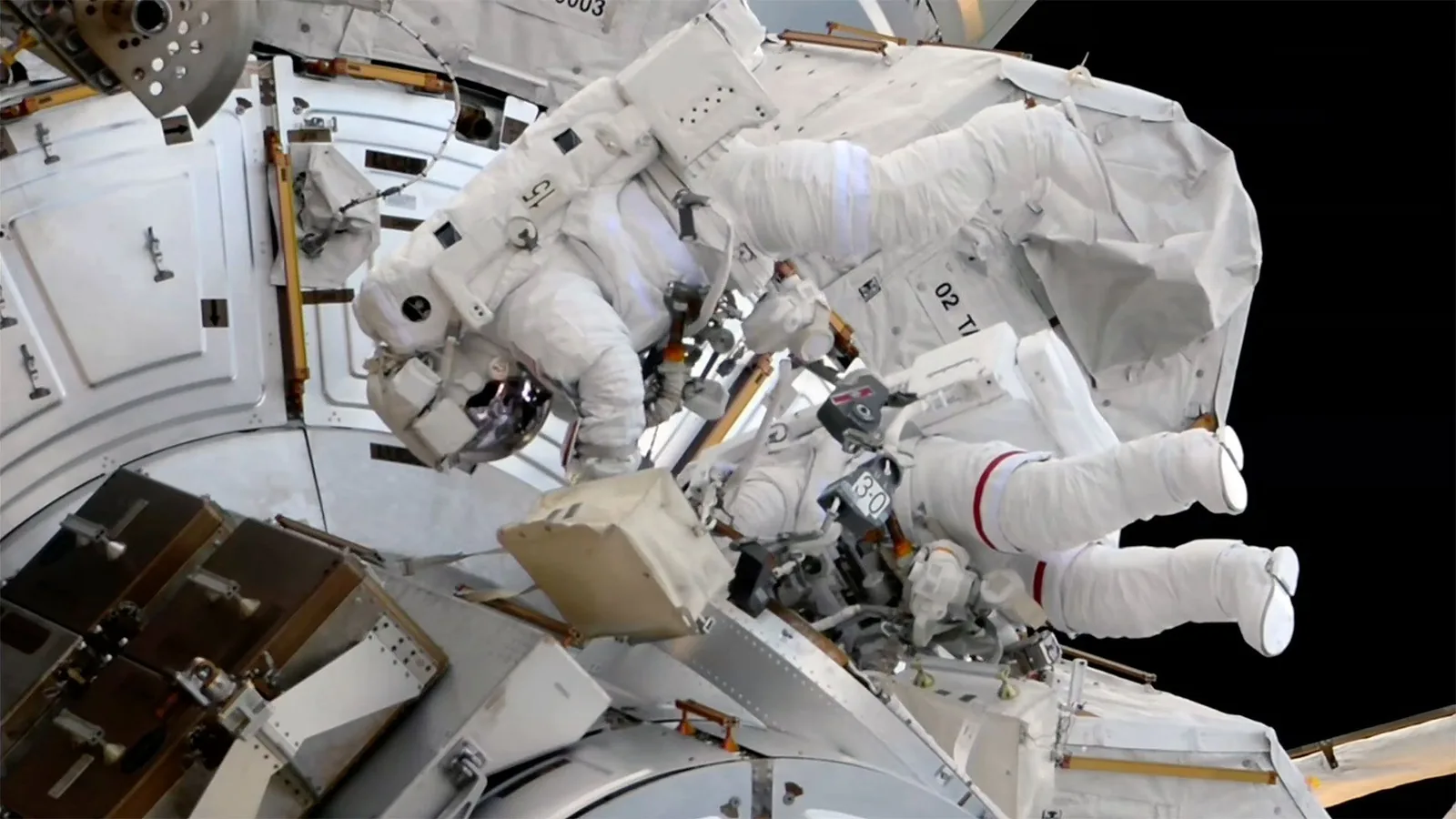
Two astronauts successfully conducted a spacewalk outside the International Space Station on Tuesday, September 1, 2026, to replace essential equipment. NASA astronaut Jessica Meir and European Space Agency (ESA) astronaut Sophie Adenot performed tasks including replacing a spacecraft docking aid and an external high-definition video camera. The extravehicular activity (EVA) lasted six hours and 49 minutes, concluding without compromising the station's operations.
The primary objective of the spacewalk, which began at 8:40 a.m. EDT (1240 GMT) from the U.S. Quest airlock, was to replace the planar deflector on the forward port of the station's Harmony Node 2. This retroreflector is crucial for navigation during rendezvous and docking operations for visiting spacecraft. The component being replaced had become coated in thruster residue from previous spacecraft maneuvers, potentially hindering its effectiveness.
"And it's off!" reported Meir as she successfully detached the old camera assembly, which was swapped out for a spare Camera Port 3 (CP3) HD camera on the station's truss. Mission Control at NASA's Johnson Space Center in Houston responded with applause, celebrating the successful replacement. Meir then assisted with other maintenance tasks, including preparing the Alpha Magnetic Spectrometer for future work.
Ongoing Scientific Study Continues Amidst Maintenance
Following the equipment replacements, astronaut Adenot proceeded with an ongoing scientific study. She swabbed exterior surfaces of the airlock and her gloves to collect samples for potential microorganism detection. Meanwhile, astronaut Meir, utilizing the Canadarm2 robotic arm, moved to a worksite near the Alpha Magnetic Spectrometer (AMS). There, she meticulously torqued 46 bolts, preparing the particle physics detector for upcoming maintenance. Meir also managed the relocation of power and thermal jumper cables and secured an articulating portable foot restraint for subsequent spacewalks.
Toward the end of the mission, Adenot encountered a temporary issue with her spacesuit, reporting limited mobility in her left shoulder joint. Mission Control, prioritizing astronaut safety, instructed her to remain in place while Meir returned to assist. Upon inspection, Meir identified that a cable had become snagged within the multi-layer insulation of Adenot's shoulder joint, restricting movement. "I think it was where the cable got caught in between the shoulder MLI [multi-layer insulation] and the rotation [joint]. I don't think it was held up by anything but some friction," Meir explained. After Meir successfully freed the obstruction, Adenot regained full mobility.
This spacewalk marked Jessica Meir's seventh EVA, bringing her total time spent on spacewalks to 49 hours and 22 minutes, placing her third among NASA's female astronauts for EVA duration. Sophie Adenot completed her third spacewalk, accumulating 19 hours and 42 minutes of experience working in space. The successful completion of these tasks highlights the crew's dedication to maintaining the integrity and functionality of the International Space Station, a vital platform for scientific research and international cooperation in orbit.