
Astronomers Detect Potential First Exomoon Orbiting Brown Dwarf
Astronomers using the VLT have identified a massive object orbiting a brown dwarf 73 light-years away, which could be the first confirmed exomoon or challenge existing definitions of planets and moons.

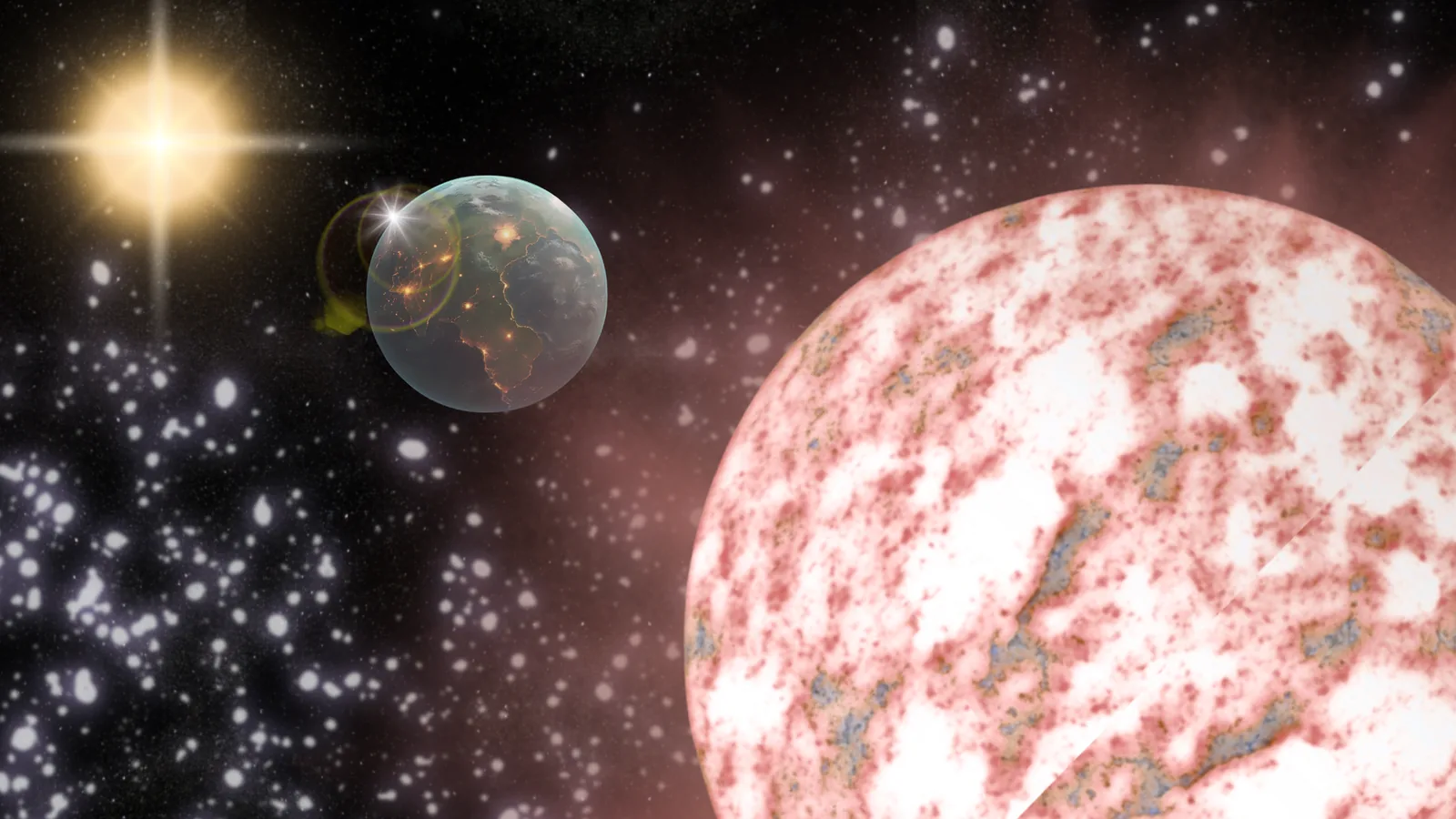
Astronomers studying the star system CD-35 2722, located approximately 73 light-years from Earth, have potentially discovered the first moon outside of our solar system. The object, detected using the Very Large Telescope (VLT), orbits a brown dwarf, a celestial body more massive than planets but too small to ignite nuclear fusion like a star. This finding, published on July 22 in the journal Nature, blurs the lines between what we define as a planet and a moon, presenting a unique challenge to astronomical classification.
The star system CD-35 2722 is home to a star with about half the mass of our sun, which is orbited by a brown dwarf. Brown dwarfs, often called "failed stars," fall into a mass range typically between 13 to 80 times that of Jupiter. The newly identified object orbits this massive brown dwarf, rather than a planet, which is how moons in our solar system behave. This unusual arrangement has led scientists to consider whether it qualifies as an exomoon or represents something entirely new that could force a redefinition of celestial bodies.
Kevin Hoy, team leader from the Universidad Diego Portales and the Millennium Nucleus of Young Exoplanets and their Moons (YEMS) in Chile, noted the difficulty in categorizing the discovery using familiar solar-system terms. "This system is somewhat hard to define using solar-system-based words like 'planet' and 'moon.' The exosatellite is clearly massive enough to be a planet, but it does not orbit a star, though it orbits an object that orbits a star," Hoy stated. He added that the object's position as a third body in the system makes astronomers lean towards calling it a moon, despite its immense size compared to our own solar system's moons.
A Moon or Something Stranger?
The team cannot yet definitively label the object as an exomoon because it requires a precise new definition of what constitutes a moon in such complex systems. Alice Zurlo, also from the Universidad Diego Portales, explained the complexities. "The satellite we report is a giant gaseous body orbiting a highly massive companion, itself several times the mass of Jupiter. We have a clear delineation between the planets and the sun in the solar system, so defining things like moons is simple," Zurlo said. "In the CD-35 2722 system, where we are blurring the lines between stars, planets, and moons, the whole thing becomes more complicated to describe."
Despite the classification challenge, Zurlo and her colleagues are confident that this detection represents an exosatellite of a novel kind, marking a first-of-its-kind observation regardless of its eventual categorization. The search for exomoons has been a long-standing goal in astronomy since the discovery of the first exoplanets in the 1990s. While the catalog of exoplanets has grown to over 6,000 confirmed entries, exomoons have remained elusive. Scientists have long theorized their existence, expecting that natural satellites would accompany planets in other star systems, mirroring our own solar system's composition.
The discovery in CD-35 2722, occurring at a distance of 73 light-years, adds a significant, albeit perplexing, data point to this ongoing quest. The sheer mass and orbital characteristics of the newly found object in relation to the brown dwarf challenge conventional astronomical models. Future observations and theoretical work will be crucial in understanding whether this object fits into our existing frameworks or necessitates a fundamental revision of how we classify celestial bodies. This potential finding underscores the vast diversity of planetary systems beyond our own and the continuous evolution of our understanding of the cosmos.