
August Full Moon Aligns with Near-Total Lunar Eclipse
Sky-gazers in North and South America can witness the August full sturgeon moon accompanied by a dramatic partial lunar eclipse on Thursday night into Friday. The Earth's shadow will obscure over 96% of the lunar surface.

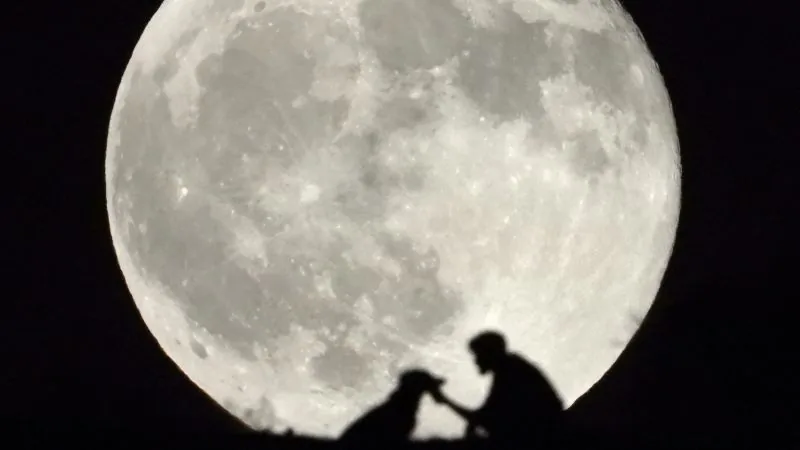
North and South America will have a prime view of a celestial spectacle as the August full sturgeon moon coincides with a nearly total partial lunar eclipse on Thursday night into Friday. The event occurs when the Earth passes between the sun and moon, casting its shadow upon the lunar surface.
This particular lunar eclipse, while partial, will be exceptionally close to totality, with Earth's umbra (its darkest shadow) expected to cover approximately 96% of the moon. This near-total coverage promises a dramatic display as the familiar full moon takes on a shadowed appearance. The eclipse will commence at 10:34 p.m. ET on Thursday, reaching its maximum phase at 12:13 a.m. ET on Friday. The peak fullness of the moon will follow shortly after, at 12:18 a.m. ET Friday.
During a total lunar eclipse, the moon often adopts a reddish hue, commonly termed a "blood moon," as shorter blue and violet light wavelengths scatter through Earth's atmosphere, allowing longer red and orange wavelengths to prevail. Predicting the exact coloration of this near-total eclipse remains challenging. Noah Petro, chief of NASA's Planetary Geology, Geophysics and Geochemistry Lab, noted, "I would expect the side of the Moon furthest from the lit area might take on a darker hue with some red to it."
Celestial Conditions and Aurora Potential
Adding to the night's cosmic potential, there's a possibility of geomagnetic storms late Thursday night, according to the National Weather Service's Space Weather Prediction Center. While not anticipated to reach severe levels, these solar wind-driven conditions could generate auroras visible in the northern United States. This presents a rare dual opportunity for sky-watchers to potentially observe both a striking lunar event and the ethereal glow of the northern lights.
Lunar eclipses, whether partial or total, occur with some regularity, though the exact number varies annually. "Some years, we actually get three," explained Pamela Gay, senior scientist at the Planetary Science Institute. "Some years, we unfortunately get zero." Most years, however, offer at least two "good opportunities" for the sun, moon, and Earth to align favorably for an eclipse. The year's first lunar eclipse, a total event visible primarily from Australia and Pacific regions, occurred in March.
Unlike their solar counterparts, lunar eclipses are entirely safe to view with the naked eye, requiring no special equipment. However, maximizing the viewing experience involves minimizing light pollution. Petro advises finding an open area away from bright lights to ensure an unobstructed view of the night sky. Gay suggests creating a comfortable setting, perhaps with a hammock and binoculars, to fully appreciate the cosmic display. "Set yourself up a hammock, pull out a pair of binoculars, go out and enjoy the entire experience," she recommended.
The August full moon carries the name "sturgeon moon," a tradition originating from Algonquin-speaking nations and other Native American groups around the Great Lakes. This name reflects the abundance of lake sturgeon caught during this period, which served as a crucial food source. Other Indigenous cultures also name the August full moon differently. For instance, Assiniboine peoples of the Northern Great Plains refer to it as the black cherries moon, while Eastern Woodlands nations call it the green corn moon.
Looking ahead, four more full moons are scheduled for 2026. Notably, November and December will feature supermoons, when the moon appears larger and brighter as it reaches its closest orbital point to Earth. The full moon schedule continues to offer celestial events for ongoing observation.