
Australia Prospector Finds Rare Meteorite Instead of Gold
An Australian prospector searching for gold in 2015 discovered a rare 4.6-billion-year-old meteorite instead.

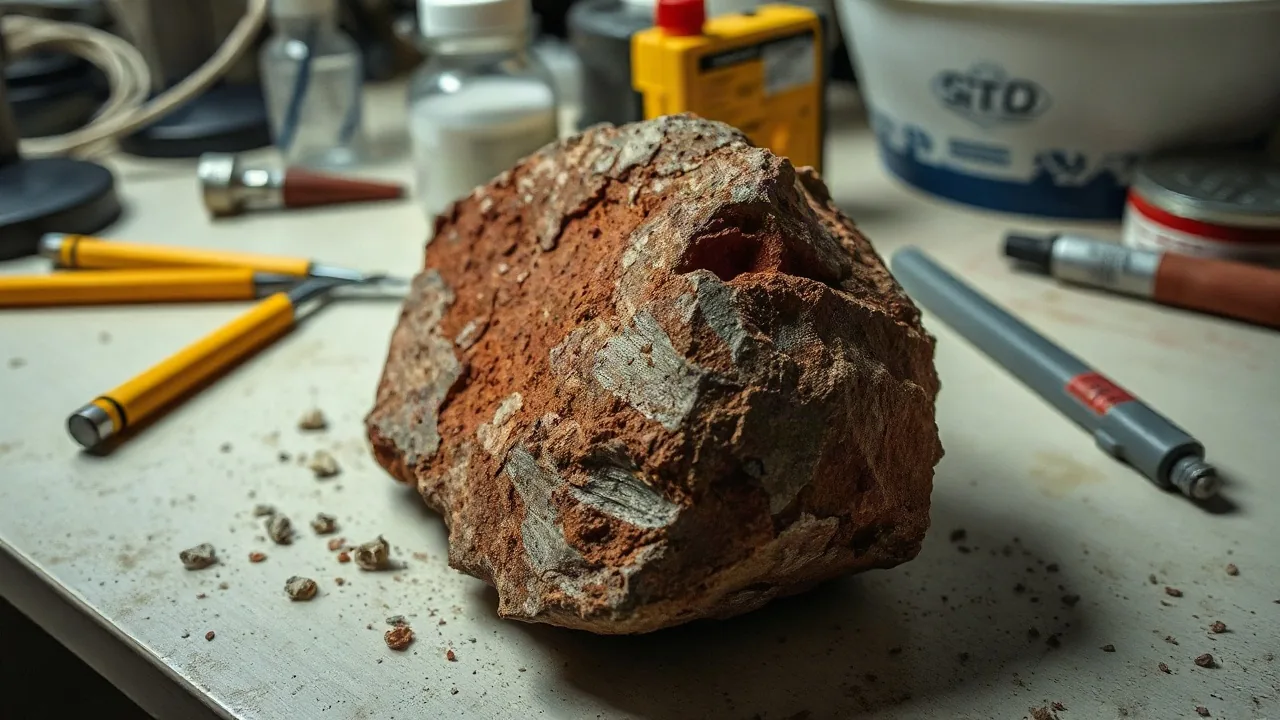
In 2015, a prospector in Australia dug up an unusually heavy, reddish rock while hoping to find gold inside. The specimen resisted every attempt to open it, including a saw, an angle grinder, a drill, acid, and sledgehammer blows. Three years later, the owner took the object to the Melbourne Museum for identification.
Geologists Dermot Henry and Bill Birch examined the specimen and quickly suspected it was a meteorite due to its high density and sculpted surface depressions. Such a rapid identification was unusual because the institution frequently receives ordinary rocks mistaken for space debris. Dermot Henry noted that only two specimens out of all those he had examined throughout his career had actually turned out to be meteorites.
The researchers used a diamond saw to extract a thin slice for study. Their findings were subsequently published in July 2019 in the Proceedings of the Royal Society of Victoria by Bill Birch, Dermot Henry, and geologist Andrew Tomkins.
Analysis and Scientific Value
The space rock measures approximately 15.4 inches long, 5.5 inches wide, and 5.5 inches thick. It belongs to the ordinary chondrite family, typically originating from the asteroid belt situated between Mars and Jupiter. These objects feature small spherical silicate grains known as chondrules, which formed when dust in the young solar system melted during a sudden heating event.
Classified with a high iron content and substantial heating within its parent asteroid, the mass contains iron-nickel alloys such as kamacite, taenite, and tetrataenite, alongside troilite. Carbon-14 dating indicated that the object fell to Earth less than 1,000 years ago, though no impact crater has been located.
With an estimated age of approximately 4.6 billion years, the object dates back to the formation of the solar system, making it older than Earth itself. Designated as the Maryborough meteorite, it stands as the 17th recorded meteorite in the state of Victoria and ranks as the second-largest single chondritic mass discovered in the region behind the Kulnine meteorite.