
Europe-China Spacecraft to Study Solar Storms From 121,000 Km Above Earth
A joint European-Chinese mission, SMILE, is launching to study solar storms. It will observe Earth's magnetosphere in X-rays from an orbit up to 121,000 km high.

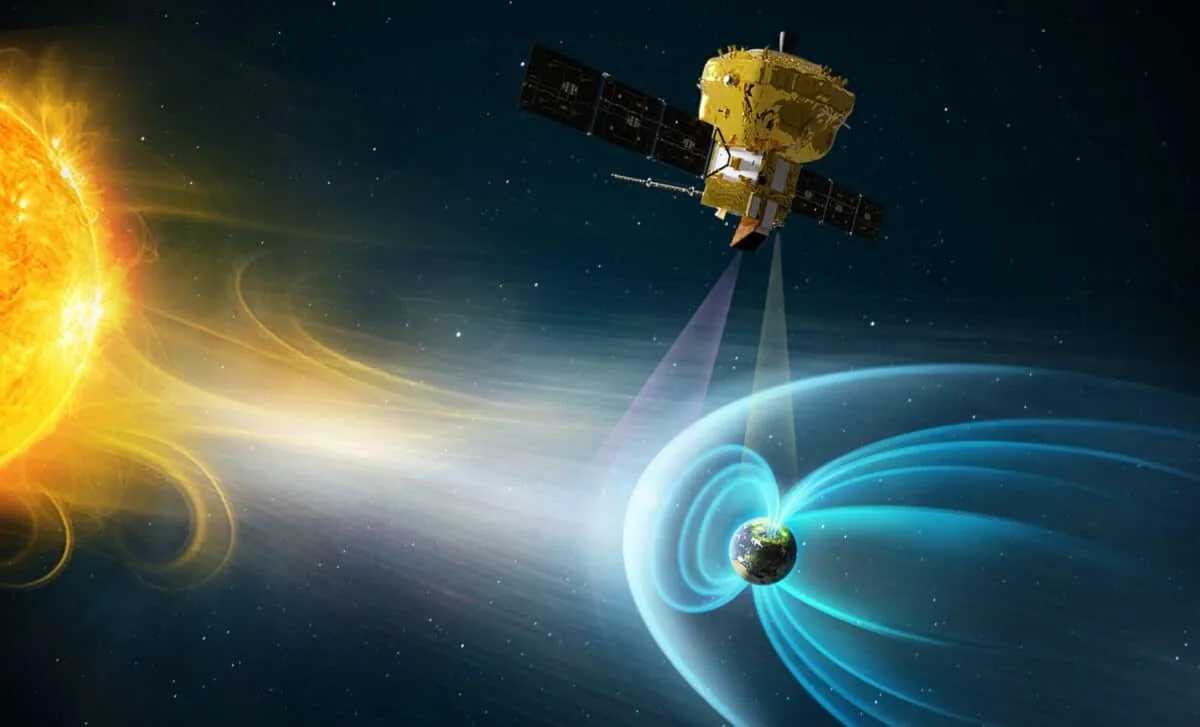
A joint European and Chinese spacecraft, the Solar Wind Magnetosphere Ionosphere Link Explorer (SMILE), is set to launch from Kourou, French Guiana, to study the intense interactions between the sun and Earth's magnetic field. This pioneering mission, developed by the European Space Agency (ESA) and the Chinese Academy of Sciences, will conduct the first-ever X-ray observations of Earth's magnetosphere during solar storm events, aiming to enhance our understanding of space weather's impact on technology and life on Earth.
The mission's objective is to unravel the complex relationship between our planet and its star. The sun continuously emits a stream of charged particles known as the solar wind. Occasionally, massive solar flares and coronal mass ejections accelerate these particles, sending them hurtling towards Earth at speeds approaching two million kilometers per hour. When these energetic particles reach our planet, Earth's magnetic field acts as a shield, deflecting most of them. However, particularly powerful solar storms can overwhelm this defense, allowing radiation to penetrate the upper atmosphere.
Understanding Space Weather's Growing Threat
The potential consequences of severe space weather events are a growing concern for modern society. These geomagnetic storms can disrupt power grids, interfere with satellite communications, and pose risks to astronauts in orbit. Historically, even the powerful 1859 geomagnetic storm, known as the Carrington Event, caused auroras visible as far south as the Caribbean and even led to electric shocks for telegraph operators. Today, our increasing reliance on sophisticated electronic infrastructure makes us far more vulnerable to such phenomena. Satellites essential for navigation, communication, and weather forecasting, along with human explorers on the International Space Station, face significant risks from heightened solar activity.
SMILE's innovative approach involves detecting the X-rays produced when solar particles collide with neutral atoms in Earth's upper atmosphere. "SMILE will be the first mission to observe Earth’s magnetosphere in X-ray light, revealing exactly when, where and how the solar wind interacts with Earth’s magnetic environment," stated an ESA representative. The spacecraft will focus on key regions where this interaction occurs, including the magnetopause, the boundary where the solar wind meets Earth's magnetic shield. Dimitra Koutroumpa of France’s CNRS institute highlighted that the mission will also investigate areas above the poles where these X-ray emissions are observable. The spacecraft is equipped with four advanced instruments, including a UK-built X-ray imager and an ion analyzer and magnetometer from the Chinese Academy of Sciences.
Following its launch aboard a Vega-C rocket, SMILE will initially establish a low Earth orbit before transitioning to a highly elliptical trajectory. This unique orbit will allow the spacecraft to journey up to 121,000 kilometers above Earth's northern pole, enabling prolonged observation periods. During its passes over the southern pole, it will fly approximately 5,000 kilometers above the surface, transmitting data to the Bernardo O’Higgins research station in Antarctica. This extended observation capability, potentially lasting up to 45 hours continuously over the northern pole, promises unprecedented insights into the dynamics of solar storms and their interaction with our planet's protective magnetic field. Scientists anticipate that the mission will begin collecting scientific data shortly after reaching its operational orbit.