
New NASA Maps Show Earth's Shifting Nighttime Lights 2014-2022
New NASA maps reveal dynamic changes in Earth's nighttime lights between 2014 and 2022. The data shows a complex global pattern of brightening and dimming, influenced by urban growth, energy efficiency, and economic shifts.

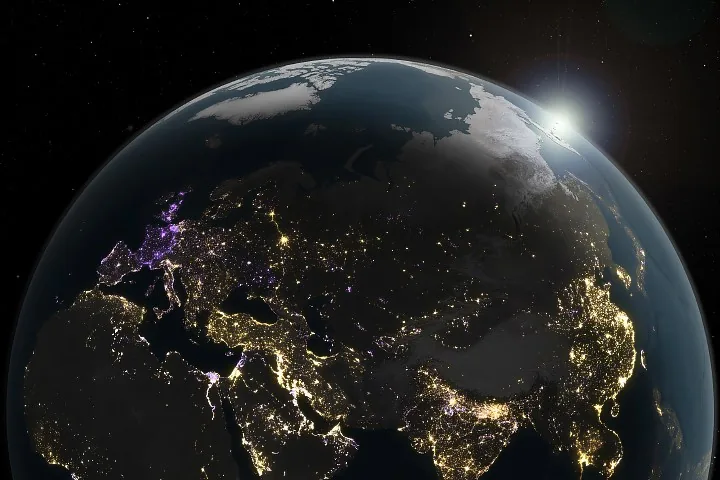
New satellite imagery from NASA reveals a dynamic picture of Earth's nighttime glow, illustrating how human activity has reshaped our planet's nocturnal illumination over nearly a decade. Analysis of data collected by NASA's Black Marble product shows that instead of a simple, steady increase in artificial light, global light patterns are far more complex, exhibiting both significant brightening in developing areas and considerable dimming in others. These findings, published in April 2026, offer a unique perspective on industrial activity, urban development, infrastructure changes, and even policy impacts.
The Black Marble product utilizes data from the VIIRS sensors aboard the Suomi-NPP, NOAA-20, and NOAA-21 satellites. This suite of instruments captures nighttime light across a broad spectrum, from green to near-infrared, allowing scientists to distinguish between city lights, reflected moonlight, and atmospheric phenomena like auroras. The updated maps showcase changes in brightness across most of the world's inhabited regions, from 60 degrees south to 70 degrees north latitude, between 2014 and 2022. Areas appearing in yellow and gold indicate an increase in light intensity during this period, while purple regions signify a decrease.
Overall, the study found a global increase in light radiance of 34 percent between 2014 and 2022. However, this aggregate figure masks significant regional variations. For instance, while West Coast cities in the United States experienced a surge in brightness corresponding with population growth, much of the East Coast saw a reduction in nighttime light. Researchers attribute this dimming on the East Coast to the increased adoption of energy-efficient LED lighting and broader economic restructuring, demonstrating how technological shifts can alter a region's energy footprint.
Global Trends and Regional Divergences
The bidirectional changes in nighttime illumination are not confined to the U.S. Internationally, rapid urban development has driven substantial light increases in China and northern India. In stark contrast, European nations have implemented energy conservation measures and widespread LED retrofits, leading to noticeable reductions in light pollution. France reported a 33 percent dimming, the UK saw a 22 percent decrease, and the Netherlands experienced a 21 percent dimming. These figures highlight a growing global awareness and effort to combat light pollution and conserve energy.
A notable event impacting European light patterns was the energy crisis in 2022, which followed the outbreak of the Russia-Ukraine conflict. This crisis led to sharp reductions in nighttime lighting across the continent as countries implemented emergency energy-saving measures. Such events underscore the vulnerability of global energy systems and the interconnectedness of geopolitical events with environmental indicators like nighttime light emissions.
These evolving light maps provide valuable insights for urban planners, environmental scientists, and policymakers. They can help track economic activity, monitor infrastructure development, and assess the effectiveness of energy-saving initiatives. The detailed visualization of global light trends allows for a more nuanced understanding of our planet's energy consumption and its environmental impact. The NASA Earth Observatory continues to provide such vital data, translating complex scientific findings into accessible visual narratives for the public.