
NASA's Psyche Probe Nears Mars for Gravity Assist Flyby
NASA's Psyche mission will fly by Mars on May 15, using the planet's gravity to boost its speed and calibrate instruments. The probe is en route to a unique metal-rich asteroid.

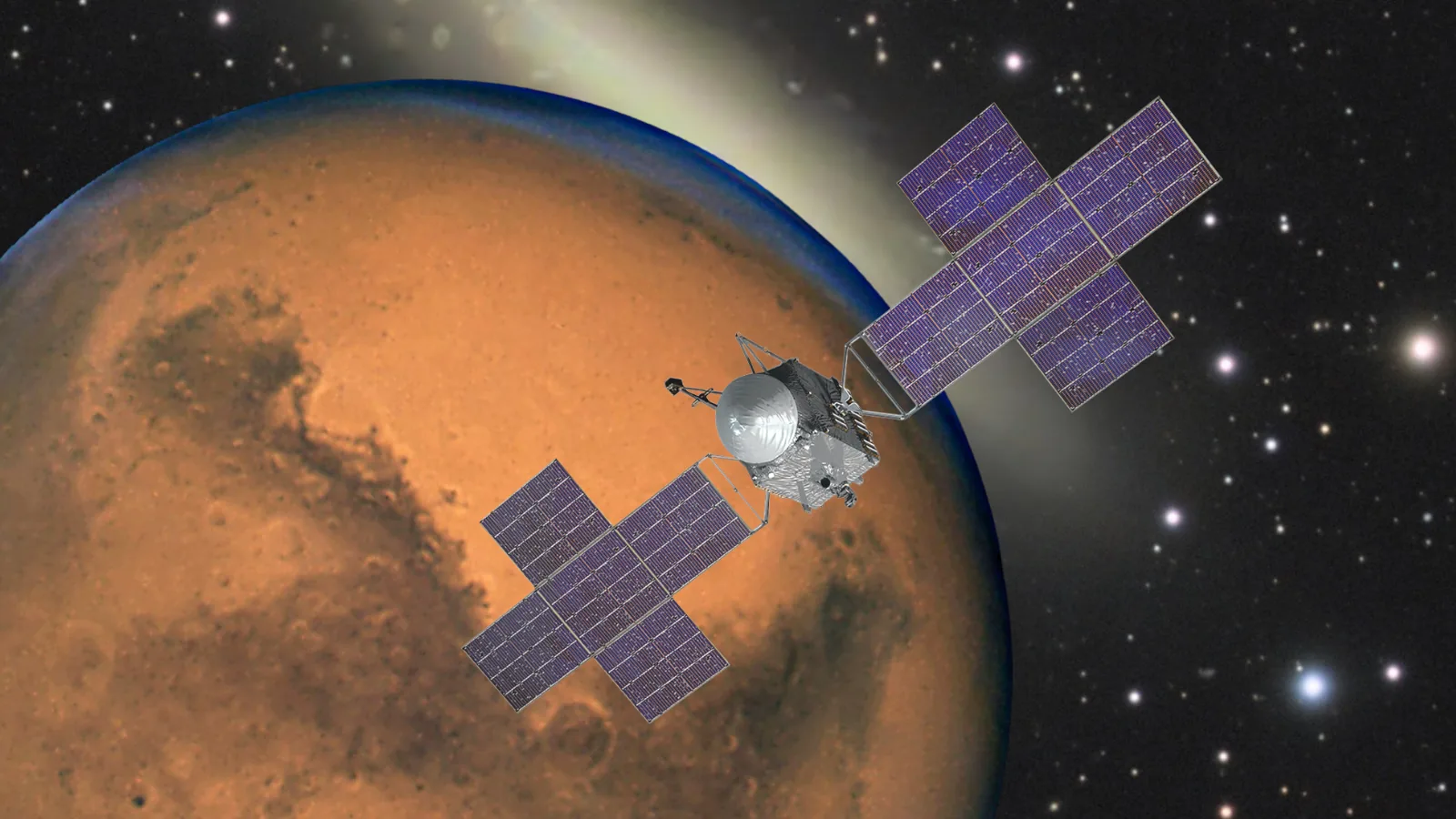
NASA's groundbreaking Psyche mission is set for a critical encounter with Mars on May 15. The spacecraft, en route to a distant metal-rich asteroid, will perform a close flyby of the Red Planet, coming within approximately 2,800 miles (4,500 kilometers). This maneuver is designed to leverage Martian gravity, providing a significant speed boost and fine-tuning the probe's trajectory towards its ultimate destination: the asteroid 16 Psyche. Launched in October 2023, the Psyche probe is expected to reach the asteroid, located in the main asteroid belt between Mars and Jupiter, in 2029.
The asteroid 16 Psyche is of immense scientific interest. Scientists believe it is a protoplanet, a building block of planets from the early solar system, whose outer layers were stripped away by ancient collisions. This leaves its exposed nickel-iron core as a rare opportunity to study the internal structure of rocky planets, similar to Earth's but without the need for deep drilling. The flyby of Mars serves a dual purpose beyond just conserving precious xenon propellant used for its ion engines. It provides an essential opportunity to test and calibrate the sophisticated scientific instruments that will be used to study the asteroid once it arrives.
Instrument Calibration and Unexpected Observations
The Psyche spacecraft's multispectral imager will capture thousands of images of Mars, beginning the calibration process earlier this month. The mission team began preparations for this encounter on February 23 with a trajectory correction maneuver, firing the spacecraft's thrusters for 12 hours to accelerate its journey and refine its approach. "We are now exactly on target for the flyby, and we’ve programmed the flight computer with everything that the spacecraft will do throughout May," said Sarah Bairstow, Psyche's mission planning lead at NASA's Jet Propulsion Laboratory. "This is our first opportunity in flight to calibrate Psyche's imager with something bigger than a few pixels, and we'll also make observations with the mission's other science instruments."
Adding an element of intrigue, the Psyche team is also preparing for the possibility of observing a faint, dusty ring around Mars. This theorized ring is thought to form from micrometeorites impacting the planet's moons, Phobos and Deimos, ejecting dust particles into space. The specific alignment of the sun, the Psyche spacecraft, and Mars could make this dust scatter sunlight, rendering it detectable by the probe's sensitive instruments. Such an observation would offer new insights into the dynamics of Martian moons and the surrounding space environment. This mission represents a significant step forward in understanding planetary formation and the composition of celestial bodies.