
NASA Psyche Probe Captures Rare Crescent Mars Image
NASA's Psyche spacecraft, en route to an asteroid, has captured a rare image of Mars showing a crescent phase. The image was taken as the probe neared the Red Planet for a flyby.

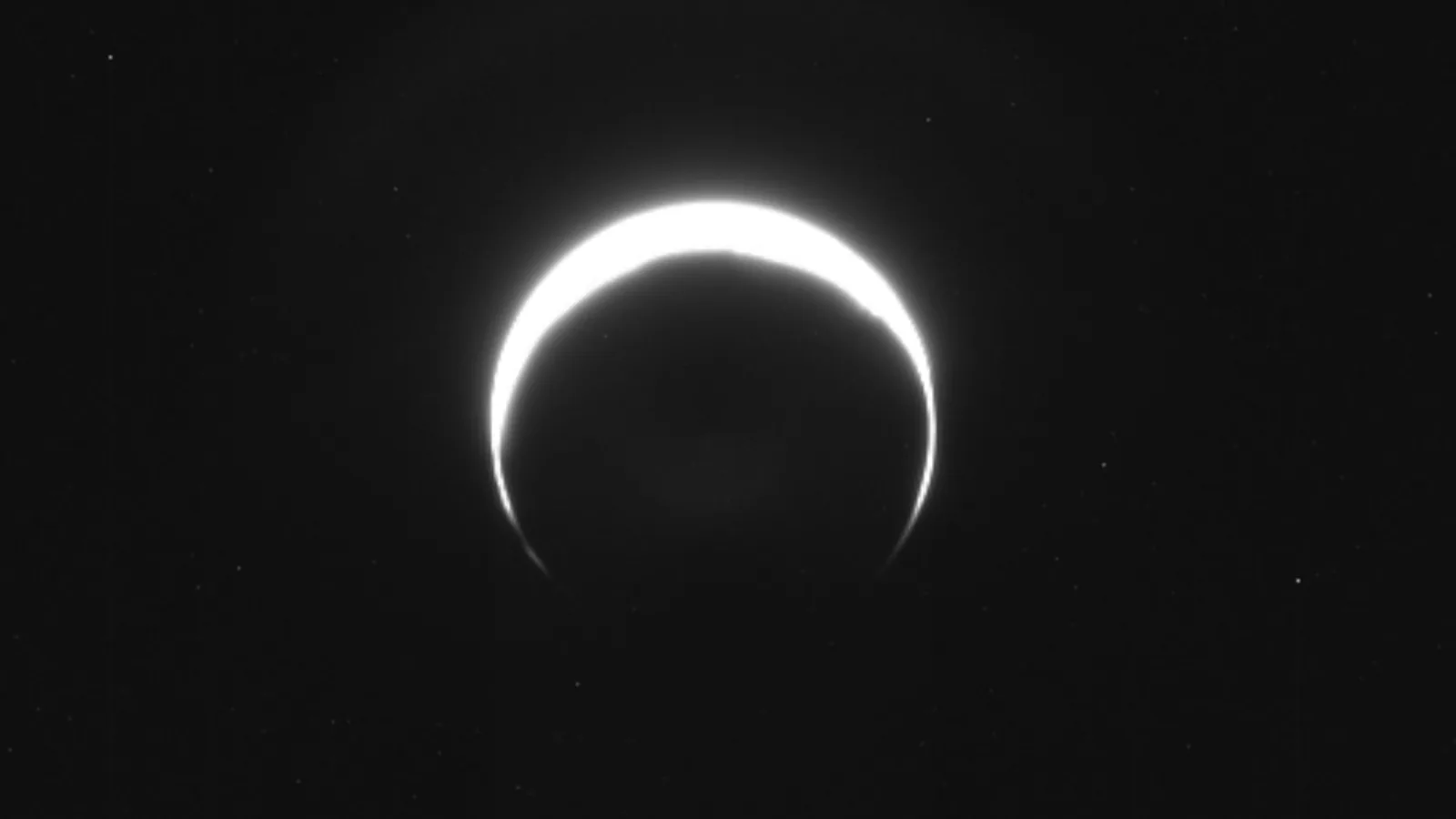
NASA's Psyche spacecraft, currently on its journey to a metal-rich asteroid, has captured a striking and unusual image of Mars, revealing the Red Planet in a crescent phase. The spacecraft, traveling at approximately 12,333 miles per hour, approached Mars for a close flyby on Friday, May 15, 2026, providing a unique vantage point. The unprocessed image, released by NASA on its Solar System X feed, showcases a sliver of sunlit Mars against the darkness of space.
This celestial sight is not an eclipse, but rather a rare phenomenon showcasing sunlight reflecting off the Martian surface and passing through its atmosphere. "This is not an eclipse, but an even more rare sight: a crescent Mars as seen by NASA’s #MissionToPsyche spacecraft," NASA stated in its announcement. "The irregularities in the crescent are likely caused by surface features, and dust and clouds in the atmosphere." The mission team utilized the close approach to calibrate the spacecraft's sophisticated observational instruments, a crucial step for its primary objective.
Instrument Calibration and Mission Goals
The flyby of Mars, occurring at a distance of about 2,800 miles (4,500 kilometers), served a dual purpose. Not only did it yield captivating imagery of the Red Planet, but it also allowed scientists to verify the functionality of Psyche's scientific tools. This calibration work, which began on May 3, 2026, is essential to ensure the instruments are prepared to collect vital data once the spacecraft reaches its ultimate destination: the main asteroid belt situated between Mars and Jupiter. The primary target in this region is a massive, metal-rich asteroid known as 16 Psyche, which measures approximately 173 miles (280 kilometers) in diameter.
Understanding the composition of asteroid 16 Psyche is a key objective for NASA, as it is believed to be a remnant from the early formation of the solar system, possibly a protoplanet's core. Studying such asteroids can provide invaluable insights into planetary formation processes that were common billions of years ago. The NASA probe, launched in 2022, is expected to arrive at the asteroid in 2029. The unique perspective gained during the Mars flyby demonstrates the mission's innovative approach to scientific observation and preparation.
The Psyche mission, led by Arizona State University, represents a significant endeavor in planetary science. The data collected from asteroid 16 Psyche is expected to shed light on the composition of terrestrial planet cores, including Earth's. The visual confirmation of the spacecraft's capabilities through the Mars flyby bolsters confidence in its future scientific returns. This event underscores the dynamic and often unpredictable nature of space exploration, where unexpected opportunities for scientific discovery arise even during transit phases of missions.