
Great Salt Lake Meteorite on Display After 2022 Cosmic Event
A significant fragment of the Great Salt Lake meteorite, which fell to Earth in August 2022, is now on display at the University of Utah. The cosmic rock offers scientists a rare link to its asteroid origins.

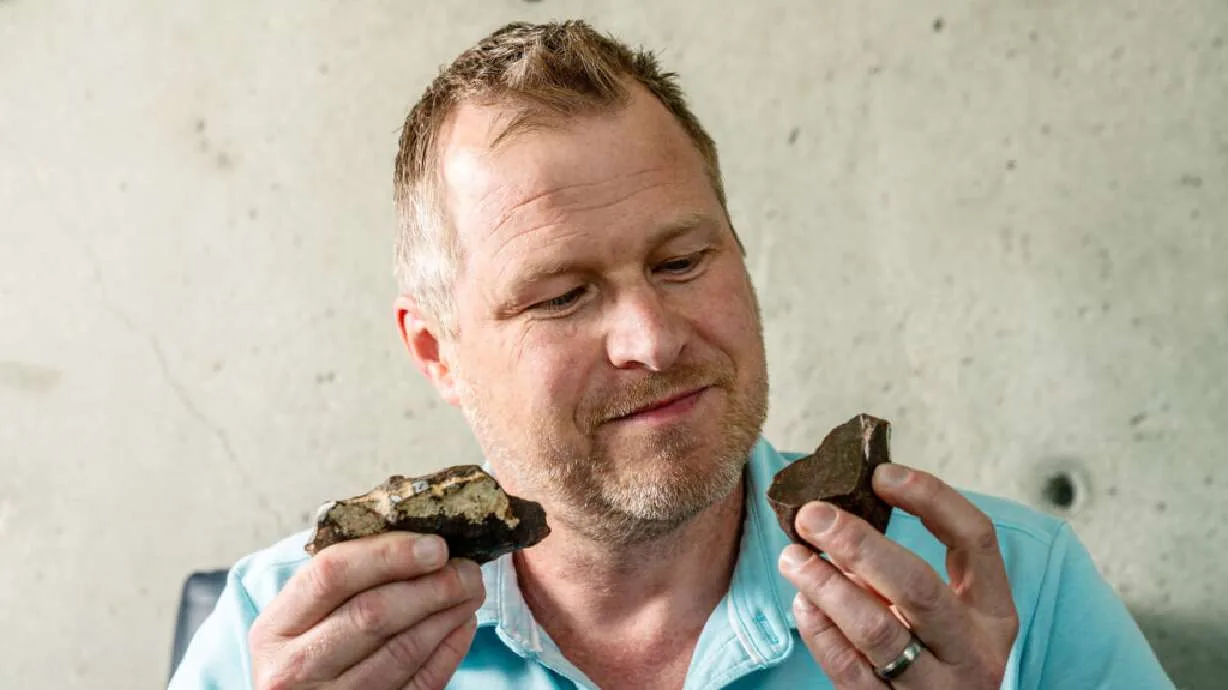
SALT LAKE CITY — The University of Utah is now showcasing a substantial fragment of the Great Salt Lake meteorite, a celestial visitor that captivated observers across the valley in August 2022. The 774-gram piece, the largest recovered from the event, is the centerpiece of a new exhibit detailing the story of this rare cosmic impact.
The meteorite's dramatic arrival on August 13, 2022, was marked by a loud boom heard throughout the Salt Lake Valley, signaling the fiery descent of a space rock. This event was not only witnessed but also captured on camera by a webcam at Snowbasin Ski Resort, drawing widespread attention, including from Utah Governor Spencer Cox. James Karner, a research associate professor in the geology department at the U. and principal investigator for the Antarctic Search for Meteorites, described the experience as unique, especially for someone who routinely searches for meteorites in Antarctica.
"What was kind of unique about this meteorite is that it was seen as a fireball coming across the Midwest and the Mountain States," Karner told KSL. "It was really cool to actually hear the event happen in my own driveway." Karner's immediate thought after witnessing the spectacle was whether any fragments had successfully reached the ground, a crucial step in classifying the event as a meteorite "fall" – one whose descent is observed by people.
Until the last two decades, pinpointing a meteorite's landing zone relied heavily on eyewitness accounts and limited video footage. However, advancements in technology, particularly the use of Doppler radar, have revolutionized the process. "In the last 20 years ... these meteors can be seen on Doppler radar. They see the explosion on Doppler radar. They see these meteorites falling to ground with the weather radar, and we can almost pinpoint exactly where they're coming down on the Earth," Karner explained.
Linking Space Rocks to Asteroid Origins
Following the 2022 event, Karner collaborated with a colleague at NASA's Johnson Space Center, utilizing weather data from Salt Lake City and Pocatello, Idaho, to confirm the meteorite's ground impact. The significant 774-gram fragment was eventually discovered by Arizona-based meteorite hunter Robert Ward and subsequently donated to the University of Utah. While dozens of additional fragments have been recovered, totaling 3.2 kilograms to date, Karner suspects more pieces may still lie hidden in the playa and waters of the Great Salt Lake.
Compositionally, the Great Salt Lake meteorite is classified as an "ordinary chondrite," a common type that makes up 80% to 85% of all known meteorites. However, its scientific value extends beyond its makeup. The detailed tracking of its fiery atmospheric passage allowed scientists to calculate its pre-impact orbit, tracing its origins back to the asteroid belt. This level of tracking, combined with the recovery of the physical rock, enables researchers to match the meteorite's composition to specific asteroid groups. This practice is still relatively rare, with only about 70 meteorites having such comprehensive tracking data, effectively linking specific asteroids to meteorite falls.
"Because we have the rock that caused it, we can see what composition that is, and then telescopes can actually match the asteroid group to that specific meteorite," Karner noted. This scientific achievement underscores the importance of events like the Great Salt Lake meteorite fall, providing a tangible link between Earth's geology and the broader solar system.
The exhibit, unveiled last week in the Department of Geology and Geophysics' main office on the second floor of the Sutton Building, aims to make this cosmic event accessible to the public. Karner emphasized the meteorite's significance not just scientifically but as a piece of Utah's natural history. "It's a significant cosmic event that is going to happen once in a lifetime, and I think it's neat because I've talked to a lot of people about this event, and a lot of people in Salt Lake City heard these explosions," he said. The rock itself is an astonishing 4.56 billion years old, predating even the oldest dinosaur fossils by tens of millions of years, offering a profound connection to the early history of our solar system and the universe.