
Hubble Telescope Spots Galaxy M88's Cosmic Voyage Toward Virgo Cluster Center
The Hubble Space Telescope has captured a new image of Messier 88 (M88), a spiral galaxy nearing the center of the massive Virgo Cluster. Its journey will fundamentally reshape the galaxy over the next 200-300 million years.

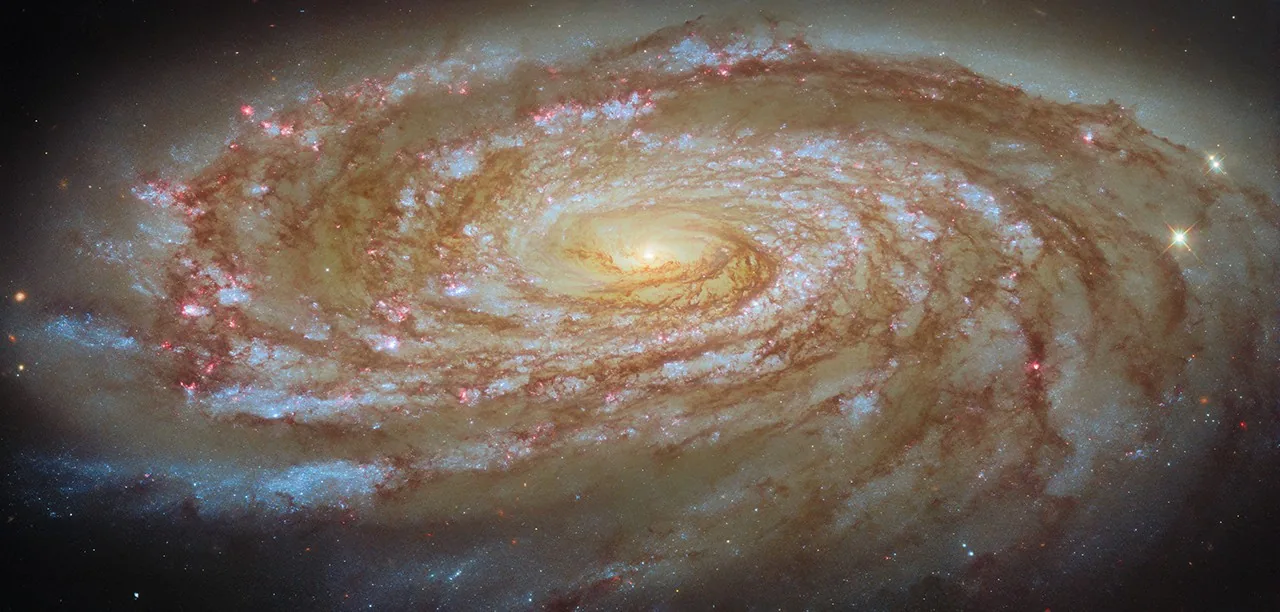
The NASA/ESA Hubble Space Telescope has delivered a stunning new image of Messier 88 (M88), a spiral galaxy embarking on a vast cosmic journey spanning hundreds of millions of years. Also cataloged as NGC 4501, M88 is situated approximately 63 million light-years away within the constellation Coma Berenices. This galaxy is classified as active due to a supermassive black hole at its core, estimated to be 100 million times the mass of our Sun, actively consuming gas and dust and powering significant outflows from the galaxy's center.
Around this energetic core, a population of ancient, reddish stars creates a warm, glowing heart. From this central region, symmetrical spiral arms gracefully unfurl, adorned with vibrant pink and blue star clusters and dense knots of dust. The current view, captured by Hubble, shows M88 from an angle that elongates its form, with its spiral arms fanning out delicately before it.
M88 is not an isolated celestial body; it is a prominent member of the Virgo Cluster, an immense congregation of over a thousand galaxies bound together by gravity. As this colossal galactic collection traverses space, individual galaxies like M88 are in perpetual motion, orbiting the cluster's collective center of gravity. M88's current trajectory is leading it on a long and potentially turbulent path toward the cluster's innermost regions.
A Galactic Transformation Underway
In approximately 200 to 300 million years, M88 will reach its closest proximity to Messier 87 (M87), the dominant elliptical galaxy that anchors the entire Virgo Cluster. As M88 ventures near this gravitational giant, it will experience intense 'ram pressure stripping.' This phenomenon occurs when a galaxy's internal gas is violently swept away as it ploughs through the pervasive intergalactic gas that permeates galaxy clusters. Evidence of this process is already discernible in M88. The leading edge of the galaxy's swirling disk of gas appears truncated and compressed, with material accumulating like snow before a plow. Notably, M88 exhibits considerably less cold gas—the essential fuel for star formation—than would be expected for a galaxy of its size, particularly in its outer regions. This deficit is a clear indicator that M88's journey through the Virgo Cluster will fundamentally alter its structure, impact its capacity for future star formation, and significantly redirect its evolutionary path.
Astronomers utilized the capabilities of the Hubble Space Telescope to observe M88 as part of an ongoing research initiative (observing program #18103, Principal Investigator: D. Thilker). This program is dedicated to scrutinizing the life cycles of spiral galaxies situated in crowded cosmic environments. Employing Hubble's Wide Field Camera 3, researchers are able to resolve individual star clusters and nebulae within galaxies located tens of millions of light-years away. By studying galaxies on these scales, scientists aim to gain a deeper understanding of how interactions within dense galaxy clusters influence a galaxy's evolution and its potential for creating new stars.