
James Webb Telescope's Best Images: 25 Stunning Cosmic Views
The James Webb Space Telescope is celebrating its fourth anniversary, showcasing a collection of its most breathtaking images. These photos highlight both the beauty and scientific breakthroughs achieved by the $10 billion observatory.

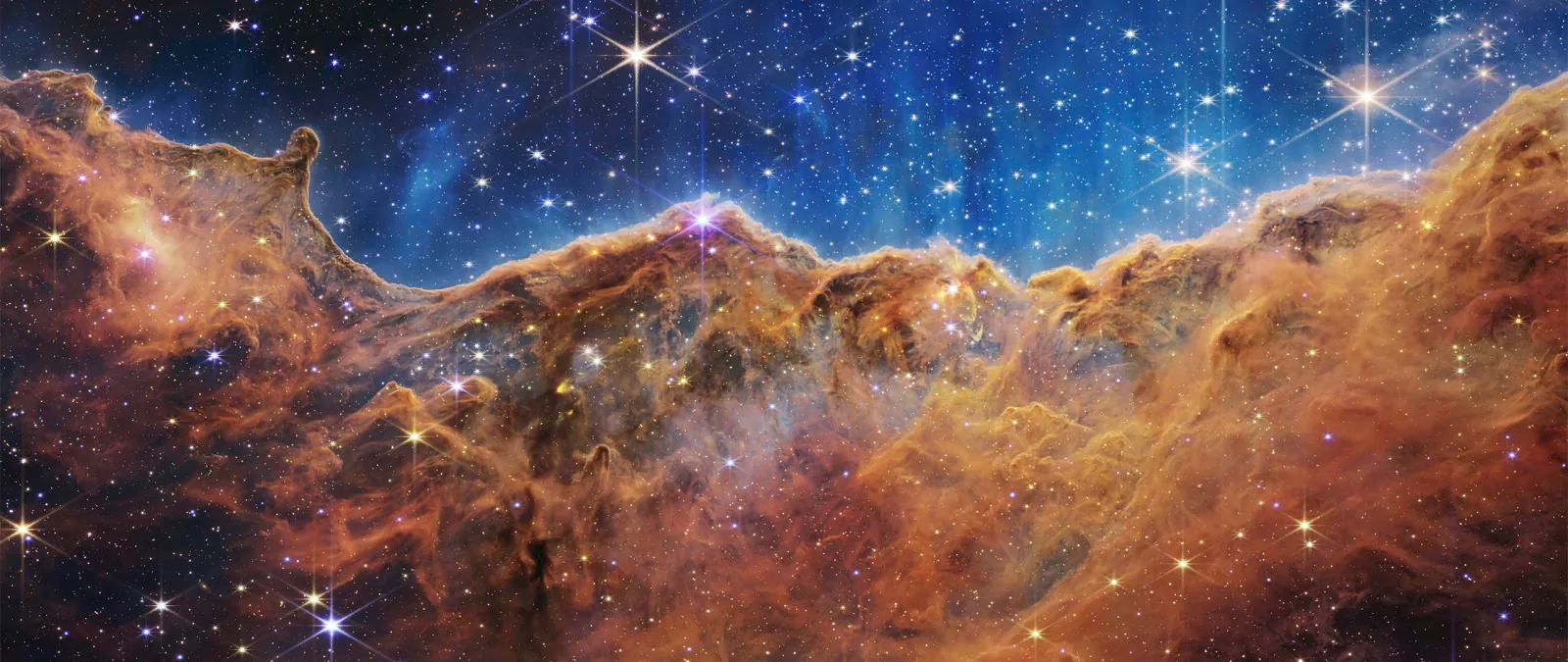
The James Webb Space Telescope (JWST) is marking its fourth anniversary, offering a spectacular retrospective of its most captivating images. In its operational life since 2022, the $10 billion observatory, a joint project of NASA, the European Space Agency (ESA), and the Canadian Space Agency (CSA), has not only delivered groundbreaking scientific discoveries but also produced a portfolio of astonishing visual data. This collection celebrates images where scientific achievement meets artistic beauty, revealing the universe in unprecedented detail.
Among the early highlights is the image of Messier 74, also known as the Phantom Galaxy. Captured in August 2022 using Webb’s Mid-InfraRed Instrument (MIRI), this photo peers through interstellar gas and dust, uncovering details previously hidden from view. Another iconic subject is the Pillars of Creation. Webb’s ability to combine data from different instruments, such as MIRI and the Near-Infrared Camera (NIRCam), results in a sharp, colorful depiction of this famed cosmic structure, teeming with galaxies, stars, and intricate cosmic phenomena.
The Tarantula Nebula, located 161,000 light-years away, is a massive and luminous star-forming region, serving as a vital laboratory for understanding stellar evolution. Webb’s instruments have also turned their gaze closer to home, capturing Jupiter and Uranus with remarkable clarity. The Jupiter image, taken with NIRCam, reveals atmospheric details, while the Uranus portrait showcases its rings and polar cap, along with nine of its 27 moons. Even Neptune’s faint rings and methane ice clouds are visible through Webb's sensitive instruments.
Spectacular Views of Planets and Galaxies
Webb’s most impressive planetary portrait may be that of Saturn, with its rings illuminated in an ethereal light. Beyond our solar system, the observatory has imaged galaxies like Messier 82 (Cigar Galaxy), a smaller but five times more luminous galaxy than the Milky Way, actively forming stars at a rate ten times faster. Webb’s infrared capabilities allow scientists to study its extremely active galactic center.
One of the first full-color images released in July 2022, SMACS 0723, is the deep-space successor to Hubble’s iconic Deep Field. This composite image, requiring 12.5 hours of exposure, offers the highest resolution ever captured of deep space, with some light having traveled over 13 billion years to reach the telescope. The Southern Ring Nebula, another early release, presents a stunning, cat’s-eye-like view of a nebula 0.5 light-years across, far surpassing previous telescope capabilities.
Stephan’s Quintet, a group of five galaxies locked in a cosmic dance approximately 290 million light-years away, was painstakingly assembled from 1,000 individual photos. The Carina Nebula, famous for its “cosmic cliffs,” was also among Webb’s initial spectacular releases. Celebrating its first birthday, the telescope revealed the Rho Ophiuchi cloud complex, the closest and arguably most beautiful star-forming region to Earth.
The telescope’s resolution was put to excellent use on NGC 346, a star cluster 200,000 light-years away, revealing more building blocks for stars and planets than previously suspected. A galaxy 500 million light-years away, the Cartwheel Galaxy, displays a striking shape resulting from a high-speed collision billions of years ago. Even MoM-z14, a faint blob discovered by Webb, represents the farthest galaxy ever observed, existing just 280 million years after the Big Bang, a testament to the telescope’s record-breaking capabilities.
The JADES program, part of the JWST Advanced Deep Extragalactic Survey, has cataloged 45,000 individual galaxies, illustrating the vastness of the cosmos. NGC 3256, a peculiar galaxy over 120 million light-years away, shows the aftermath of a cosmic collision between two spiral galaxies. The Red Spider Nebula, officially NGC 6537, reveals its central star with unprecedented clarity against its dusty gas shroud, a detail not visible in previous observations. Finally, Messier 77, a barred spiral galaxy 45 million light-years distant, is presented with a clarity unattainable from Earth due to Webb’s unobstructed view.