
Japan's MMX Mission Launches to Unravel Mars Moon Mysteries
Japan's Martian Moons eXploration (MMX) mission has successfully launched, aiming to study Mars's two unusual moons, Phobos and Deimos, and potentially bring back samples. This ambitious endeavor could revolutionize our understanding of the solar system.

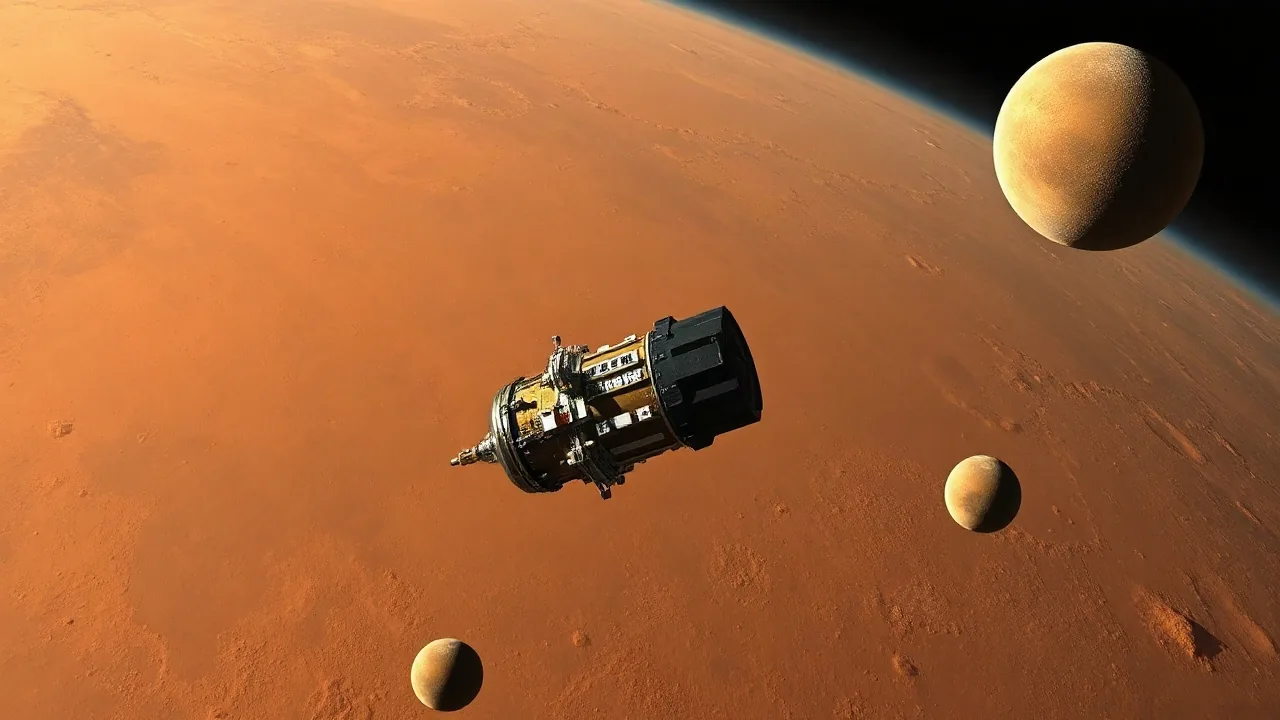
Japan's ambitious Martian Moons eXploration (MMX) mission has successfully lifted off aboard an H3 rocket from the Tanegashima Space Center, marking a significant step in planetary science. The spacecraft is embarking on a journey to study Mars's two small, irregularly shaped moons, Phobos and Deimos, which have long puzzled scientists due to their origins. The mission, led by the Japan Aerospace Exploration Agency (JAXA), aims to determine whether these moons were captured asteroids or formed in a different manner entirely.
The launch on October 23, 2026, occurred without issue, propelling the MMX spacecraft towards its interplanetary destination. The mission's primary objectives include observing the surfaces and internal structures of Phobos and Deimos, understanding their formation history, and investigating Martian geology. A key component of the mission involves a planned landing on Phobos, where the spacecraft will collect samples before returning them to Earth for detailed analysis. This sample return capability represents a major technological challenge and a significant scientific opportunity.
Unraveling the Mystery of Martian Moons
The existence of Phobos and Deimos, with their small size and peculiar orbits, has been a subject of scientific debate for decades. Current theories suggest they could be captured asteroids from the outer solar system or remnants from the early formation of Mars. The MMX mission seeks to gather definitive evidence to resolve this long-standing question. Dr. Hitoshi Hasegawa, the MMX project lead, stated, "Understanding the origin of these moons is crucial for piecing together the early history of the Martian system and potentially the entire solar system. We are on the cusp of a major discovery."
The MMX spacecraft is equipped with an array of advanced scientific instruments, including cameras, spectrometers, and a drill for sample collection. Its journey to Mars is expected to take approximately seven months. Once in orbit around the Red Planet, the mission will spend nearly three years conducting observations and performing maneuvers to approach Phobos for landing. The complex operations required for sample collection and the subsequent return journey to Earth are scheduled to conclude by late 2031.
This mission is not just about understanding Mars's moons; it also offers a unique opportunity to study the Martian environment from a unique vantage point. Data collected by MMX could provide insights into the planet's atmosphere, radiation levels, and surface composition, complementing findings from other Mars missions. The successful deployment of the MMX spacecraft signals a new era of international collaboration and scientific inquiry in space exploration.
The scientific community anticipates that the return of samples from Phobos could be a "transformative leap" for planetary science. Analysis of these extraterrestrial materials on Earth, under controlled laboratory conditions, will allow for unprecedented precision in dating the samples and determining their elemental and isotopic composition. This detailed information will help refine models of planetary formation and evolution, offering a clearer picture of how rocky planets, including our own, came to be.