
Japan's MMX Mission Departs for Phobos to Unlock Mars Moon Secrets
Japan's historic Mars Moons eXploration (MMX) mission has launched, aiming to land on Phobos, one of Mars's moons, and return samples to Earth. The mission seeks to unravel the origins of the Martian moons.

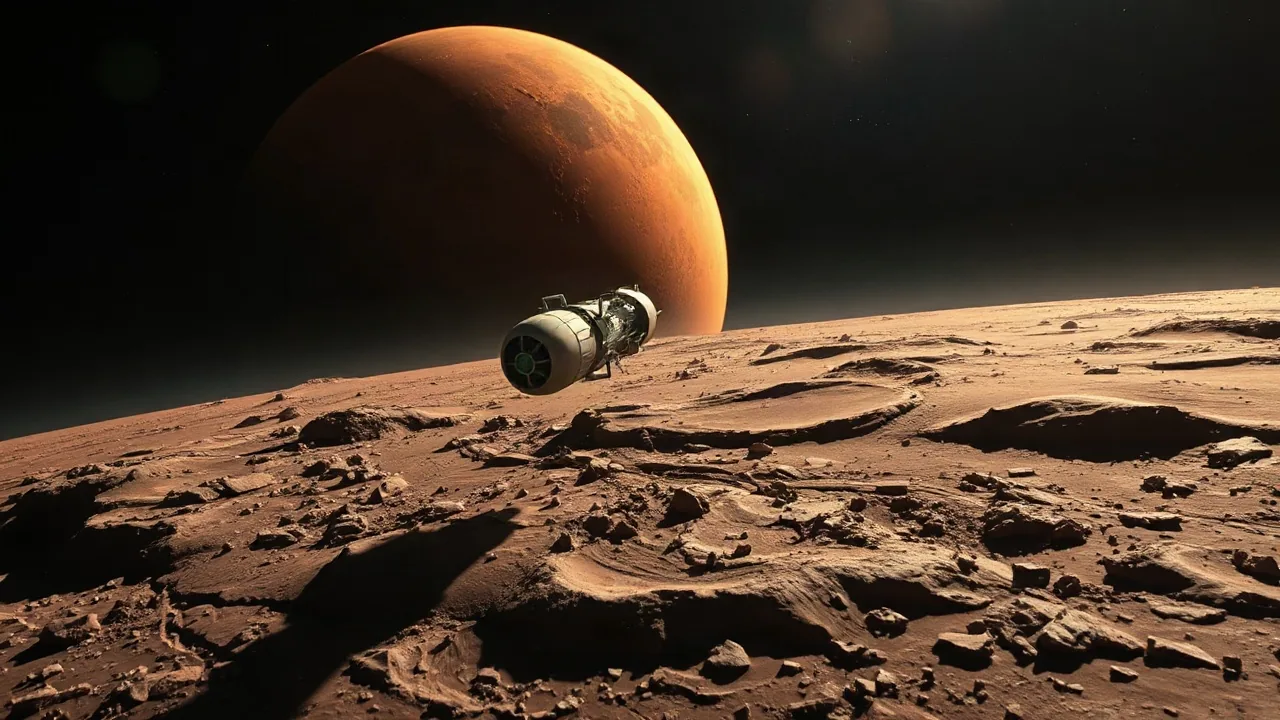
Japan's historic Mars Moons eXploration (MMX) mission blasted off from the Tanegashima Space Center on October 20, 2026, carrying a state-of-the-art spacecraft designed to land on Phobos, one of Mars's two moons, collect samples, and return them to Earth. The mission, led by the Japan Aerospace Exploration Agency (JAXA), represents a significant step in humanity's exploration of the Red Planet and its enigmatic celestial companions.
The MMX spacecraft will travel for approximately 10 months before reaching Mars. Once in orbit, it will conduct observations of both Phobos and Deimos, Mars's other moon, before descending to the surface of Phobos. Scientists hope that the samples collected from Phobos, a roughly 22-kilometer (13-mile) diameter moon, will provide crucial clues about the formation of the Martian system and potentially the solar system itself. Current theories suggest that the moons may be captured asteroids, but their composition remains a mystery.
Unraveling Martian Moon Mysteries
The primary objective of the MMX mission is to determine the origin of Phobos and Deimos. These small, irregularly shaped moons have long puzzled scientists. Unlike Earth's moon, which is thought to have formed from debris after a giant impact, Phobos and Deimos do not appear to share Mars's geological composition. This has led to speculation that they might be captured asteroids from the outer solar system or remnants from the early stages of Mars's formation.
"This is a truly once-in-a-lifetime opportunity to bring back material from a Martian moon," said Dr. Hitoshi Kuninaka, project manager for the MMX mission at JAXA. "The samples we retrieve could revolutionize our understanding of planetary formation and the history of our solar system." The Japan Aerospace Exploration Agency has partnered with several international organizations for this ambitious endeavor, including NASA, highlighting the global scientific community's interest in the mission's outcomes.
The MMX spacecraft is equipped with advanced scientific instruments, including a camera, a spectrometer, and a drill capable of collecting subsurface samples. The landing on Phobos is scheduled for 2027, and the return journey to Earth is expected by 2029. This multi-year journey underscores the complexity and technical challenges involved in interplanetary sample return missions. The mission also carries a small rover developed by NASA, which will be deployed on Phobos's surface to conduct further surface analysis before the main spacecraft departs.
The success of the sample return mission hinges on several critical maneuvers, including a precise landing on Phobos's low-gravity surface and a subsequent ascent back into orbit. JAXA has extensive experience with sample return missions, having successfully retrieved samples from asteroids Itokawa and Ryugu with its Hayabusa and Hayabusa2 missions, respectively. These past successes provide confidence for the MMX mission's ambitious goals.
Understanding the origins of Phobos and Deimos could also shed light on the conditions under which planets form and evolve in other star systems. If these moons are indeed captured asteroids, their study could offer insights into the composition and dynamics of the asteroid belt and the Kuiper Belt, providing a unique window into the early solar nebula. The data gathered by the Mars Moons eXploration mission will be made available to the global scientific community, fostering further research and discovery.