
May 2026 Blue Moon: When and Where to See Rare Lunar Event
A rare "Blue Moon," the second full moon of May 2026, will rise on the evening of May 30. Stargazers can also spot the star Antares near the moon and observe planetary alignments.

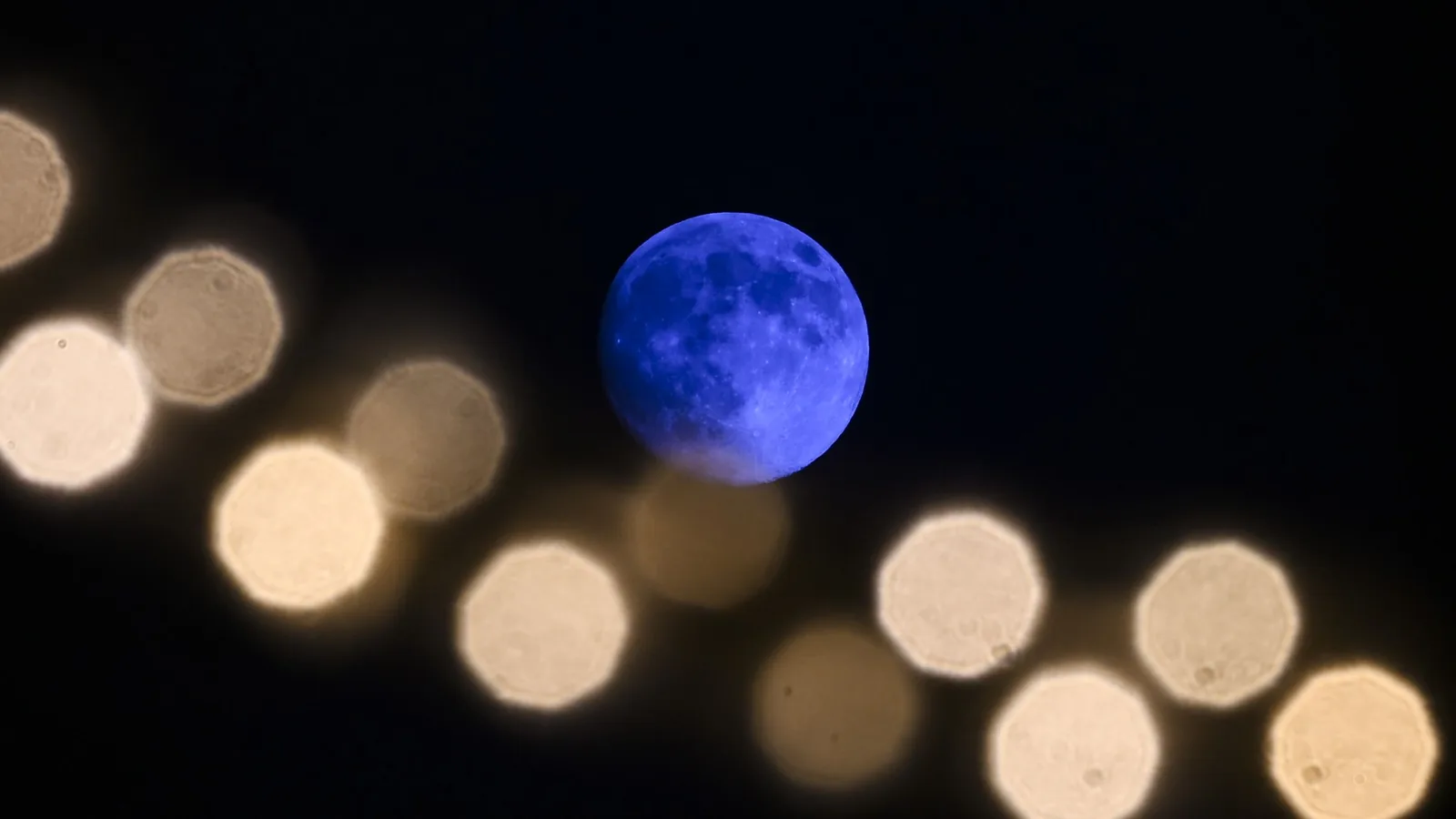
A rare celestial event, dubbed the "Blue Moon," is set to grace the eastern sky at sunset on May 30, 2026. This phenomenon marks the second full moon to occur within a single calendar month, a rarity that captivates skywatchers. The moon will rise near the prominent red star Antares, located within the constellation Scorpius.
For those eager to witness the spectacle, the Blue Moon will reach its peak illumination in the early hours of May 31, at 4:45 a.m. EDT (0845 GMT). However, viewers across the United States will have their first opportunity to observe it as it ascends above the eastern horizon around sunset on May 30. Precise viewing times for specific locales can be ascertained using astronomical tracking tools. As the moon climbs, observers should look for the distinct reddish glow of Antares, a supergiant star, positioned to the lower left of the lunar disk. Adding to the night's celestial display, Jupiter, Venus, and Mercury will form a visible line above the western horizon, illuminated by the setting sun.
Understanding the Blue Moon Phenomenon
Despite its evocative name, the Blue Moon will not exhibit a literal blue coloration. The term "Blue Moon" is a calendrical designation, not an indicator of hue. Any unusual colorations, such as the orange-red tints sometimes seen at moonrise and moonset, are atmospheric effects caused by light scattering through Earth's dense atmosphere. This specific type of Blue Moon, defined as the second full moon within a single calendar month, occurs approximately every 2.5 years. This timing anomaly arises from the discrepancy between the Gregorian calendar's monthly structure and the moon's synodic period of 29.5 days, which governs its phases.
It is important to note that an older definition of a Blue Moon also exists, referring to the third full moon in an astronomical season that contains four full moons. While this seasonal definition is less common, the May 31, 2026, event aligns with the more widely understood monthly definition. Skygazers interested in capturing the lunar event can consult guides on moon photography techniques and optimal equipment, such as cameras and lenses suited for night sky imaging.
The occurrence of a Blue Moon serves as a fascinating reminder of the interplay between celestial mechanics and human timekeeping. It highlights the slight but persistent differences between natural lunar cycles and our constructed calendars. Such events encourage public engagement with astronomy and provide a shared experience for communities worldwide. Future lunar events, including supermoons and eclipses, will continue to draw attention to the night sky.