
Moon Joins Bright Stars Spica and Antares in July Sky
This week, the moon will guide stargazers to two of summer's most brilliant stars, Spica and Antares. Look for the celestial dance from July 20-26, 2026.

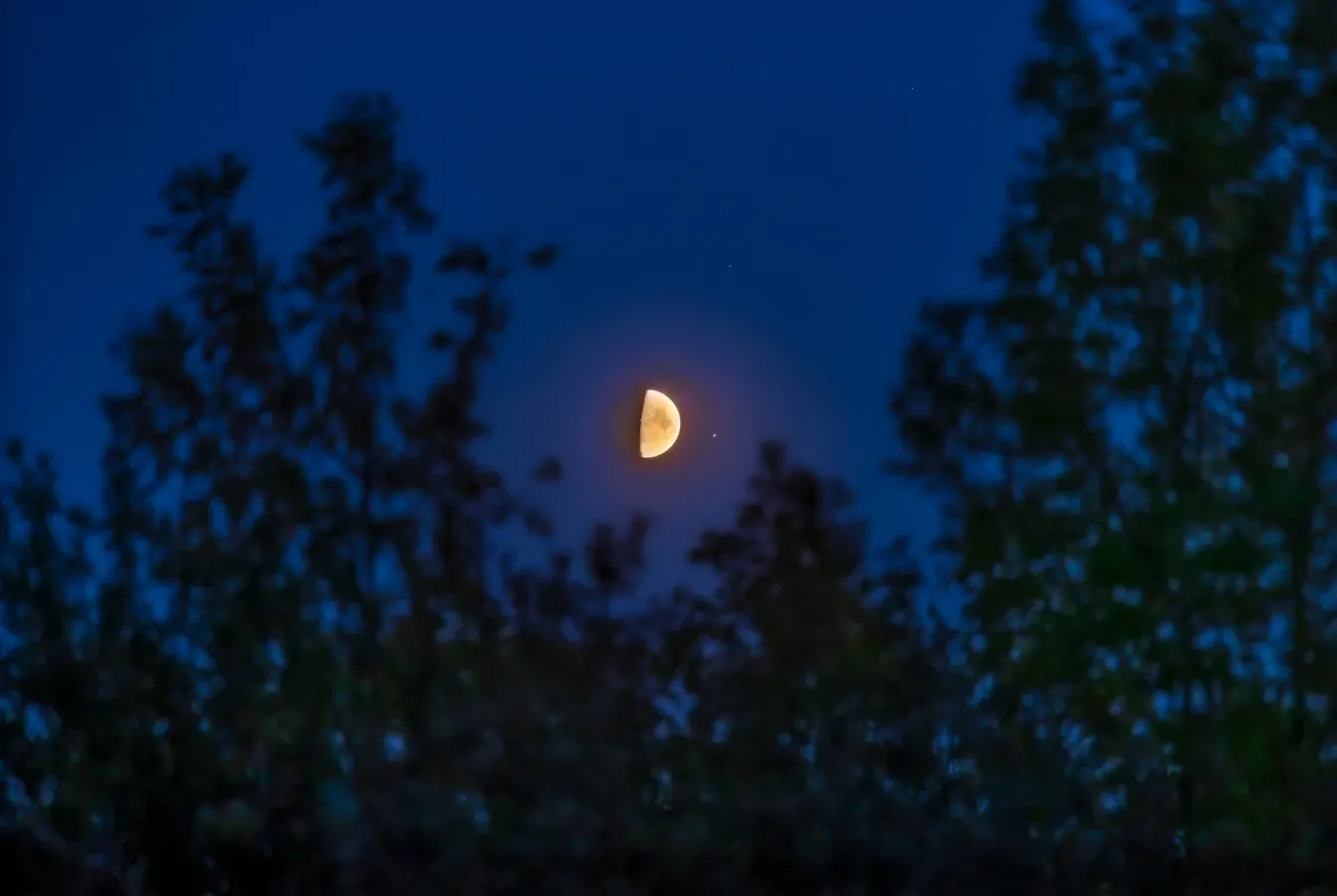
The moon will offer a celestial tour this week, guiding observers to two of the brightest stars of summer: Spica and Antares. From July 20 to July 26, 2026, the lunar phase will draw attention to these prominent points of light in the night sky, providing a perfect opportunity for amateur astronomers and casual skywatchers alike. The week begins with the moon positioned near Spica in the constellation Virgo, a star renowned for its brilliance during the Northern Hemisphere's summer months. By July 21, the moon will appear half-lit, continuing its journey.
Later in the week, the moon's path will bring it close to Antares, a striking red supergiant star located in the constellation Scorpius. Antares, situated approximately 550 light-years from Earth, is one of the largest stars visible from our planet. For those in North America and across mid-northern latitudes, this celestial alignment offers a fantastic chance to observe these astronomical wonders.
The constellation Scorpius itself is a notable sight in the summer sky. Unlike many constellations that require imagination to decipher their forms, Scorpius genuinely resembles the creature it represents, with a distinct curved body and a hooked tail. While the entire constellation may not be fully visible from mid-northern latitudes as it hugs the southern horizon, individual bright stars are easily identifiable. Among these are the three bright stars within the scorpion's stinger: Shaula, Acrab, and Dschubba. Observing these, alongside the prominent Antares, makes for a rewarding stargazing experience.
Looking Ahead to August Celestial Events
The lunar cycle continues its progression over the coming weeks. The moon will continue to wax, leading up to the full Buck Moon on July 29, which will rise during dusk. Following this, the Delta Aquariid meteor shower is set to peak on July 31 and August 1. However, stargazers should note that the shower's visibility may be affected by bright moonlight. Shortly after, the annual Perseid meteor shower will begin its build-up, reaching its peak on the night of August 12-13. This shower is anticipated to produce around 50 shooting stars per hour, promising a spectacular display.
Adding to the excitement, a total solar eclipse is scheduled to occur just before the Perseid peak. On August 12, the moon will transit directly between the Earth and the sun, casting a shadow across specific regions. The path of totality, though narrow, will stretch across eastern Greenland, western Iceland, and northern Spain. Viewers within this path will experience a brief period of totality, up to 2 minutes and 18 seconds, during which daylight will transform into a deep twilight, and the sun's corona may become visible if the skies are clear.
Eclipse enthusiasts are preparing for this event in diverse locations, from Greenland's Scoresby Sund to Iceland's dramatic volcanic landscapes and Spain's flat coastal horizons. For North America, the eclipse will be a partial event, with the greatest coverage visible in eastern Canada and the northeastern United States. Cities like St. John's will see approximately 53% of the sun obscured, while Halifax can expect about 31%, Boston 16%, and New York around 10%. It is crucial for anyone viewing the solar eclipse to use proper solar eclipse glasses to protect their eyes. The celestial events described are timed for mid-northern latitudes, and specific timing for other locations can be found using online planetarium software.
The coming weeks offer a rich tapestry of celestial events, from the moon's close encounters with bright stars to significant meteor showers and a dramatic total solar eclipse. These occurrences provide compelling reasons for the public to engage with the wonders of astronomy and to look up at the night sky.