
NASA Taps Blue Origin for Crucial Mars Communications Orbiter
NASA has chosen Blue Origin to develop and build a vital communications orbiter for its upcoming Mars exploration missions. The contract signifies a major step in enhancing data transfer capabilities for future robotic and potentially human endeavors on the Red Planet.

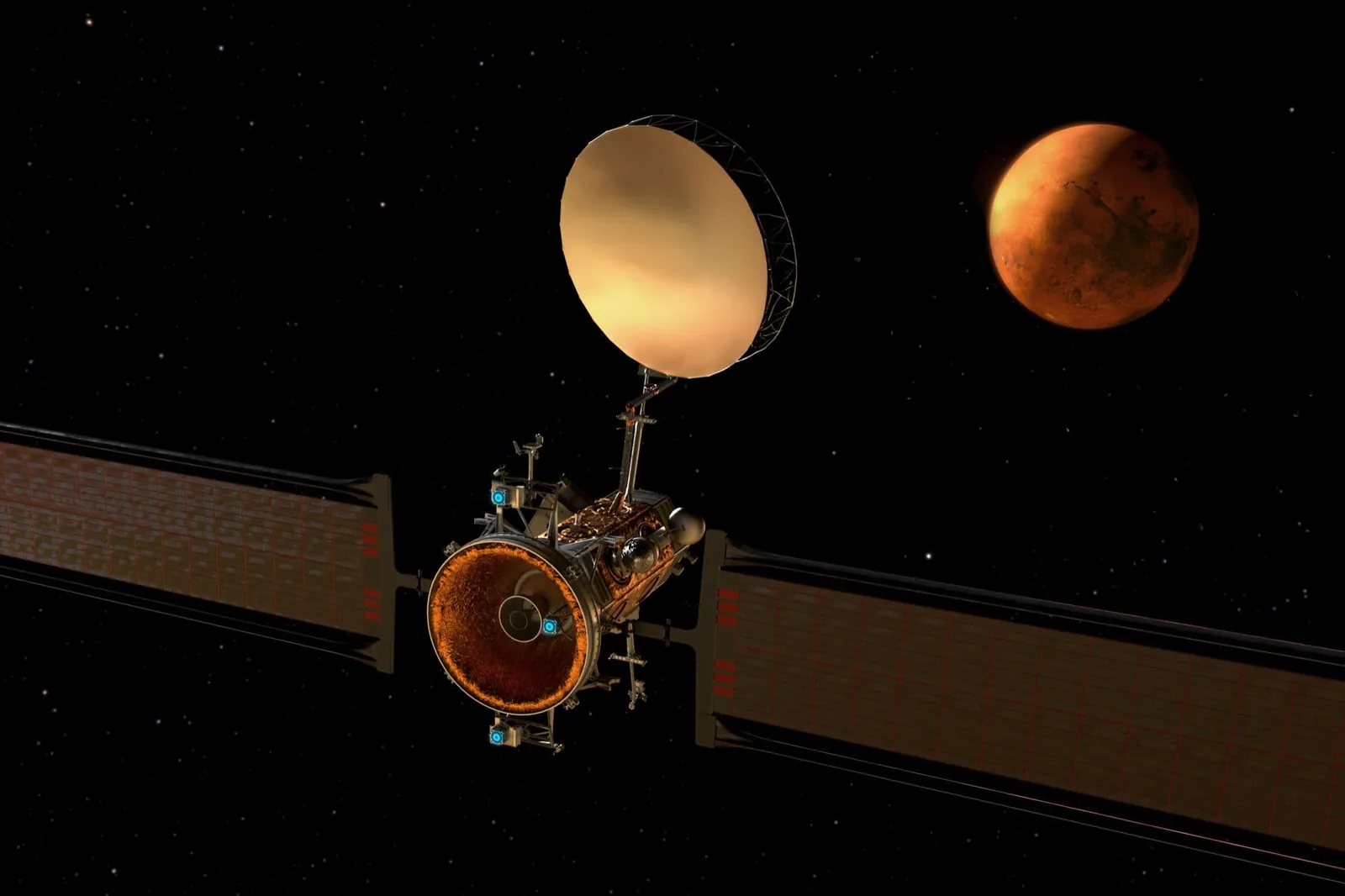
NASA has officially selected Blue Origin to provide a critical communications orbiter for its ongoing Mars exploration initiatives. The contract, awarded by the U.S. space agency, designates the company founded by Jeff Bezos to design, build, and operate the spacecraft, which will significantly bolster data relay capabilities between Earth and Mars. This development is a key component in NASA's strategy to enhance communication infrastructure for future robotic landers, rovers, and ultimately, human missions to the Red Planet.
The new orbiter is envisioned to function as a vital node in the Deep Space Network, providing higher bandwidth and more reliable data transmission than currently available. This will allow for the swift transfer of vast amounts of scientific data collected by surface assets, as well as crucial telemetry and command information. It also paves the way for real-time or near-real-time communication, a significant leap forward from the current communication delays dictated by planetary alignment and orbital mechanics.
Enhancing Mars Exploration Capabilities
The selection of Blue Origin represents a significant investment by NASA in its long-term vision for Mars exploration. While specific financial details of the contract were not immediately disclosed, the scope of the project suggests a multi-year development and deployment timeline. This initiative aims to overcome the current limitations in communication bandwidth, which have often constrained the pace and complexity of scientific investigations on the Martian surface. Higher data rates will enable more sophisticated scientific instruments and potentially allow for remote operation of rovers and other assets with greater autonomy and responsiveness.
This move also underscores NASA's strategy of diversifying its partnerships for major space missions. Blue Origin, while a newer entrant into the large-scale spacecraft development arena compared to established players, has been steadily building its capabilities in launch services and other space technologies. Securing this contract positions Blue Origin as a key player in NASA's future deep space architecture. The orbiter's mission is expected to commence in the late 2020s or early 2030s, aligning with a projected increase in the cadence of Mars missions.
A spokesperson for NASA's Jet Propulsion Laboratory (JPL), which often manages planetary missions, stated, "This communications orbiter is essential for the next generation of Mars science. It will enable us to receive unprecedented volumes of data and maintain continuous contact with our explorers on the surface." The successful deployment and operation of this communications orbiter will be crucial for missions such as potential sample return efforts and the groundwork for eventual human sorties. The enhanced communication infrastructure will also be invaluable for supporting future human missions to Mars, providing a robust link for astronaut health monitoring, operational commands, and scientific observations.
The development of such advanced space communication systems is a complex undertaking, requiring cutting-edge engineering and rigorous testing. Blue Origin will need to leverage its expertise in satellite design, propulsion, and long-duration spaceflight operations to meet NASA's demanding requirements. This project aligns with the broader goals of enhancing interplanetary communication networks, a challenge that extends beyond Mars to future explorations of the outer planets and beyond. The success of this initiative could serve as a model for future communication infrastructure development in deep space exploration.