
NASA Confirms Mars Maven Spacecraft Mission Ended After Decade
After six months of silence, NASA has declared its Mars Atmosphere and Volatile Evolution (MAVEN) spacecraft mission over. Launched in 2013, the spacecraft studied the Martian atmosphere for over a decade.

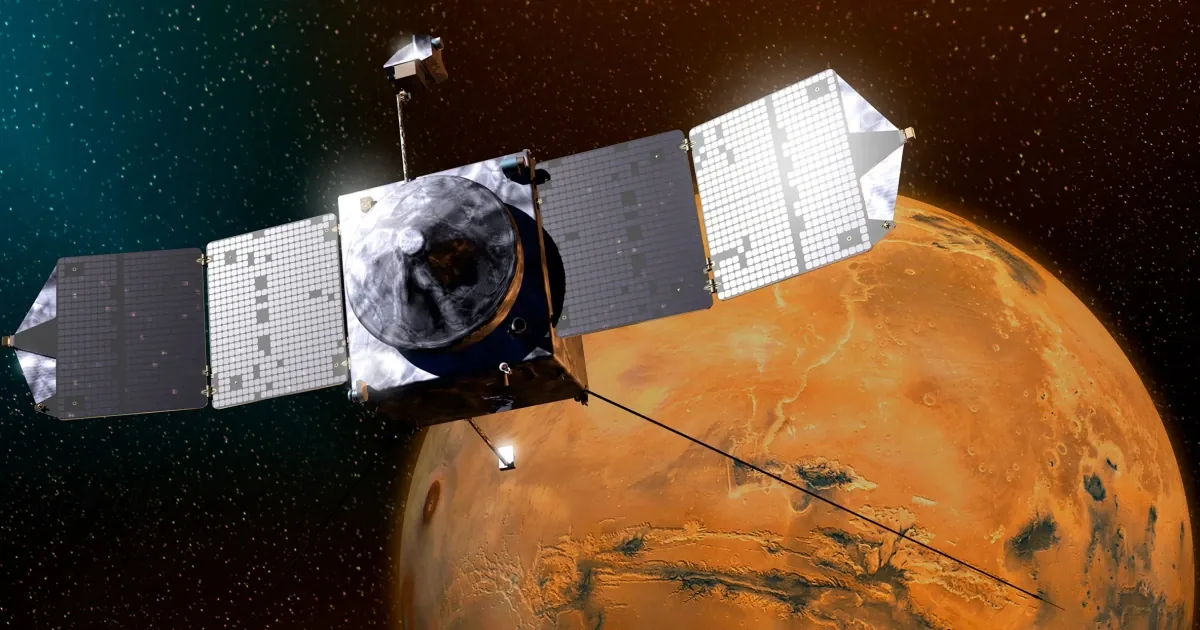
NASA officially declared the end of its Mars Atmosphere and Volatile Evolution (MAVEN) mission on Wednesday, confirming the spacecraft's demise after more than a decade of studying the Red Planet. The spacecraft fell silent in early December, following a maneuver where it passed behind Mars, leading to a rapid spin that depleted its batteries and disrupted its orbit. A NASA review board convened earlier this year determined the spacecraft to be unrecoverable.
Launched in November 2013 from Cape Canaveral, Florida, the MAVEN mission's primary objective was to investigate the Martian upper atmosphere and its interaction with the Sun and solar wind. For ten years, the orbiter gathered crucial data on how atmospheric loss has shaped Mars over billions of years, providing insights into whether the planet ever possessed a thicker atmosphere and liquid water.
Investigating Mars' Atmospheric Mysteries
During its extended mission, MAVEN made significant contributions beyond its core objectives. It played a vital role in relaying communications for NASA's surface rovers, including Curiosity and Perseverance. The spacecraft also observed an interstellar comet, C/2013 U1 (Lovejoy), in 2015, an event that offered rare insights into objects originating from outside our solar system.
The exact cause of the spacecraft's rapid spin and subsequent loss of communication is still under investigation by NASA. Initial data suggests an anomaly occurred during its passage behind Mars, leading to the uncontrolled rotation and power drain. This event marked a sudden end to a mission that had already exceeded its planned one-year duration by nearly a decade.
Shannon Curry, MAVEN's lead scientist at the University of Colorado Boulder, expressed the mission's impact, stating that the spacecraft achieved "amazing discoveries" and "truly advanced our understanding of the Martian atmosphere and evolution." The data collected by MAVEN is expected to inform future exploration efforts and contribute to our understanding of planetary climate change.
The loss of MAVEN represents a significant setback for ongoing Martian atmospheric research. However, the wealth of data it gathered over its operational life is considered invaluable for scientists seeking to comprehend the history and potential habitability of Mars. The findings from MAVEN will continue to be analyzed for years to come, shaping our perception of the Red Planet's past and future.