
NASA's Psyche Spacecraft Captures Stunning Mars Flyby Views
NASA released breathtaking footage from its Psyche spacecraft during a recent flyby of Mars. The images offer a unique perspective of the Red Planet from 4,609 km away.

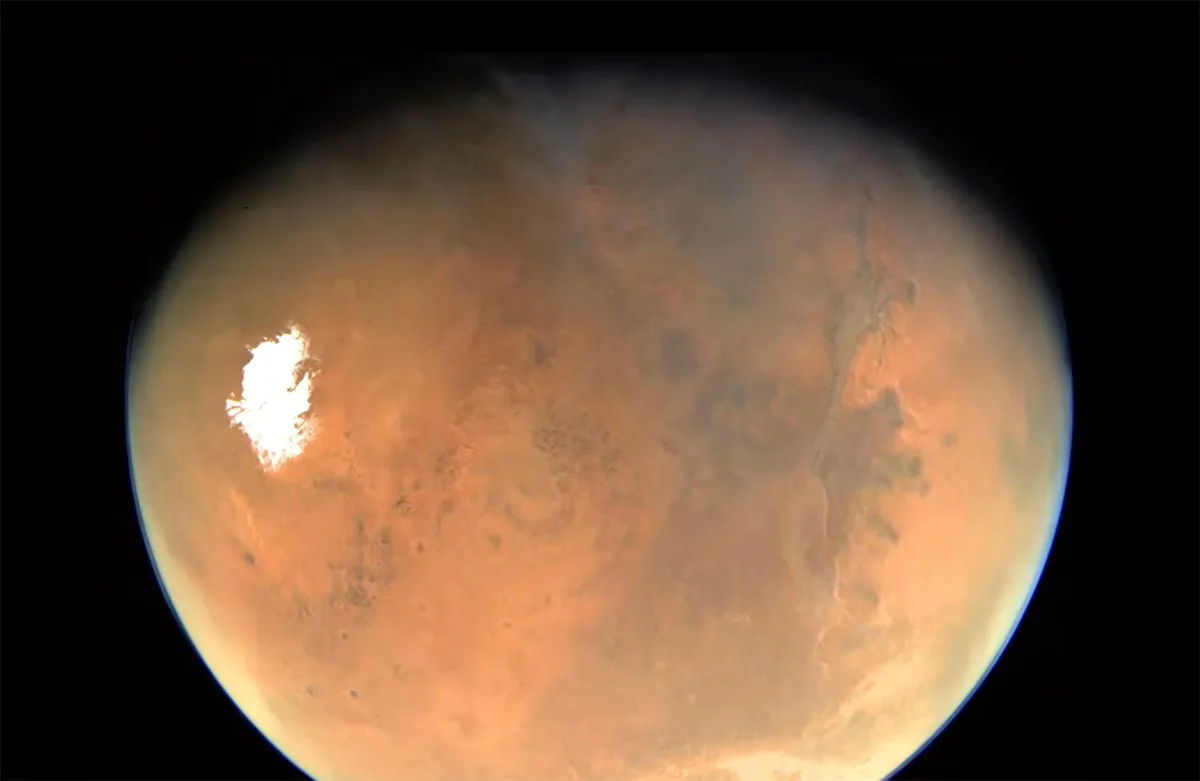
NASA has unveiled striking new video footage captured by the Psyche spacecraft as it completed a significant flyby of Mars. The spacecraft, currently en route to study the metal-rich asteroid Psyche in the main asteroid belt, passed within 4,609 kilometers (2,864 miles) of the Red Planet in May 2026. The resulting imagery provides an unprecedented view of Mars from a distance, showcasing its distinct surface features.
As the Psyche spacecraft approached Mars, the planet initially appeared as a slender crescent due to the relative positions of the spacecraft, Mars, and the Sun. However, as Psyche drew closer, it was able to capture increasingly detailed images of the Martian terrain. These views included recognizable craters, the planet's south polar ice cap, and the prominent Huygens crater, a large double-ringed impact basin. The images were acquired over the course of a month-long flyby period.
Gravity Assist Boosts Deep Space Mission
The journey to the asteroid Psyche is a long one, and like many deep space missions, it involves strategic maneuvers to conserve fuel. Engineers often utilize 'gravity assist maneuvers,' a technique that employs the gravitational pull of a large celestial body, such as a planet, to accelerate or alter a spacecraft's trajectory. The Mars flyby served precisely this purpose for the Psyche mission, providing a crucial gravitational boost. Beyond trajectory adjustments, these flybys offer invaluable opportunities to test scientific instruments in preparation for the mission's primary objectives.
In addition to its primary goal of reaching asteroid Psyche in 2029, the Mars flyby allowed the mission team to rigorously test Psyche's sophisticated science instruments. The spacecraft is equipped with a multispectral imager, featuring a pair of cameras designed to photograph surfaces across various wavelengths of light. These same cameras captured the recent Mars imagery, enabling scientists to verify the instruments' functionality and performance. According to mission scientists, the instruments operated as expected, returning data that aligns with existing knowledge of Mars while also offering potentially novel insights from Psyche's distinct vantage point.
“The mission’s imager, magnetometer, and gamma-ray and neutron spectrometer teams worked overtime to make full use of this planetary encounter, and all instruments delivered great results,” said Lindy Elkins-Tanton, principal investigator for Psyche at the University of California, Berkeley. “We didn’t anticipate big discoveries, given how extensively the planet has been studied, but we did complement Mars science with the data we collected through Psyche’s unique perspective.”
One of Psyche's key instruments is a gamma-ray and neutron spectrometer, designed to analyze the elemental composition of materials on the asteroid's surface. During the Mars flyby, this instrument was able to conduct scientific observations. The principle behind this instrument involves measuring the neutrons and gamma rays emitted when cosmic rays interact with a planet's surface, allowing scientists to deduce the chemical makeup of that body. “Around the time of Mars closest approach, the neutron spectrometer detected a count-rate enhancement close to what we anticipated. It was very gratifying to see,” stated David Lawrence, science lead for Psyche’s spectrometer at the Johns Hopkins Applied Physics Laboratory. “As expected, we didn’t detect gamma rays from Mars, but we put the instrument through its paces, and it performed excellently.”
The mission also features a magnetometer, which is intended to measure asteroid Psyche's magnetic field to determine if the asteroid is indeed the metallic core of a protoplanet. The Mars flyby marked the first time this magnetometer measured the magnetic field signature of any celestial body. “As the spacecraft passed close to Mars, the magnetometer saw an intense uptick in magnetic field corresponding to the bow shock region, where the solar wind slams into the planet’s magnetic field,” explained Ben Weiss, Psyche’s deputy principal investigator and magnetometry investigation lead at the Massachusetts Institute of Technology. “This flyby calibration effort validated the instrument’s performance under dynamic conditions while also revealing the fascinating physics of planetary magnetism.”
Jim Bell, Psyche imager instrument lead at Arizona State University, commented on the imager's performance: “Psyche's imager performed brilliantly, delivering some rarely seen views of the Red Planet. Besides the obvious beauty of the photos, we were also able to fully test its calibration and sensitivity to scattered light, including picking out the Martian moons Phobos and Deimos from very far away as a part of a practice for the satellite search that we’ll use at the asteroid Psyche to look for any moonlets there.” The mission team is now engaged in comparing these new images with existing data from other Mars orbiters and rovers. Meanwhile, Psyche continues its voyage toward its asteroid target. “This gravity assist was years in the making, and the navigation team nailed it – Psyche flew by Mars on exactly the trajectory we needed to set us on a path to rendezvous with the asteroid in the summer of 2029,” said Bob Mase, Psyche’s project manager at NASA’s Jet Propulsion Laboratory. “The spacecraft is in great shape, and we’re on schedule to resume sustained thrusting with the solar-electric propulsion system later this fall.”