
NASA's Roman Telescope Launches to Uncover Universe's Dark Secrets
NASA's new Nancy Grace Roman Space Telescope has successfully launched, aiming to explore dark energy, black holes, and exoplanets with its unprecedentedly wide field of view.

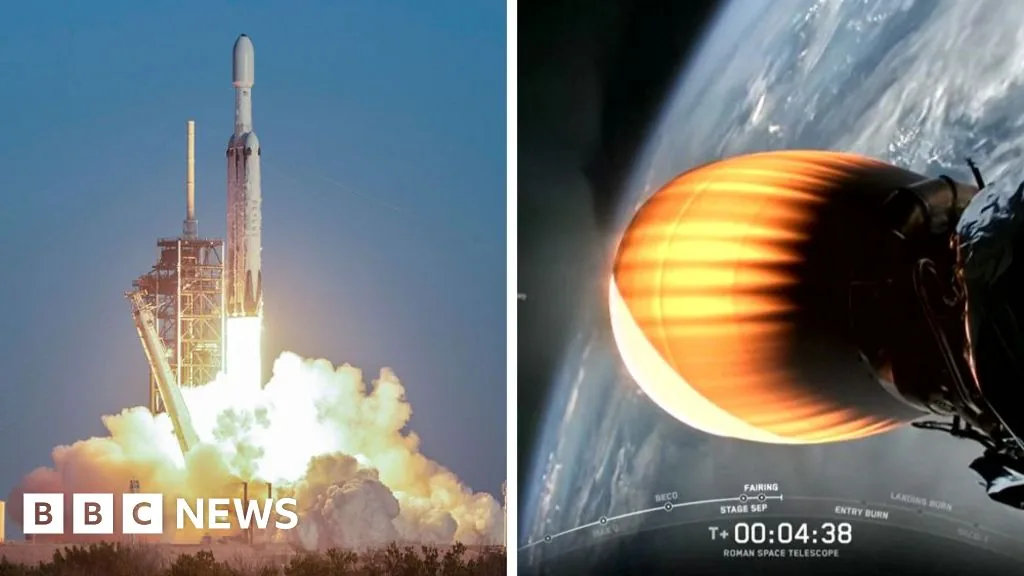
NASA's powerful next-generation Nancy Grace Roman Space Telescope successfully blasted off from Florida on Sunday morning, embarking on a mission to unravel some of the Universe's deepest mysteries, including dark energy, black holes, and the potential for life beyond Earth. The telescope is designed to capture expansive panoramic views of space, boasting a field of vision 100 times larger than that of both the Hubble and James Webb space telescopes. Its journey begins with a 100-day voyage to a vantage point approximately one million miles from Earth, from where it will commence charting planets outside our solar system, known as exoplanets.
"Roman is going to change the way we look at the Universe," said Nicky Fox, a NASA administrator. The successful launch took place from the Kennedy Space Center in Florida. Jackie Townsend, a project manager for NASA's Roman telescope, described the event as "glorious" during a news conference. "The ride was magnificent. It put us right where we wanted to be." Roughly 30 minutes after its launch atop a SpaceX rocket, Roman separated and began its transit to its designated orbit.
Fox further elaborated on Roman's ambitious exoplanet discovery potential, stating, "Roman is going to discover tens of thousands, maybe even 100,000 new exoplanets." She emphasized the significance of this pursuit: "Why do we care so much about exoplanets? Because one of our main goals at NASA is answering the question, 'Are we alone in the Universe?'" The mission's scope extends to mapping billions of galaxies and studying cosmic phenomena.
Understanding Dark Energy and Dark Matter
The Nancy Grace Roman telescope is poised to revolutionize our understanding of the cosmos, particularly in its investigation of dark energy and dark matter. These elusive components are believed to constitute about 95% of the Universe. Dark matter, though invisible, provides the gravitational scaffolding for cosmic structures, while dark energy is the mysterious force accelerating the Universe's expansion. Scientists anticipate that Roman's wide-field instrument will offer unprecedented data to help characterize these fundamental cosmic constituents.
Astronomer Jenifer Millard explained that the telescope's distant orbit, four times further from Earth than the Moon, is crucial for its infrared observation capabilities. This positioning is intended to prevent interference from the infrared light emitted by Earth and the Moon, ensuring clearer data collection for instruments designed to detect "heat light." While NASA's James Webb Space Telescope, launched in 2021, also operates about a million miles from Earth, its observational scope is more focused compared to Roman's expansive survey capabilities.
The telescope honors physicist Nancy Grace Roman, NASA's first chief astronomer and its first female executive in the 1960s. She played a pivotal role in securing approval for the Hubble Space Telescope and later identified dark energy as its most intriguing discovery. The new Roman telescope is expected to build upon this legacy, significantly advancing our comprehension of phenomena like dark energy and dark matter.
With a primary mission lifespan of five years and a goal to operate for ten, Roman's "crisp, sweeping surveys will help scientists investigate dark energy and dark matter, discover and characterise exoplanets, map billions of galaxies, study black holes, and explore objects from our own solar system to the edge of the observable Universe," according to NASA. The pursuit of answering whether humanity is alone in the Universe, a core objective for NASA, is expected to be significantly advanced by Roman's ability to observe distant worlds and potentially resolve their atmospheres, offering clues to habitability.