
Northern Lights Visible This Weekend: 10 States Could See Aurora
The aurora borealis may grace the skies of up to 10 U.S. states this weekend, July 31 to August 2, as a solar storm impacts Earth. A coronal mass ejection from the sun could bring the celestial display to northern regions.

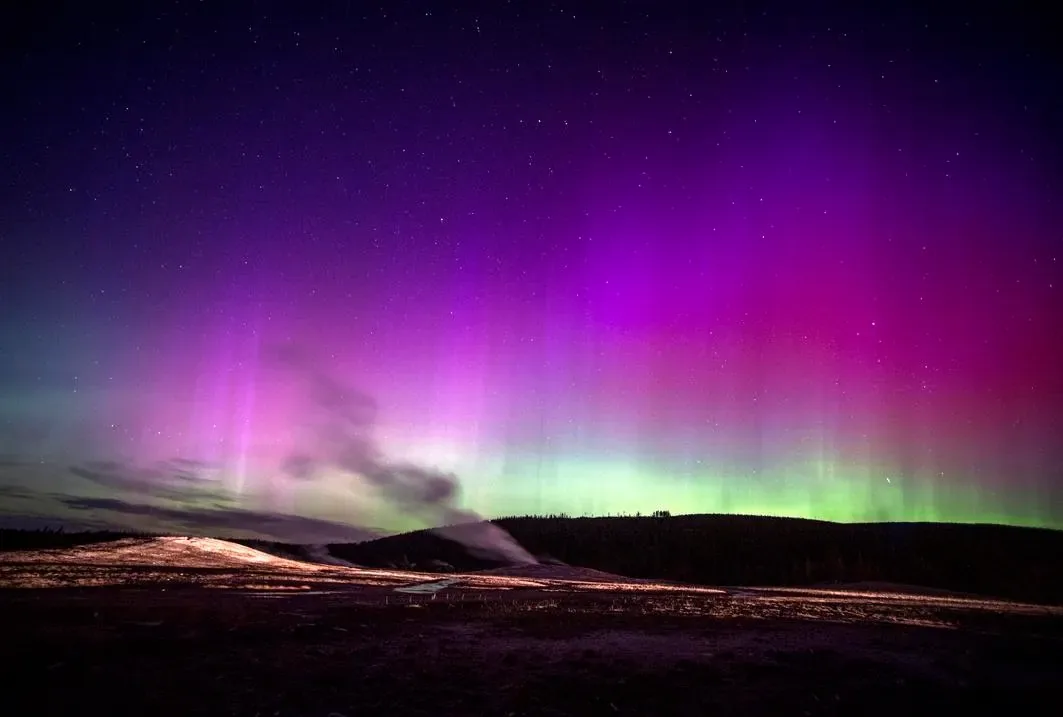
The aurora borealis, commonly known as the northern lights, is forecast to be visible across parts of the northern United States this weekend, from Friday, July 31, through Sunday, Aug. 2. This celestial event is expected as a coronal mass ejection (CME) that departed the sun on July 30 interacts with Earth's magnetic field. While the CME's arrival is anticipated in the early hours of Sunday, Aug. 2, potentially triggering a G2-class geomagnetic storm, lesser but significant geomagnetic activity might also be observable early Saturday, Aug. 1.
Experts at Spaceweather.com reported that the CME, a massive cloud of solar plasma and magnetic fields, was ejected following a solar flare that, though weak, persisted for many hours. The initial impact on Saturday could push the aurora into view for residents in northern-tier U.S. states situated near the Canadian border. However, this display might be faint, possibly only detectable by camera equipment rather than the naked eye, as phone cameras are often more sensitive to low light conditions. The combination of short summer nights and the recent full moon may further diminish the visibility of any faint aurora.
Conditions for Viewing
According to forecasts from the National Oceanic and Atmospheric Administration (NOAA), heightened geomagnetic activity is possible on Saturday, Aug. 1, with Kp 4 conditions predicted. Approximately 24 hours later, early Sunday, Aug. 2, a G2-class geomagnetic storm is expected, forecast to reach Kp 5.67 conditions, followed by a G1-class storm in its wake. "G1-G2 (Minor-Moderate) geomagnetic storms are likely on 02 Aug due to the anticipated arrival of a CME that left the sun on 30 Jul," NOAA stated in its forecast discussion. Isolated active periods were also suggested for Saturday, Aug. 1, resulting from CMEs that left the sun between July 26-27.
The UK Met Office’s Space Weather Operations Center offered a similar outlook but expressed slightly more caution, forecasting a weak CME that might deliver glancing impacts late on July 31. They also noted a chance of active intervals from any CME glance or fast wind enhancement through August 1-2, with a potential for G1-G2 geomagnetic storms from the July 30 CME arrival. These predictions indicate a relatively modest space weather event, sufficient to offer observers in northern U.S. states a chance to witness the aurora, provided skies are clear and the solar wind's magnetic field aligns southward upon reaching Earth.
Visibility of the northern lights, or aurora borealis, across states like Washington, Idaho, Montana, North Dakota, Minnesota, Wisconsin, Michigan, Maine, Vermont, and New Hampshire is possible with a G1 geomagnetic storm. A stronger G2 storm could potentially extend faint auroral displays into northern parts of Oregon, Wyoming, Nebraska, Iowa, Illinois, Indiana, Ohio, Pennsylvania, New York, Vermont, and New Hampshire. However, current forecasts do not anticipate widespread visibility across central or southern U.S. regions. It's important to remember that Kp values do not guarantee aurora visibility at every location within a given latitude; some areas might only register a faint photographic glow.
The ultimate success of witnessing the aurora borealis depends on several factors beyond geomagnetic storm strength. Clear skies are paramount, as are low levels of light pollution. Locations far from city lights will offer the best chance to see faint displays. Additionally, the orientation of the interplanetary magnetic field, known as Bz, plays a crucial role. When the Bz component points southward, it can connect more efficiently with Earth's magnetic field, allowing greater energy and charged particles to enter the magnetosphere. A sustained southward Bz orientation could intensify the aurora and push its visibility further south than predicted. Conversely, a northward Bz direction might result in weaker displays or restrict them to higher latitudes. Skywatchers are advised to look towards the northern horizon during the darkest hours of the night for the best viewing opportunities.