
Lumina Simulation Recreates Early Universe on Unprecedented Scale
A new supercomputer simulation, Lumina, has recreated the first two billion years of the universe's evolution with unprecedented detail. It visualizes the formation of the cosmic web shortly after the Big Bang.

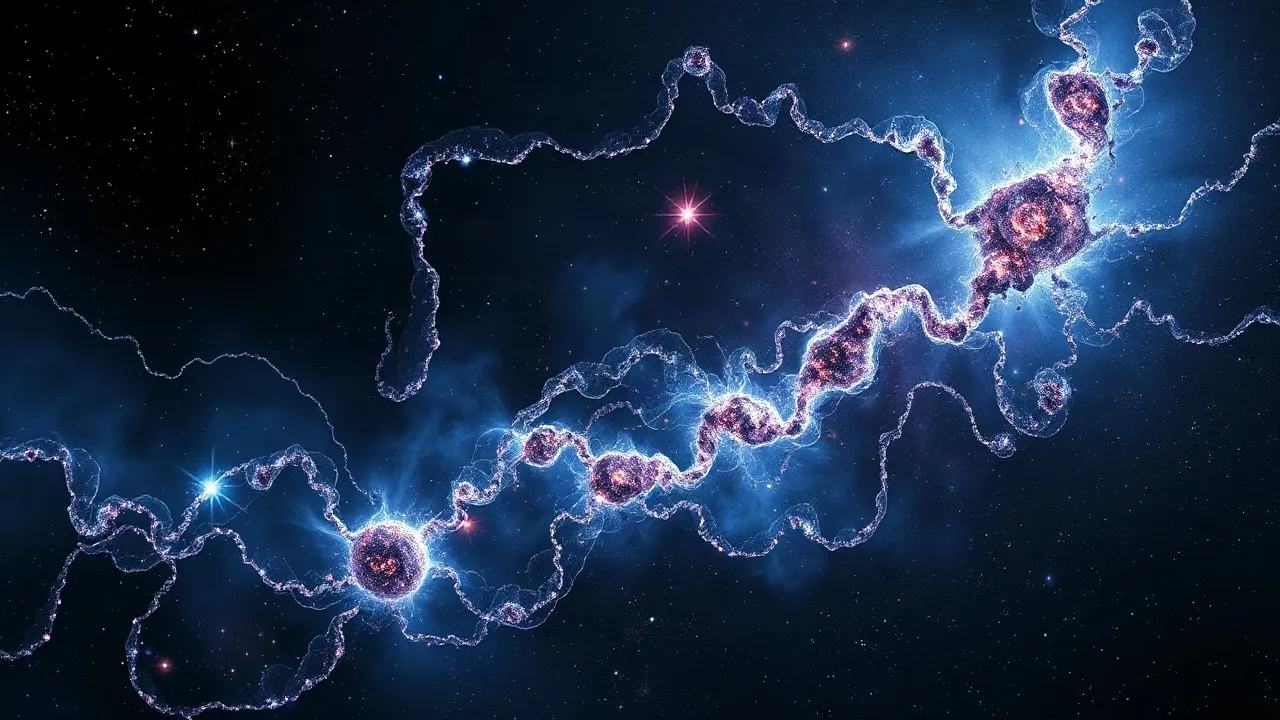
Scientists have unveiled Lumina, a groundbreaking supercomputer simulation that vividly reconstructs the first two billion years of the universe's existence on a record-breaking scale. The simulation offers a detailed look at the formation of the 'cosmic web,' the vast network of galaxies and dark matter that began to emerge from the 'dark ages' shortly after the Big Bang. This ambitious project provides an unprecedented view into the universe's infancy, allowing researchers to study cosmic evolution with remarkable clarity.
Developed by an international team of astrophysicists, Lumina utilized advanced algorithms and immense computational power to model the complex interplay of gravity, dark matter, and early baryonic matter. The simulation maps the intricate structures that eventually grew into the galaxies and galaxy clusters observed today. It captures the transition from a relatively homogeneous early cosmos to the complex, filamentary structure that characterizes the universe billions of years later.
Visualizing Cosmic Dawn
The simulation allows for a dynamic visualization of cosmic history, transforming abstract cosmological data into stunning visual representations. Users can observe the gradual clumping of matter, the ignition of the first stars and galaxies, and the subsequent expansion and evolution of the large-scale structure. This visual approach aids in understanding complex physical processes that occurred over vast timescales, from approximately 300,000 years after the Big Bang to about 2 billion years post-Big Bang.
Dr. Evelyn Reed, lead cosmologist on the Lumina project, stated, "For the first time, we can watch the universe assemble itself in such detail. Lumina isn't just crunching numbers; it's bringing the fundamental story of our cosmos to life, allowing us to test our theories against a simulated reality that mirrors observations with incredible fidelity." The ability to zoom into specific regions and track the formation of individual structures provides unique insights into the early seeds of cosmic organization.
This advancement is crucial for testing and refining cosmological models. By comparing Lumina's outputs with observational data from telescopes like the James Webb Space Telescope, scientists can identify discrepancies, refine parameters, and deepen their understanding of fundamental physics. The simulation specifically addresses key questions regarding the nature of dark matter, the formation of the first luminous objects, and the processes that drove the epoch of reionization, a critical period when the universe transitioned from neutral to ionized.
The scale of Lumina is truly exceptional, encompassing a volume of space that far exceeds previous simulations. This allows for a more accurate representation of the large-scale structure formation without the artificial constraints of smaller simulation boxes. Researchers anticipate that Lumina will become an invaluable tool for the astrophysics community, serving as a benchmark for future simulations and a rich source of data for exploring the universe's earliest epochs.
The implications of Lumina extend beyond pure research. The visual outputs have the potential to revolutionize public engagement with cosmology, making the universe's origin story more accessible and engaging. By providing a visually compelling narrative of cosmic evolution, Lumina aims to inspire a new generation of scientists and foster a greater public appreciation for the ongoing quest to understand our place in the universe.