
Robotic Claws to Capture Space Debris in $80 Million Mission
An ambitious $80 million mission is set to deploy giant robotic claws to capture defunct satellites, addressing the growing threat of space junk. The initiative marks a significant step in cleaning up Earth's orbit.

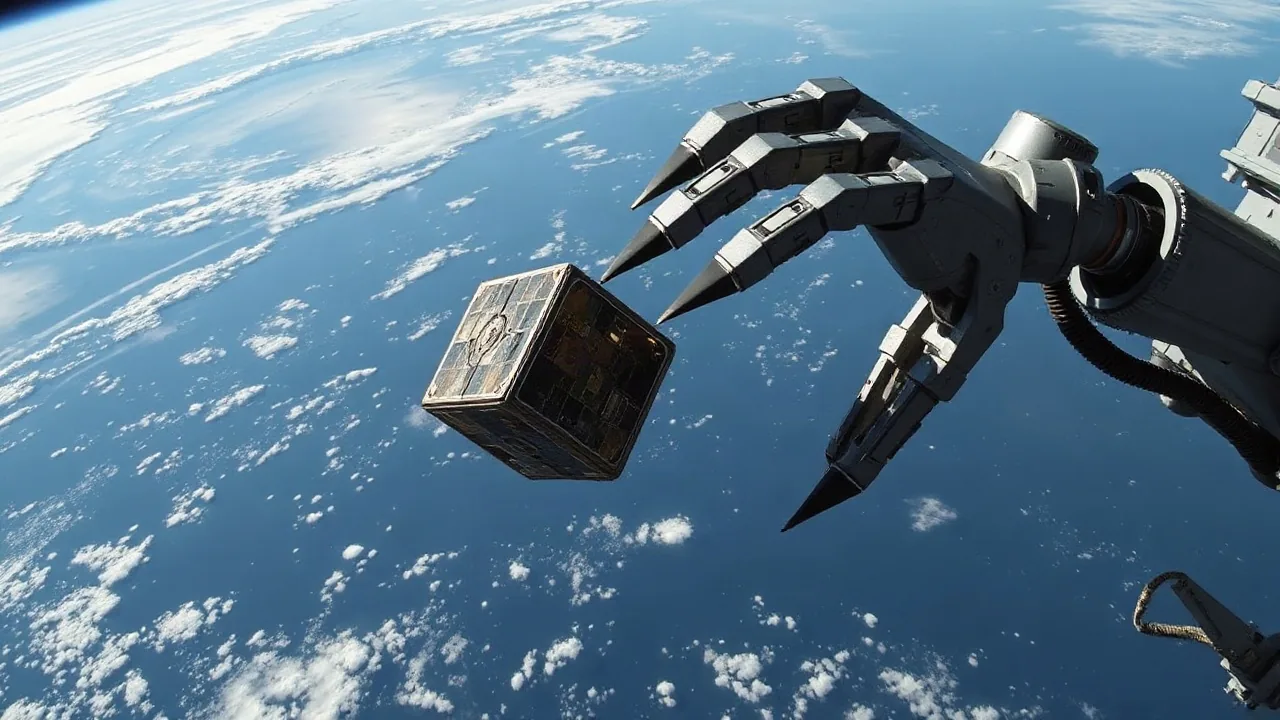
A pioneering $80 million mission is preparing to deploy advanced robotic claws into Earth's orbit to capture and deorbit defunct satellites, aiming to mitigate the escalating crisis of space debris. This initiative represents a critical advancement in the ongoing efforts to secure the long-term sustainability of space activities.
The mission, funded by international partners and led by a consortium of aerospace firms, will utilize specialized spacecraft equipped with sophisticated grasping mechanisms. These robotic arms are designed to latch onto larger pieces of space junk, such as retired satellites, and guide them safely out of orbit, preventing them from colliding with active spacecraft or contributing to further fragmentation.
Addressing the Growing Space Junk Problem
Space debris, often referred to as space junk, comprises discarded rocket bodies, defunct satellites, and fragments from collisions or explosions. It poses a significant and growing threat to operational satellites, the International Space Station, and future space missions. The United Nations estimates that there are over 900,000 pieces of debris larger than 1 cm and more than 50,000 pieces larger than 10 cm currently orbiting Earth. If left unchecked, a cascade of collisions, known as the Kessler Syndrome, could render low Earth orbit unusable.
Previous efforts to address space junk have largely focused on tracking debris and designing satellites with deorbiting capabilities at the end of their lifespans. However, the challenge of removing existing large objects has remained a significant hurdle. This new mission's focus on active capture and removal marks a more aggressive approach to orbital cleanup.
"The sheer volume of debris in orbit is reaching a critical point," stated Dr. Anya Sharma, lead mission scientist for the project. "We are no longer just talking about theoretical risks; we are seeing an increase in close calls and the potential for cascading failures. This mission is designed to tackle some of the largest and most problematic pieces of junk directly."
The robotic claws have been engineered to withstand the harsh conditions of space, including extreme temperatures and radiation. Advanced AI systems will assist in navigating the complex orbital environment, identifying targets, and executing precise maneuvers for capture. The goal is to demonstrate the feasibility and effectiveness of robotic capture as a viable solution for active space debris removal.
The $80 million budget covers the development, launch, and initial operational phase of the mission. Funding is a mix of government grants and private investment, reflecting a broad recognition of the importance of space sustainability. Following the demonstration phase, if successful, the technology could be scaled up for more extensive orbital cleanup operations, potentially involving multiple capture vehicles.
This undertaking is more than just a technological experiment; it is a crucial step towards safeguarding the space environment for future generations. As humanity continues to expand its presence in orbit for communication, navigation, scientific research, and exploration, ensuring a clean and safe orbital neighborhood becomes increasingly paramount. The success of these robotic claws could pave the way for a new era of responsible space stewardship.