
Three Supermassive Black Holes Found in Early Universe Galaxy
Astronomers have detected three supermassive black holes within a single galaxy dating back to the early universe. This groundbreaking discovery challenges current models of galaxy and black hole formation.

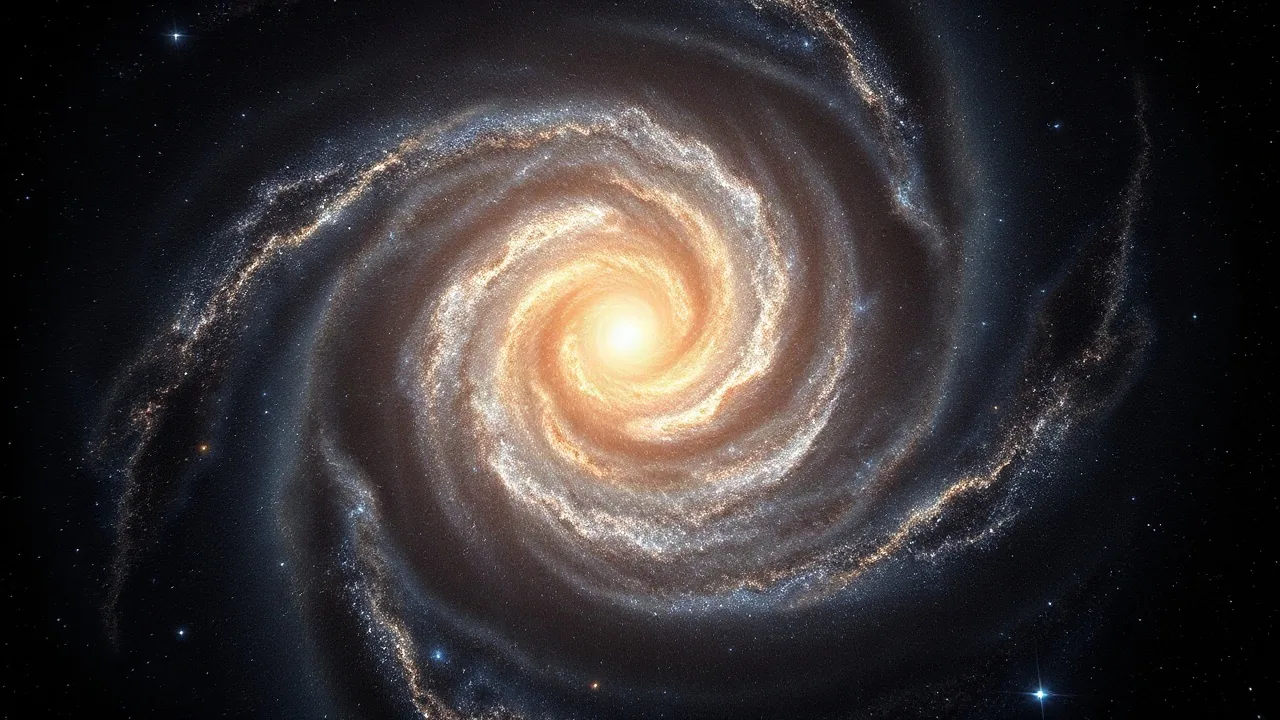
Astronomers have made a remarkable discovery, identifying three supermassive black holes residing within a single galaxy from the universe's infancy. The finding, published on October 24, 2026, provides an unprecedented glimpse into the conditions of the early cosmos and offers new challenges to existing theories of galaxy and black hole evolution. The galaxy, observed using advanced telescopic data, is estimated to have formed when the universe was only a fraction of its current age, pushing the boundaries of our understanding of cosmic history.
The detection of multiple supermassive black holes in such an ancient galaxy is particularly surprising. Current cosmological models suggest that supermassive black holes grow over billions of years, typically by accreting gas and merging with other black holes. Finding three such massive objects in a galaxy from the dawn of time implies that their formation and growth mechanisms might be more rapid and efficient than previously understood. Researchers utilized data from the Atacama Large Millimeter/submillimeter Array (ALMA) and the Hubble Space Telescope to analyze the light signatures and structural properties of the distant galaxy.
Challenging Cosmic Formation Theories
This discovery could significantly alter our understanding of how galaxies and the central black holes within them co-evolve. "To find not just one, but three active supermassive black holes in a galaxy from such an early epoch is astonishing," stated Dr. Eleanor Vance, lead astrophysicist on the research team from the Institute for Cosmic Studies. "It suggests that the processes driving the formation and growth of these cosmic behemoths might have kicked into high gear much sooner than our current models predict." The research team is now focused on analyzing the spectral data to understand the activity levels and mass distribution of each of the three black holes.
The implications extend beyond just black hole growth. The immense gravitational pull and energetic outflows from these three active black holes would have profoundly influenced the surrounding galaxy. They could have regulated star formation within the galaxy by either triggering or suppressing the birth of new stars, depending on the energy feedback mechanisms at play. Understanding this intricate interplay is crucial for piecing together the complete evolutionary narrative of galaxies in the early universe. The scientists are particularly interested in how these multiple black holes co-existed without disrupting the galactic structure to a point of collapse.
Further observations are planned using next-generation telescopes to gather more detailed information about the galaxy and its inhabitants. Scientists hope to map the distribution of gas, dust, and stars more precisely and to determine the precise masses and accretion rates of each black hole. This multi-faceted approach will be key to unraveling the mystery of how such a complex system could arise so early in cosmic history. The existence of such a system challenges our fundamental assumptions and opens up new avenues for theoretical and observational research in astronomy.