
Neutrino Science: Nobel Prize Physics Explores Universe's Origins
This year's Nobel Prize in Physics honors breakthroughs in understanding neutrinos, elusive subatomic particles crucial for unraveling the universe's mysteries. Research involving the IceCube Neutrino Observatory played a pivotal role.

The 2026 Nobel Prize in Physics has been awarded to researchers for their groundbreaking work on neutrinos, fundamental subatomic particles that hold keys to understanding the cosmos. These nearly massless particles, often called "ghost particles" due to their elusive nature, interact very weakly with matter, making them incredibly difficult to detect but also providing a unique window into extreme cosmic environments.
The award recognizes decades of persistent scientific inquiry into the nature of neutrinos and their role in the universe. Neutrinos are produced in vast quantities by stars, supernovae, and other energetic cosmic events. By studying these particles, scientists can gain insights into the processes occurring at the very core of stars and the aftermath of colossal cosmic explosions that are otherwise hidden from view.
Unveiling the Universe's Secrets with IceCube
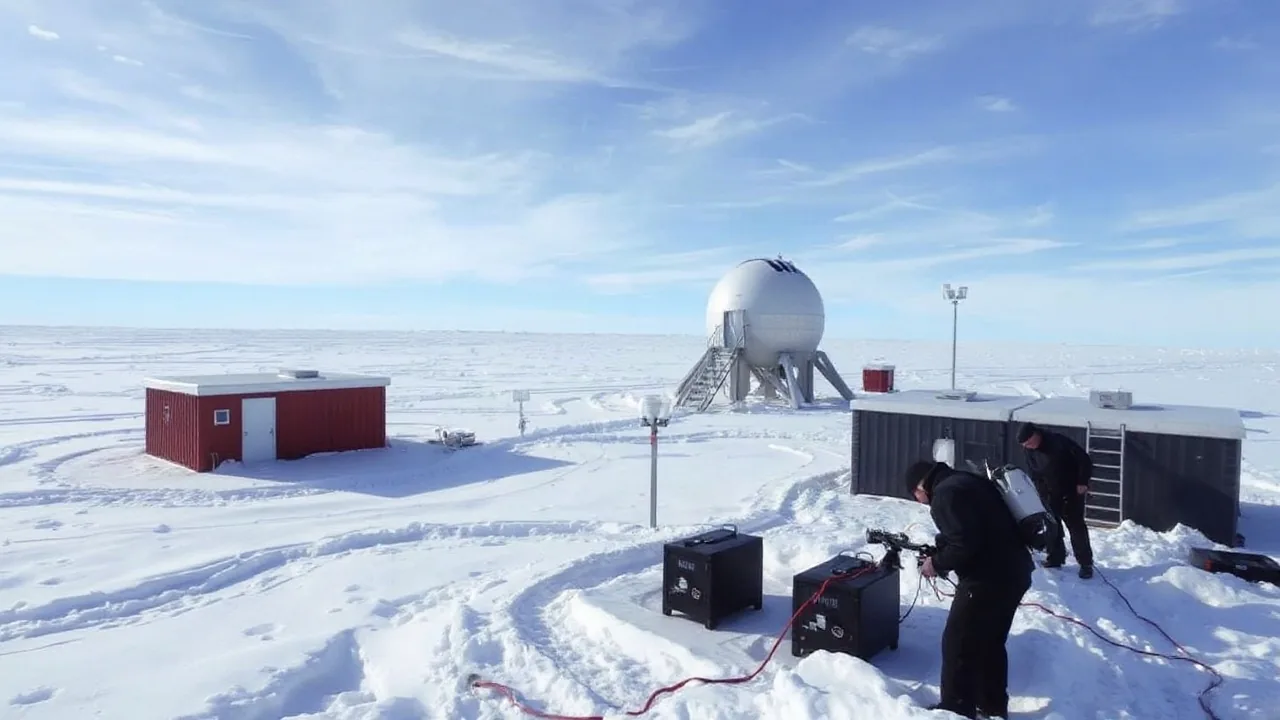
A significant portion of the celebrated research involved the IceCube Neutrino Observatory, a detector buried deep within the Antarctic ice. Completed in 2010, IceCube is the largest neutrino detector ever built, designed to capture the faint signals left by high-energy neutrinos as they pass through the ice. Its unique location and immense scale allow it to detect neutrinos originating from sources far beyond our solar system, offering unprecedented views of the universe.
This facility has been instrumental in confirming that neutrinos oscillate, meaning they can change from one type to another as they travel. This discovery, made possible by precisely measuring neutrino interactions, confirmed that neutrinos must have mass, a finding that has profound implications for the Standard Model of particle physics, which originally predicted they were massless. The detection of high-energy neutrinos from astrophysical sources also opened the new field of multi-messenger astronomy, combining neutrino data with observations from light, gravitational waves, and other cosmic messengers.
Francis Halzen, a professor at the University of Wisconsin-Madison and lead principal investigator for the IceCube Neutrino Observatory, has been a central figure in the efforts to detect and study these cosmic neutrinos. His leadership and the collaborative spirit of the IceCube Collaboration, which includes researchers from institutions worldwide, have been critical to the success of this ambitious scientific endeavor.
The study of neutrinos continues to push the boundaries of our knowledge. Future experiments aim to further refine measurements of neutrino properties, search for sterile neutrinos, and use these particles to probe even deeper into the universe's most violent and energetic phenomena. The work recognized by the 2026 Nobel Prize provides a foundation for many of these ongoing and future explorations, solidifying the importance of subatomic particle physics in our quest to comprehend the cosmos.