
Passport Free Checks: How Biometric Screening Reshapes Airport Security
Major airports worldwide are rolling out biometric systems that eliminate passport checks, streamlining international travel. Here's how facial recognition and iris scanning technology work in practice.

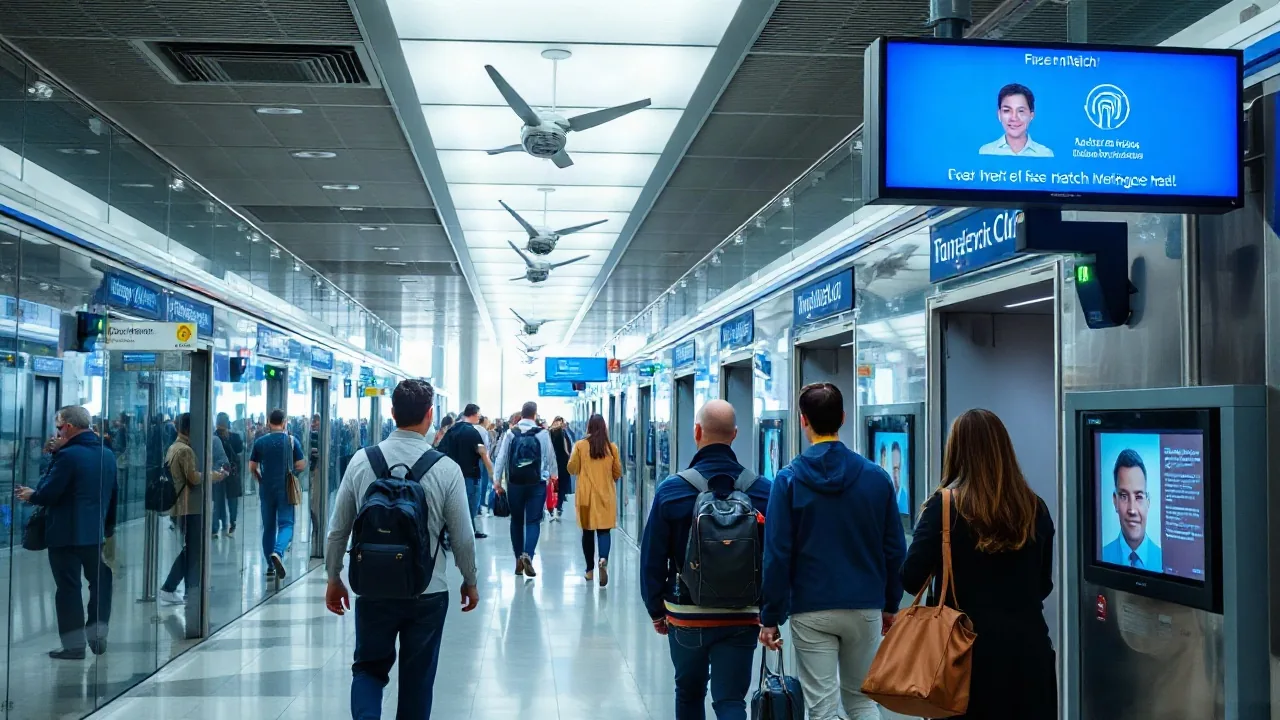
Atlanta Hartsfield-Jackson International Airport implemented its first passport free checks gate on September 8, 2026, marking a milestone for U.S. aviation. Travelers exiting flights now walk through a corridor equipped with high-resolution cameras that match their faces against government databases in under three seconds, bypassing the traditional passport control desk entirely.
This shift represents one of the fastest adoptions of biometric exit technology in American airports. The system, supplied by a consortium of tech firms and U.S. Customs and Border Protection (CBP), processes roughly 4,200 passengers per hour compared to 800 through conventional booths. What five years ago seemed futuristic is now operational at seven major U.S. hubs.
How Biometric Screening Actually Works
Biometric screening gates use multiple verification layers. First, a high-definition camera captures a real-time facial image. That image is instantly compared against a database containing photos from U.S. passports, visas, and entry records. Iris scanning and fingerprint readers serve as backup confirmations for travelers whose faces don't yield a confident match.
According to Dr. Sarah Chen, director of aviation technology at the International Air Transport Association (IATA), "Multimodal biometrics reduce false rejections to below 0.2 percent, which is critical for passenger experience. Single-modality systems fail far more often in real-world settings." The integration of facial, iris, and fingerprint data creates a redundant system that flags inconsistencies before a traveler reaches a security officer.
Processing speed depends on database architecture. U.S. systems query about 280 million passport records and 50 million visa-entry logs. European airports using similar technology connected to Schengen databases process roughly 300 million identity records. The latency is typically under one second, meaning the bottleneck is now foot traffic through the gate, not data lookup.
Rollout Timeline and Current Coverage
As of September 2026, airport technology deployments include the following U.S. locations:
- Atlanta Hartsfield-Jackson (exit gates operational September 2026)
- Dallas Fort Worth (entry and exit, operational since February 2026)
- Los Angeles International (exit only, operational since June 2026)
- Miami International (mixed entry-exit, operational since April 2026)
- Chicago O'Hare (entry gates, operational since January 2026)
- New York JFK (pilot gates, September 2026 expansion announced)
- San Francisco International (planned rollout, December 2026 target)
CBP has allocated $340 million across fiscal years 2025 and 2026 to deploy these systems at 18 additional airports by end of 2027. The agency reports that early adopters show zero security breaches attributable to biometric gate malfunction or spoofing attempts.
Privacy, Data Retention, and Border Control Implications
Critics raise concerns about facial image retention. Current CBP policy deletes exit photos after 72 hours for U.S. citizens returning home. Entry photos for foreign nationals are retained for 14 days. Advocacy groups like the Electronic Frontier Foundation have demanded deletion timelines be cut to 24 hours and independent auditing of gate software.
David Rosenthal, attorney specializing in border control law at Georgetown University, notes: "The legal framework for these systems is still evolving. The Fourth Amendment questions around bulk biometric capture remain unresolved in federal court, and we may see litigation within 18 months."
From a future of travel perspective, proponents argue that reducing face-to-face interactions at busy borders lowers contagion risk during disease outbreaks and eliminates human error in passport verification. Processing 4,200 passengers per hour versus 800 means international hubs can manage peak hours without bottlenecks that force flight delays.
Foreign carriers are watching closely. Air France announced in August 2026 that it will install matching biometric exit gates at Charles de Gaulle Airport by mid-2027. Japan's Haneda Airport has fast-tracked a similar program, with systems expected online by March 2027. Cross-border standardization remains incomplete, however. Facial recognition databases vary by nation, and iris-scan templates are not universally interoperable.
Airport operators report maintenance challenges. Cameras require calibration every 30 days to account for lighting drift and lens degradation. Software updates occur monthly, requiring scheduled downtime. At Dallas Fort Worth, a recent firmware patch temporarily reduced throughput by 8 percent until database indexing was optimized.
Passenger adoption has been faster than expected. Surveys by IATA show 76 percent of travelers prefer biometric travel gates over traditional lines, citing speed and reduced human interaction. Of those surveyed, 12 percent cited privacy concerns. Opt-out lanes remain available at all U.S. facilities, though wait times at Dallas Fort Worth sometimes exceed 45 minutes during peak hours.
The aerospace and aviation industry is treating passport-free systems as a cornerstone of post-2026 airport infrastructure. Major terminal expansions now budget for biometric gates as baseline infrastructure, not optional enhancements. This signals industry consensus that facial and iris recognition will define international airport operations for the next decade.